

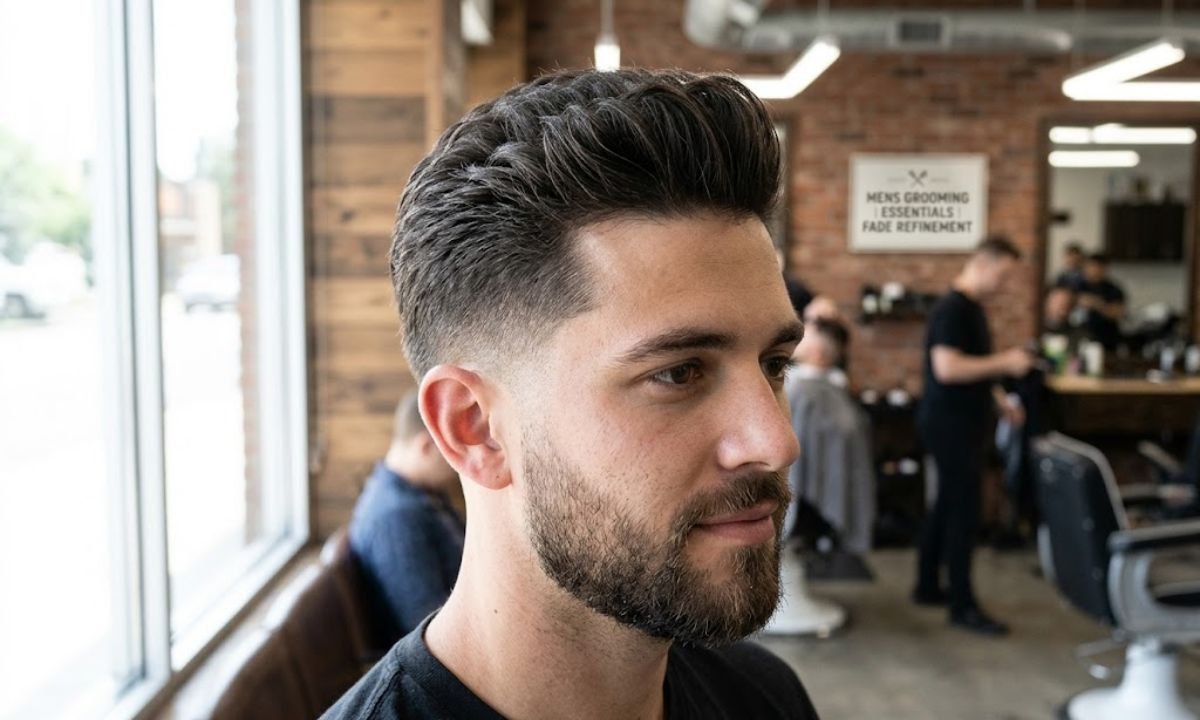
You want to grow out a fade and skip the weird middle phase.
Here’s the honest answer: you can’t erase it, but you can shrink it a lot.
Pick a target hairstyle, stop refreshing the short sides, and book maintenance trims instead of full haircuts.
Add smart styling and a clear barber script, and most guys look tidy the whole way.
Maybe you’re wondering how long this takes, or whether the sides will stick out like wings.
Maybe you dread the fuzzy sides and the day your fade line disappears.
This guide answers all of that in plain talk.
Grab a coffee and jump to whatever part you need.
Quick Answer
Most people need three to four months to get through a fade grow-out with decent shape.
Hair gains about half an inch per month, so a skin fade needs time to catch up with the top.
Here’s the short plan:
- Choose your destination first. A low taper fade, a classic scissor cut, or a textured crop.
- Stop clipping the sides. Let the hair length recovery begin.
- Keep the neckline and ears clean. Tidy edges make growth look planned.
- Visit a barber every 4 to 6 weeks for bulk removal, not a full reset.
- Style the sides down and back with a matte clay or styling cream.
Want the full story?
Keep reading, because the details save you from a bad month.
What happens when you grow out a fade?

A fade is a gradient, and gradients need constant upkeep.
Once you stop clipping, every strand starts racing upward from the same starting line.
Your hair follicles keep working on their own schedule.
They push out new scalp hair at a steady pace, so the short upper sides slowly meet the longer top.
The result? A haircut transition that feels messy at first, then softer, then surprisingly decent.
The trick is knowing which stage you’re in and what to do about it.
Why the fade loses its shape as hair grows

A skin fade works because the fade line sits at a precise height.
The sides go from bare skin to a few millimeters, then blend into the top.
When hair regrowth starts, that blend lifts evenly.
But the top is longer, so the contrast between top and sides shrinks only when the sides catch up.
Think of it like a freshly painted line on a road.
Give it a few weeks and traffic blurs the edge, so the sharp outline fades into the surface.
That blur is the fade growing process in action.
It’s normal, and it’s the sign you’re moving forward.
What makes the awkward stage of a fade difficult to manage?

The awkward stage haircut feels odd because your hair proportions change fast.
The sides gain volume while the top stays roughly the same, and the whole hair silhouette shifts.
You might also notice uneven hair length around the ears and the nape.
Those areas grow at slightly different speeds, which makes the shape look lopsided.
Let’s break down the three biggest headaches.
Each one has a simple fix.
Why do the sides look wider than the top during regrowth?

Here’s the culprit: side hair widening.
Short hair on the side panels grows outward before it grows down, so it sticks out like a shelf.
The top, meanwhile, falls with gravity.
That makes the head look wider at the ears and flatter at the crown.
Thicker or dense hair shows this most.
Also, curl compression can make the sides look even bigger once curls start to stack.
You don’t need to panic.
A light trim near the ear edges and a bit of bulk removal calms the shelf effect fast.
How does uneven hair length affect the haircut’s overall balance

Balance is about haircut proportions.
When the top is four inches and the sides are one inch, the eye reads a sharp jump.
With uneven regrowth, that jump gets bumpy.
The crown and cowlicks pop up, and the hairline shape looks different than it did a month ago.
Here’s a quick way to check:
Stand in front of a mirror and look at your profile. If the sides are puffing past your ears, the balance is off.
Small fixes help more than big cuts.
A barber can use point cutting to soften only the bulky edge.
When does the contrast between the sides and top become less noticeable?

Around week 6 to 8, most people see the harsh fade contrast soften.
The sides reach about half an inch and start to blend with the top.
By week 10 to 12, the fade gradient looks more like a rough taper.
This is the stage where the haircut finally starts to feel intentional.
Expect the fuzzy sides phase right before that.
It’s annoying, but it’s also the last big hurdle.
How long does it take to grow out a fade?
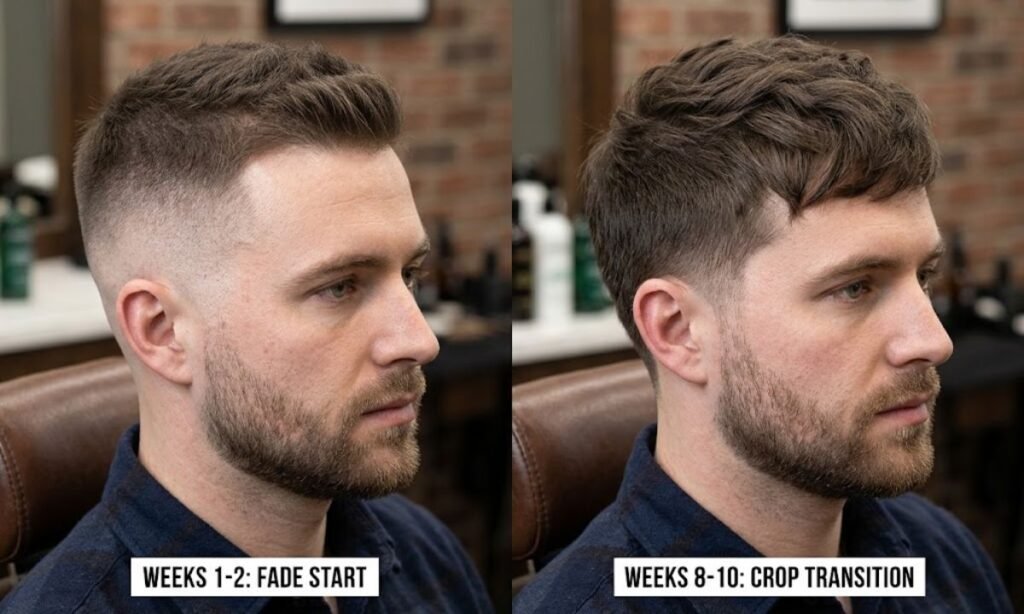
The average hair growth rate is about half an inch per month, or roughly three to four centimeters over three months.
Sources like the American Academy of Dermatology (AAD) and MedlinePlus describe a similar pace for scalp hair.
So a skin fade often needs about 12 to 16 weeks to look neat.
A fuller medium scissor cut can take five to six months.
Your hair growth cycle also plays a role.
Genetics, age, diet, and sleep all nudge the speed slightly up or down.
How long until the sides can be shaped with scissors?

Barbers usually need about one inch of length to use scissor-over-comb work.
For most people, that means 8 to 10 weeks after the last clipper cut.
The scissor-over-comb technique lets a barber blend lengths without buzzing anything short.
That’s what keeps your progress intact.
If you want to grow out faded sides without clippers, this is the milestone to wait for.
Before that, light tidying around the edges is all you need.
Why the starting fade and target haircut change the timeline

A high skin fade takes longer than a low fade because more skin must cover over.
The mid fade sits in between.
Your destination matters just as much.
A short back and sides needs less length than a long hairstyle or a low taper mullet.
Here’s a simple comparison:
| Starting cut | Target cut | Rough timeline |
|---|---|---|
| Low fade | Low taper fade | 6 to 10 weeks |
| Mid fade | Classic scissor cut | 12 to 16 weeks |
| High skin fade | Textured crop | 14 to 18 weeks |
| Skin fade | Medium scissor cut | 20 to 26 weeks |
These are averages, not promises.
Your hair texture and hair density can shift them either way.
Should you grow out the top and sides at the same time?

Short answer: yes, in most cases.
Growing both together keeps your haircut silhouette closer to balanced.
But it isn’t all or nothing.
Sometimes a small trim on the top buys you a calmer awkward stage.
Let’s look at both sides of that choice.
The right call depends on your target hairstyle.
What happens when the top grows faster than the faded sides?

When the top races ahead, you get a mushroom effect.
The crown flops over short sides, and the head looks top heavy.
This is common with thick hair and wavy hair.
The top has weight and falls, while the sides barely move.
The contrast looks even bigger in photos.
That’s why a lot of men panic around week four.
Don’t reach for the clippers.
A gentle texture trim on top often solves it.
Should you trim the top to match the growing sides?

Sometimes, yes.
A light point cutting pass keeps the top from overpowering the sides.
But avoid cutting a lot.
If you’re heading for a French crop or comb over, you’ll need that top length later.
A good rule: remove weight, not length.
Ask for thinning or bulk removal rather than a shorter top.
Your barber will know the difference.
Use clear words and bring reference photos.
How to grow out a fade step by step

Here’s the simple system.
Follow it, and the awkward stage gets shorter and calmer.
This works for a skin fade, mid fade, or low fade.
You’ll just adjust the timing.
Step 1: Choose your target hairstyle

Start with the end goal.
Without a haircut destination, you’re guessing every month.
Save three haircut reference photos that match your face and hair texture.
Good options include a textured crop, a side part, or a classic scissor cut.
One quick example: Dan has wavy hair and wants a side part.
He saves photos of mid-length cuts with a soft taper, then shows them at every visit.
Step 2: Stop refreshing the short sides

This is the hardest rule.
Every fresh buzz resets the hair length recovery clock.
Skip the weekly clipper touch up.
If the sides feel messy, trim only the edges instead.
Think of it as pruning a bush.
You can shape the outline without chopping the whole plant.
Step 3: Keep the neckline and edges neat
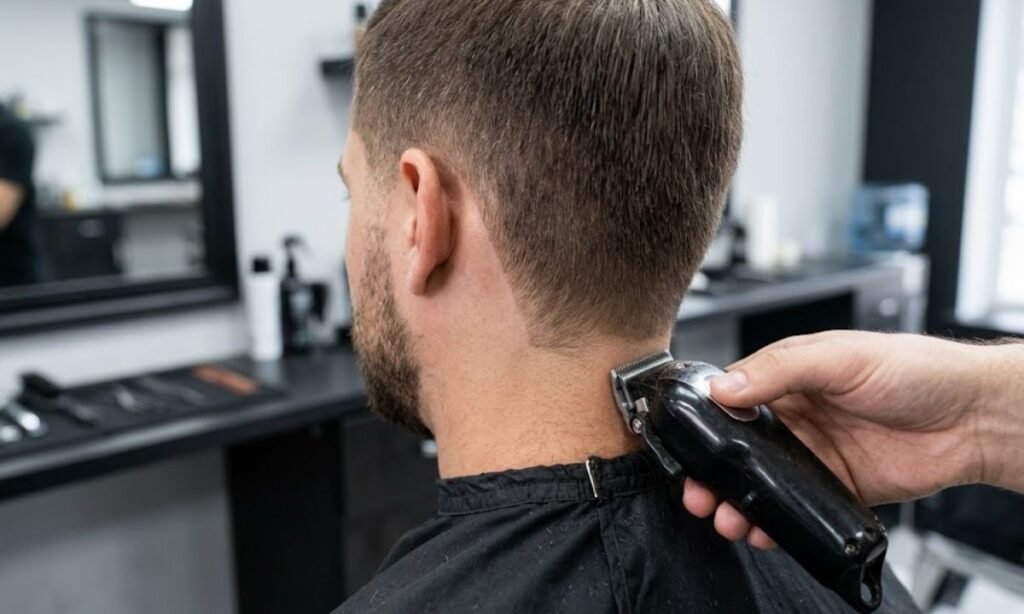
A tidy neckline makes grown-out hair look planned.
A nape with stray fuzz screams “unfinished.”
Ask for a clean neckline cleanup, plus sideburn cleanup and ear cleanup.
These take a few minutes and protect your length.
This is also how you keep the neckline clean while growing out a fade.
A natural taper at the back beats a hard block every time.
Step 4: Reshape bulk without recreating the fade

Bulk is the enemy of a smooth grow-out.
But cutting it short brings you back to square one.
Use thinning shears or point cutting to remove weight.
That lets the hair outline relax without losing length.
This is called haircut reshaping.
It’s the secret behind a grown-out fade that looks intentional.
Fade grow-out timeline: weeks 1–16 and beyond

Here’s what to expect, week by week.
Treat it like a map, not a rulebook.
Your fade grow-out timeline may run faster or slower.
Still, the stages tend to look the same.
Weeks 1–3: Let the fade soften
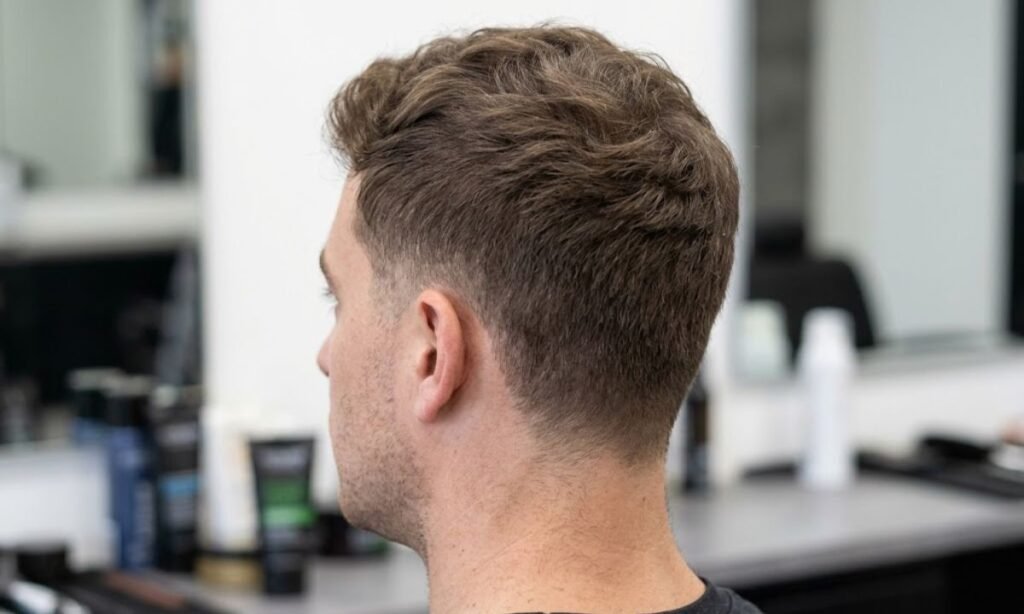
You won’t see much yet.
The fade line softens a little, and the sides look slightly fuzzy.
Resist the urge to buzz.
Use this time to pick your target hairstyle and book a barber consult.
Good habits start here.
Keep the neckline clean and style the top the way you always do.
Weeks 4–6: Manage fuzzy edges and puffy sides

Welcome to the peak of puffy sides.
The hair is long enough to stick out but too short to lie flat.
Use a matte paste or styling cream to press the sides back.
A light blow dryer on low heat helps set the direction.
Book a barber cleanup if the ears look wild.
This step alone makes a visible difference.
Weeks 7–10: Control side bulk

Now the sides reach near an inch.
This is when side bulk shows up most, especially with thick hair.
Ask for bulk removal with scissor-over-comb.
The goal is to shape, not shorten.
Here’s a tip: pick the same barber every time.
They’ll remember what you’re building toward.
Weeks 11–16 and beyond: Shape the new haircut

This is where the fun starts.
The fade gradient is almost gone, and a real shape appears.
Your barber can build a low taper fade, short back and sides, or medium scissor cut.
Any of them look cleaner than the middle stage.
After this point, it’s about fade maintenance.
Keep your haircut frequency steady and enjoy the new look.
How do you manage uneven regrowth when growing out a fade?

Uneven growth is normal.
But it can make you feel like the haircut is broken.
Two things help most: understanding why it happens, and blending smartly.
Let’s cover both.
What causes patchy or uneven-looking hair growth?

Your hair follicles don’t all grow at the same time.
Some sit in the growth phase, others rest, so lengths vary.
Cowlicks, scars, and hair density differences add to the effect.
Areas like the crown, behind the ears, and the nape often show it first.
A harsh previous skin fade can also expose uneven spots.
Once hair covers them, the patchy look usually fades.
If you notice real bald patches that don’t improve, talk to a doctor.
Sources like Johns Hopkins Medicine and the AAD explain when hair loss needs a professional look.
How can you blend different hair lengths without cutting them too short?

Use hair blending methods that keep length intact.
Ask for scissor-over-comb and point cutting instead of the clippers.
A barber can also use a long clipper guard only on the edges.
That keeps the hair perimeter clean while preserving the body.
You can help at home with a wide-tooth comb.
Combing the sides down shows you where the bulk sits.
How often should you visit a barber during fade grow-out?

Plan on a visit every four to six weeks.
That’s less often than a fade, but it’s still regular.
Think of these visits as maintenance appointments.
You’re guiding the shape, not restarting it.
Here’s how to make each one count.
It comes down to timing and communication.
When should you schedule maintenance appointments instead of a full haircut?

Schedule a quick visit when the neckline gets fuzzy or the ears look messy.
That’s usually around week four.
Skip full haircuts until you hit your target hairstyle.
A full cut too early resets your progress.
A barber consultation at the start helps a lot.
It sets the plan for every visit after.
How can you maintain a balanced shape between barber visits?

Check your side panels every few days.
If they widen, press them down with a comb and a little hair wax.
Trim nothing at home unless you really know what you’re doing.
One slip with the clippers can undo weeks of effort.
Photograph your hair once a week from the same angle.
The pictures show progress, and they help you stay patient.
What should you ask your barber while growing out a fade?

Clear words save you from surprises.
Barbers read minds poorly, but they follow instructions well.
Tell them you’re growing out short sides and want to keep length.
That single sentence changes how they cut.
Here’s a script you can copy.
And a list of what a barber can safely do.
A barber script for your grow-out appointments
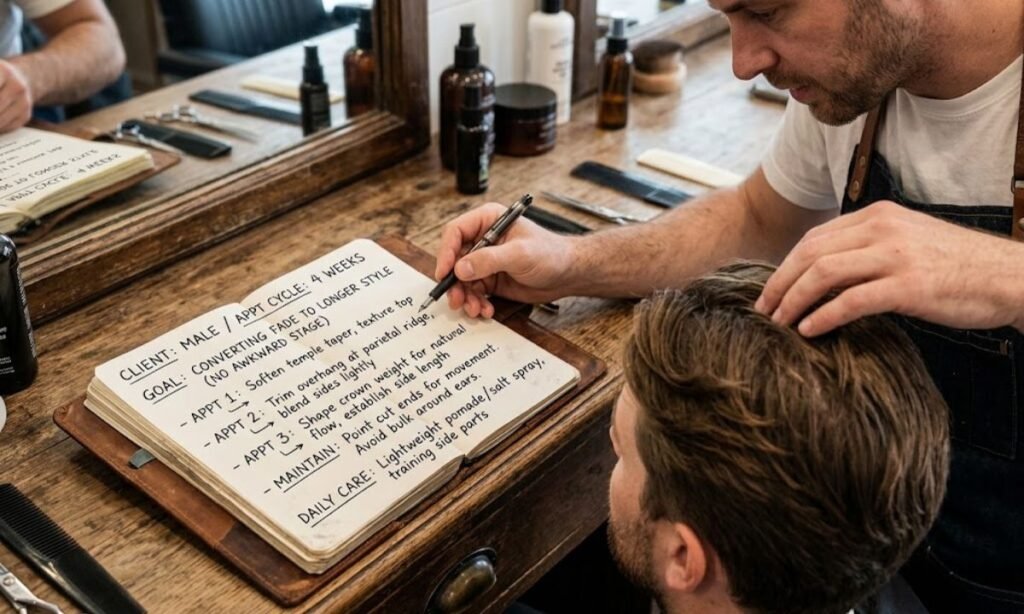
Try this: “I’m growing out my fade toward a low taper.
Please clean the neckline and ears, remove bulk, and keep as much length as you can.”
Then add: “Can you use scissors on the sides instead of clippers?”
That question signals you know the plan.
Show your reference photos.
A picture beats a hundred words.
What can a barber trim without resetting progress?
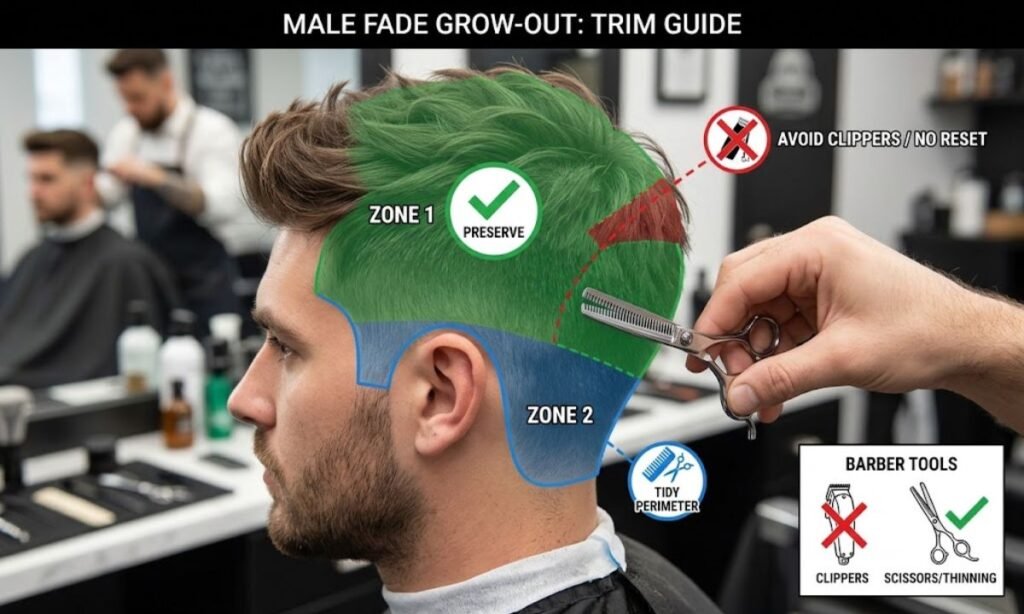
A barber can safely do several things.
None of them shorten the main length.
- Neckline cleanup and nape tidying
- Sideburn cleanup and ear edges
- Point cutting to soften heavy spots
- Thinning on the upper sides
- Scissor-over-comb blending near the fade line
Everything else is optional.
When in doubt, ask before they pick up the clippers.
How do you style a fade during the awkward stage?

Styling is your secret weapon.
With the right product, puffy sides look calm and planned.
Direction matters more than product.
Start with how you comb, then add hold.
Let’s go through both.
You’ll see why small details make a big difference.
Control puffy sides with styling direction and light hold

Towel dry your hair first.
Then comb the sides down and back with a wide-tooth comb.
Apply a pea-size amount of matte paste or hair pomade to your palms.
Run it through the sides lightly, not the roots.
Finish with a quick pass of low heat from a blow dryer.
Use a heat protectant if you do this often.
Choose styling products based on hair texture

Not every product suits every head.
Pick based on your hair thickness, curl pattern, and scalp type.
| Hair type | Best product | Why it works |
|---|---|---|
| Fine hair | Styling powder | Adds grip and volume without weight |
| Thick hair | Matte clay | Holds bulk down and keeps a flat finish |
| Dry hair | Styling cream | Adds moisture and a soft hold |
| Oily scalp | Matte paste | Controls shine without heaviness |
| Curly hair | Leave-in conditioner | Supports curl definition and softness |
Start small and add more if needed.
Too much product makes hair look greasy, which hurts the awkward stage even more.
Which haircut should you transition to after a fade?

This choice shapes everything else.
A good haircut destination keeps you motivated when the mirror gets cruel.
Most men land on one of two paths.
Either a tidy short cut or a softer, longer scissor style.
Let’s look at both.
Pick the one that fits your lifestyle, not just your Pinterest board.
Low taper or classic short back and sides

A low taper fade is the easiest exit from a fade.
It keeps the sides short and clean, but it leaves a bit more length at the ears and neckline.
A classic short back and sides goes a step further.
It uses scissor-over-comb work and a medium taper fade or mid taper fade style blend.
Both look sharp at work and at weddings.
They also need less upkeep than a true skin fade.
If you want fast results, aim here.
You’ll feel normal again in about eight to twelve weeks.
Textured crop, side part, or medium scissor cut

Want more personality?
Try a textured crop, French crop, or side part with a soft taper.
These cuts need more length on top, and a bit more on the sides.
That means more patience, but the payoff is a look that feels modern and easy.
A medium scissor cut gives you a full, natural shape.
It’s great for wavy hair and curly hair, and it hides uneven regrowth well.
A middle part also works if your hair is thick enough.
Just style the sides back so they don’t flare out.
How does fade type and hair texture change the plan?

No two heads grow out the same way.
Your starting fade and your natural texture change the plan in real ways.
A high fade exposes more skin, so the middle stage lasts longer.
Tightly coiled hair behaves differently from straight hair, too.
Let’s break it down.
You’ll spot your own situation fast.
Low, mid, high, and skin fade differences

A low fade starts near the ears and the nape.
It grows out quickly because the short zone is small.
A mid fade sits around the temples.
It’s the middle path, and it usually needs 12 to 14 weeks.
A high fade climbs near the crown.
That leaves a lot of short hair to cover, so expect the longest wait.
A skin fade adds another layer.
The bare skin zone shows every tiny bit of growth, so it feels messy sooner than a shadow fade or temp fade.
Other styles behave in their own ways:
- Burst fade: grows out fast, since it circles only the ear.
- Drop fade: curves behind the ear, so the back needs extra cleanup.
- Taper fade: the easiest to soften, because it’s already gradual.
- Blowout taper fade: keeps volume on top, so the sides must catch up.
Know your fade, and you know your timeline.
That’s half the battle.
Straight, wavy, curly, and coily hair

Hair texture changes how the awkward stage looks.
It also changes what products and cuts work best.
Straight and wavy hair

Straight hair lies flat, which can make the sides look sleek.
But fine hair can also reveal the fade line longer, since it lacks body.
Wavy hair tends to puff at the sides first.
Use styling cream and a wide-tooth comb to guide it back.
A matte clay adds hold without shine.
Pair it with a light blow dryer pass for a clean outline.
Curly and coily hair
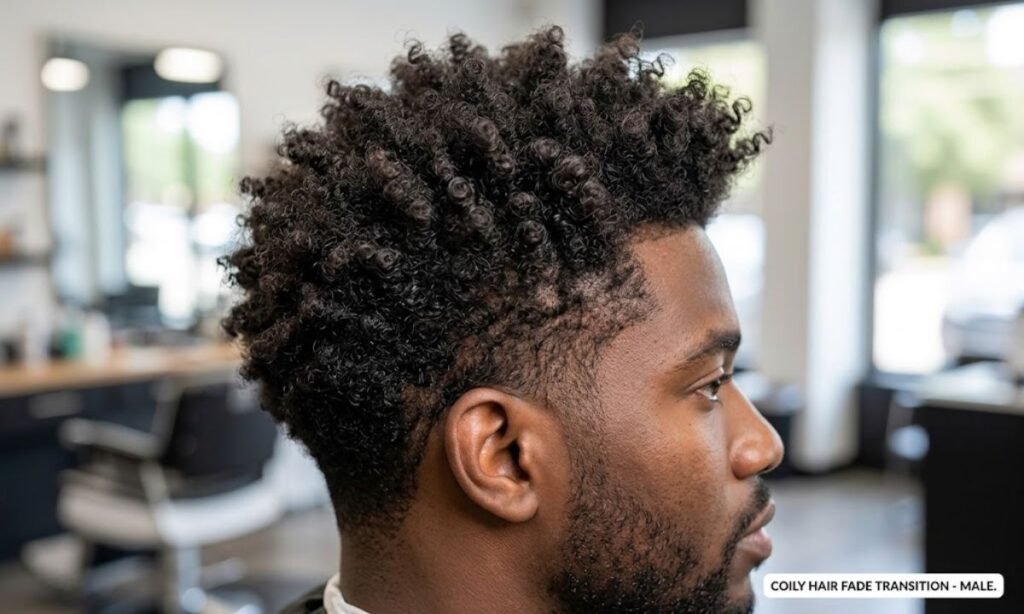
Curly hair and coily hair gain width quickly.
The curl pattern stacks, and curl compression makes the sides look bigger than they are.
Use a leave-in conditioner to keep curl definition crisp.
Avoid brushing dry curls, because that leads to frizz and hair breakage.
For Afro hair, aim for a low taper or a medium scissor cut.
These shapes keep your hair proportions balanced as the sides fill in.
Also remember hair shrinkage.
Curls look much shorter than they are, so measure progress by stretching a strand.
Which mistakes spoil a fade grow-out?

Most grow-out disasters come from impatience.
A single bad cut can set you back a month.
The good news is that mistakes are easy to avoid.
You just need to know what to watch for.
Overtrimming, DIY refades, and unclear haircut goals

Overtrimming is the top offender.
Asking for “just a little off” can mean something different to every barber.
DIY refades come next.
A quick pass with clippers at home often leaves a harsh line that takes weeks to fix.
Unclear goals cause the rest.
Without reference photos, your barber guesses, and guesses can be wrong.
Here’s a quick checklist:
- Don’t use clipper guard sizes shorter than your current length.
- Don’t skip the barber consultation.
- Don’t chase a perfect fade line during the middle stage.
- Don’t ignore neckline upkeep.
- Don’t switch barbers every month.
Fix these, and you protect your progress.
It’s that simple.
How can you keep hair healthy while growing out a fade?

Longer hair needs a bit more care.
Healthy strands grow, hold shape, and look better in the mirror.
You don’t need a ten-step routine.
A few small habits cover it.
Think of it as basic hair maintenance routine work.
Simple, steady, and easy to repeat.
Condition, detangle gently, and limit heat damage

Use a gentle shampoo and a light conditioner.
A leave-in conditioner helps with hair moisture, especially for dry hair.
Detangle with a wide-tooth comb, starting from the ends.
Gentle hair detangling cuts down on hair breakage.
Limit the blow dryer to low heat or medium heat.
Always use a heat protectant first.
Towel dry by patting, not rubbing.
Towel drying gently keeps the surface smooth and cuts frizz.
If you notice sudden shedding or thinning, speak with a doctor.
Resources from MedlinePlus and Johns Hopkins Medicine explain common causes of hair loss.
How do you stay patient and track progress during the grow-out?

The hardest part isn’t the haircut.
It’s the waiting.
Take a photo every Sunday, from the front, side, and back.
After a month, you’ll see changes your eyes missed.
Set a simple goal, like “hit week 8 without touching the clippers.”
Small wins beat vague promises.
Tell a friend you’re doing it.
A little accountability goes a long way.
What if you need to look sharp for work or events while growing out a fade?

Life doesn’t pause for your hair.
Interviews, weddings, and Monday meetings still happen.
Book a maintenance visit a few days before the event.
Ask for neckline cleanup, ear cleanup, and light bulk removal.
Style the sides back with hair wax or matte paste.
A neat side part or comb over can hide a lot of awkwardness.
Wear a cap on casual days if you want a break.
Just avoid tight hats that press the sides out.
You can also checkout this article as well: High Taper Fade Black Male: 22 Styles and a Barber Guide
Frequently asked questions about growing out a fade

How long does it take to grow out a fade?
Most people need 12 to 16 weeks for a clean shape.
A fuller cut can take five to six months.
Can you grow out a fade without looking awkward?
You can reduce the awkward look a lot.
Use a clear plan, tidy edges, and the right styling product.
When can you shape grown-out sides with scissors?
Usually around 8 to 10 weeks, once the sides reach about an inch.
That’s enough length for scissor-over-comb work.
How do you stop sides from sticking out?
Comb them down and back, add a matte clay or styling cream, and ask your barber for bulk removal.
Avoid cutting them shorter.
Should you trim the top while growing out a fade?
Only lightly. Use point cutting or thinning to remove weight.
Keep the length you need for your target hairstyle.
How often should you see a barber?
Every four to six weeks works for most people.
Treat each visit as a maintenance stop.
How do you grow out a fade with curly hair?
Use a leave-in conditioner, protect curl definition, and avoid dry brushing.
A medium scissor cut often fits best.
What should you tell your barber?
Say you’re growing out your fade, name your target hairstyle, and show reference photos.
Ask them to clean edges and remove bulk, not length.
Final Thoughts

Growing out a fade isn’t about perfect hair.
It’s about steady progress and a few smart choices.
Pick your target hairstyle, stop chasing the short sides, and visit your barber for maintenance.
Style with intention, and the awkward stage turns into a quick chapter instead of a long headache.
Now it’s your turn.
Which week are you on, and what’s bugging you most about the sides?
Drop a comment, share this with a friend who’s stuck in the same spot, and come back to update us on your progress.
We’ll keep refreshing this guide as new tips and tools show up.

I’m Michael Charles, the creator of MegaCrazes—your source for fresh hairstyles, sharp haircuts, and simple hair-care inspiration. Find your style. Own your look.