

Updated October 2026
Will it suit my face?
Will my barber get it right?
Will I fight with it every single morning?
Those three worries show up in almost every barber chair.
They’re fair, and this guide answers all of them.
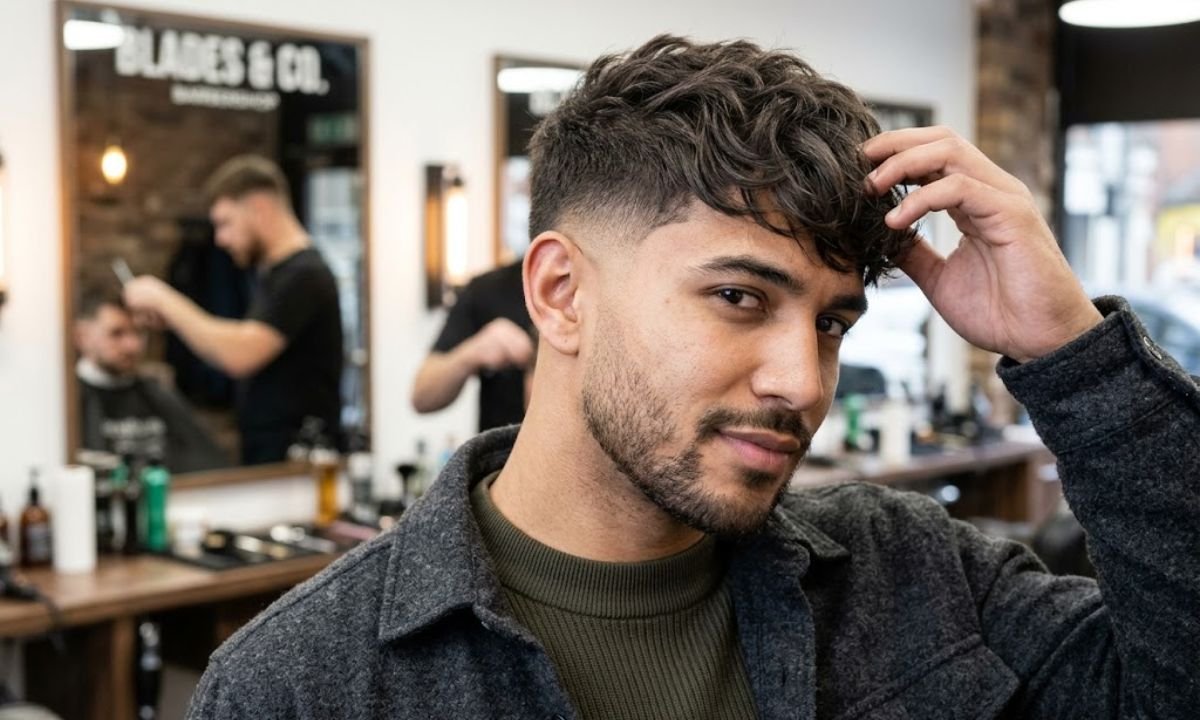
A high taper fade textured fringe is a modern men’s haircut with tight, tidy sides and a loose, choppy top.
The taper starts high, so the sides stay clean without going bald at the edges.
The fringe sits forward, broken up with point cutting, so it looks lived in rather than combed.
It suits most hair textures, from straight hair to curly hair.
It asks for a trim every three to four weeks.
Styling takes about two minutes once you’ve found the right hair product.
Quick Answer
The cut is short sides and long top with a gradual, high taper fade and a textured fringe on the front.
Expect clipper guard work from about a number 1 at the top of the taper down to a tight finish near the nape and sideburns.
The top usually runs 2 to 4 inches, depending on your hair texture and how much movement you want.
Here’s what to remember before you book:
- Best for: most hair types, especially thick hair and wavy hair, with tweaks for fine hair and coily hair.
- Ask for: a high taper, not a skin fade, with a textured top cut by point cutting and a fringe that clears your eyebrows.
- Style with: matte clay, hair paste, or styling cream, plus a little texturizing spray for hair volume.
- Refresh: every 3 to 4 weeks for the taper, every 6 to 8 weeks for the top.
That’s the whole idea in four lines.
The rest of this guide shows you how to make it work on your head.
What Is a High Taper Fade Textured Fringe?
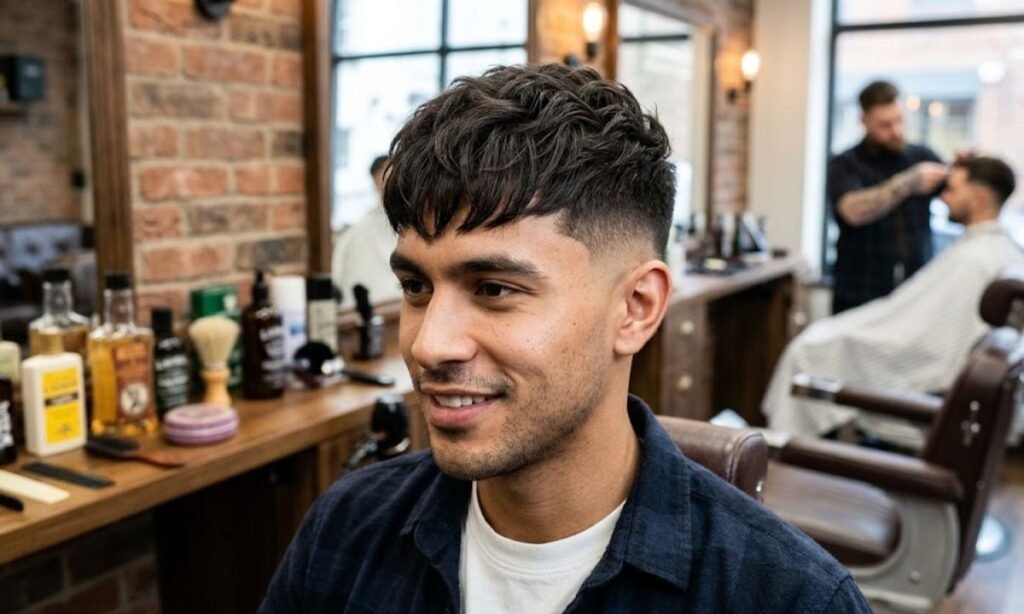
Think of it as two haircuts living together.
The bottom half is a high taper, where the hair length shortens gradually up the sides and back.
The top half is a textured fringe, where the front hair falls forward in uneven, broken pieces.
The word “high” tells you where the taper begins.
It starts up near the temple and the crown, instead of low around the ears.
That placement gives you a cleaner, sharper outline from every side.
The word “fringe” simply means the front section of the top is long enough to rest on your forehead.
“Textured” means your barber cut it so it doesn’t lie flat in one solid block.
Together they create a men’s textured fringe that feels relaxed but still looks sorted.
What Does a High Taper Fade Textured Fringe Look Like From Every Angle?
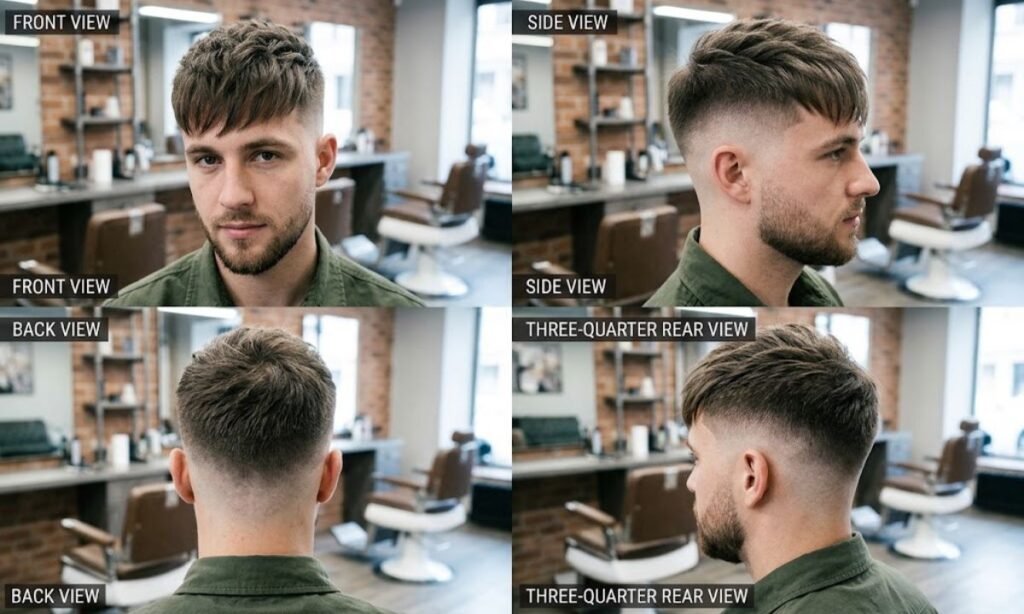
A good cut earns its keep from all sides, not just in the mirror.
You see the front. Everyone else sees the side and the back.
So let’s walk around your head.
How Does the Haircut Look From the Front, Side, and Back?

From the front, you see a soft fringe across the hairline, usually just above the eyebrows.
The sides sit close to your head, so the top looks fuller by comparison.
That contrast frames your face without crowding it.
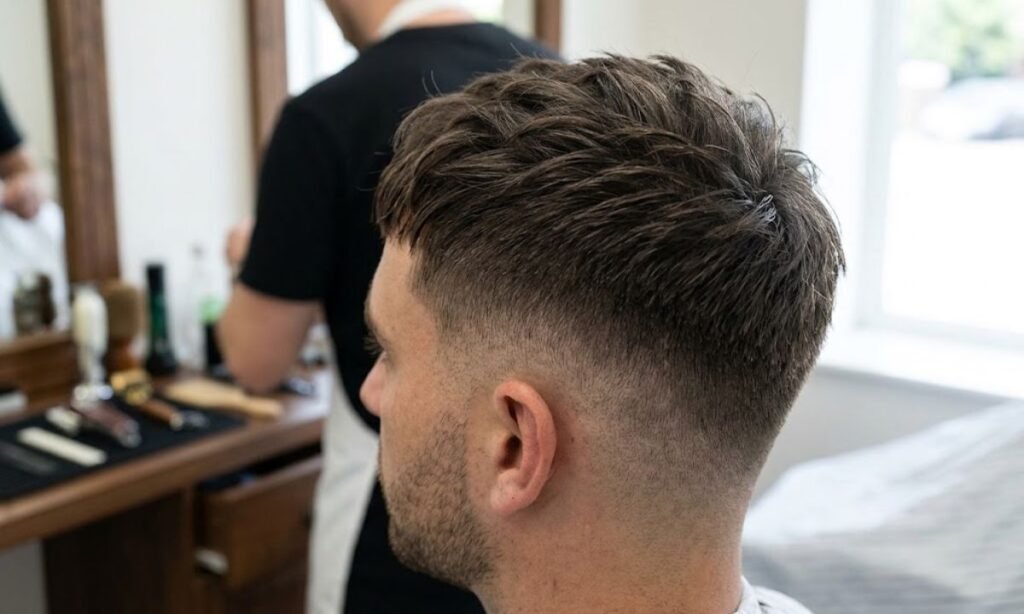
From the side, the taper draws a clean curve from the temple down past the ear.
The sideburns stay slim and neat, and the top lifts slightly away from the scalp.
You get a tidy profile with a bit of movement on top.
From the back, the nape is cleaned up and shaped, either rounded or squared.
The hair above it blends upward, so you don’t see a hard line or a bald band.
A good back view is where you spot a good barber.
How Much Contrast Should There Be Between the Top and Sides?
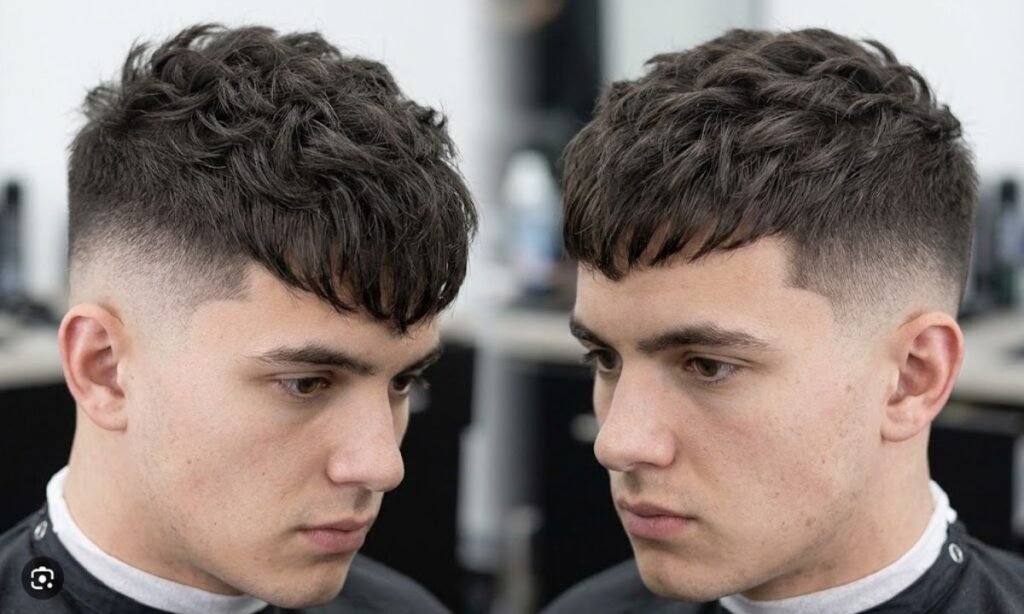
Contrast is the volume of the story.
A bigger gap between a short side and a long top makes the cut look bolder.
A smaller gap looks softer and works better at the office.
Most people land in the middle.
The sides sit around a number 1 to 2 near the top of the taper, then shrink gradually toward the neckline.
The top stays at least 2 inches longer than the longest part of the sides.
If your hair is thin or fine, go for a little less contrast.
A huge gap can make the top look sparse by comparison.
A softer blend keeps everything looking denser.
How Long Should the Top Be for a Textured Fringe?
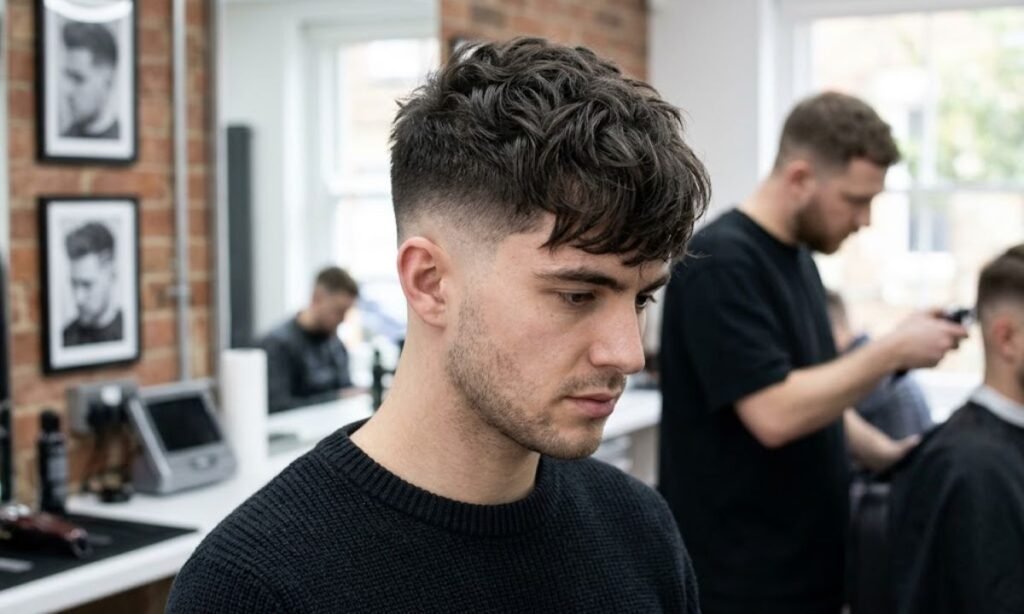
Length decides everything here.
Cut it too short and the texture disappears.
Leave it too long and the shape collapses.
What Top Length Creates the Best Separation Between Strands?
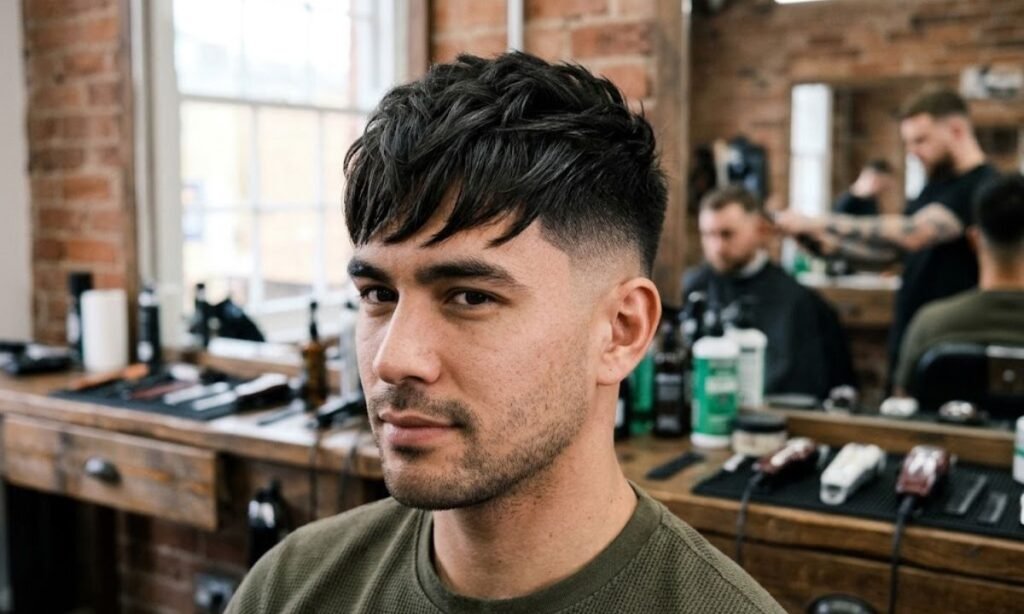
The sweet spot is usually 2.5 to 3.5 inches on the top.
That’s long enough for point cutting to create real gaps and short enough to hold its shape.
Below 2 inches, you get a crop. Above 4, you get a flop.
Your hair texture shifts these numbers a little.
Straight hair needs the lower end, because gravity pulls it flat quickly.
Curly hair can carry the upper end, since curls spring up and appear shorter.
Ask your barber to cut in layers rather than one blunt line.
Layers let each strand sit at a slightly different height.
That’s what creates the visible separation people love.
How Does Fringe Length Affect Styling Flexibility?
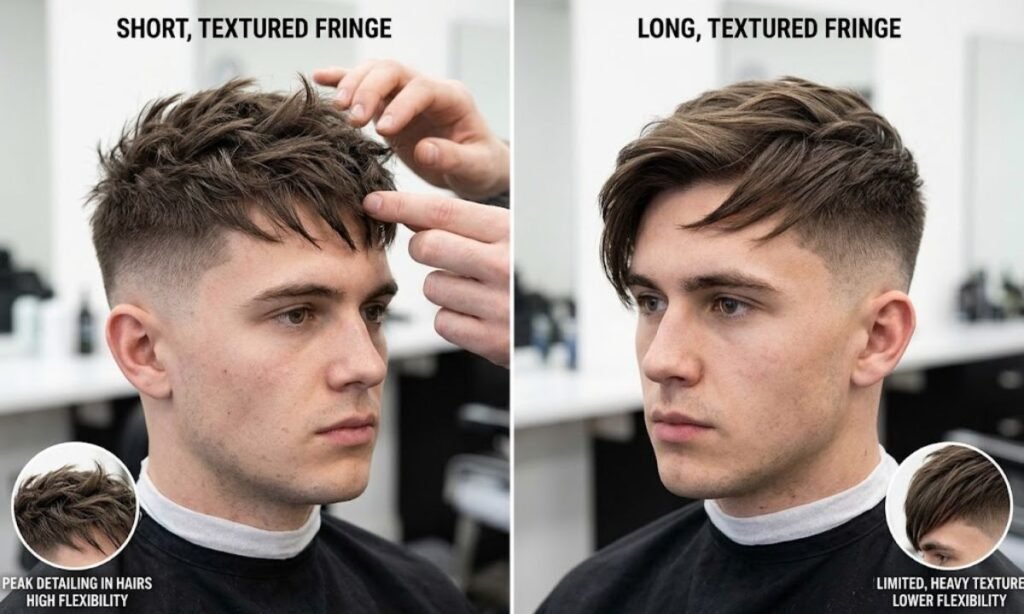
A short fringe sits just above the eyebrows.
It’s quick to style and looks sharp, but you can only push it forward or slightly sideways.
Think of it as the low maintenance setting.
A long fringe reaches the brow or beyond.
You can sweep it to one side, push it up, or let it hang forward.
More options also mean more time, so be honest about your morning routine.
Here’s a simple comparison:
| Fringe length | Style options | Morning effort | Best for |
|---|---|---|---|
| Short (above brow) | Forward, slight side sweep | Low | Busy schedules, thick hair |
| Medium (at brow) | Forward, side swept, pushed up | Medium | Most hair types |
| Long (below brow) | Swept, pushed back, messy forward | Higher | Wavy hair, curly hair |
When Should You Keep Extra Length for Natural Movement?
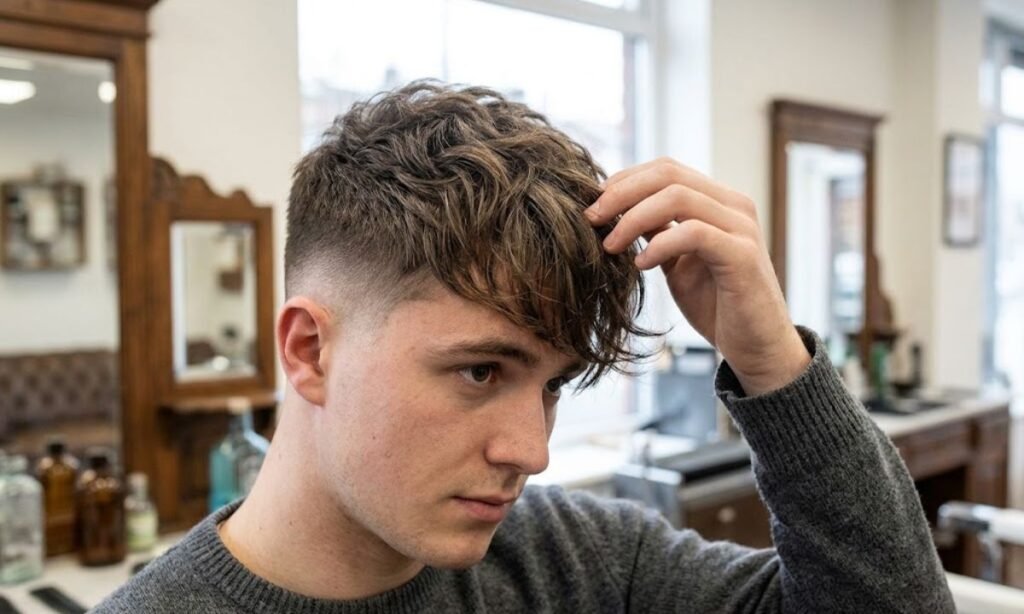
Keep extra length when your hair has natural wave or curl.
The weight of a longer fringe pulls the pattern down and keeps frizz in check.
Cut it too short, and it springs up into a shape you didn’t order.
Extra length also helps when you’ve got a cowlick at the front.
A bit of weight tames the direction that stubborn patch wants to go.
Say your hair kicks right at the front hairline. Leave an extra half inch there, and it lies calmer.
The same rule applies if you’re growing out a shorter style.
Trim the sides regularly and let the top keep its length.
That’s how a long textured fringe comes together without an awkward in between phase.
What Makes the Taper “High”?
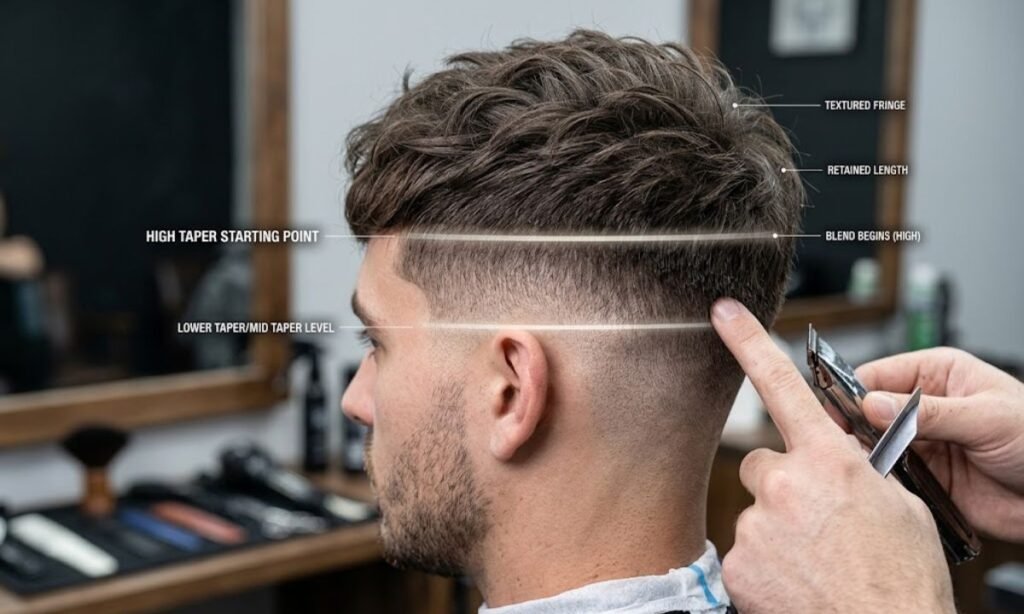
A taper is high when it begins above the ear, near the temple and crown.
The hair shortens gradually from there down to the nape.
The shortest part still blends softly instead of dropping to skin.
A mid taper starts around the ear.
A low taper fade starts below it and hugs the sideburns and neckline.
The higher the start, the stronger the contrast.
What Makes the Fringe “Textured”?
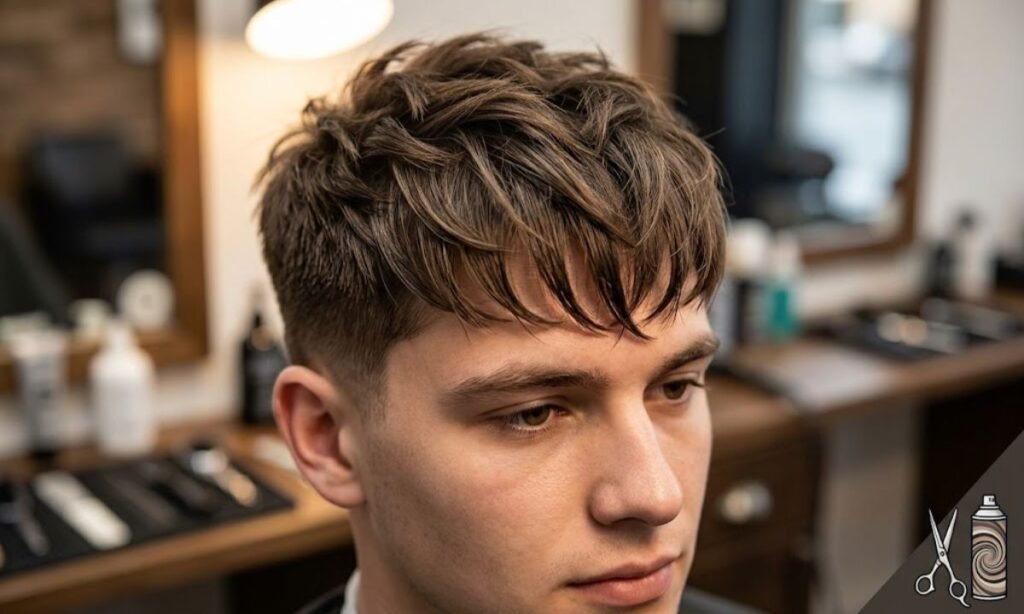
Texture comes from the cutting method, not from product alone.
Barbers use point cutting, razor work, or thinning shears to remove weight in small sections.
That leaves the ends uneven, so strands separate on their own.
Product finishes the job but can’t fix a blunt cut.
If the ends are all one length, even the best matte clay won’t give you a choppy fringe haircut.
Start with a smart cut and the hair styling gets easy.
What Should the Finished Haircut Look Like?
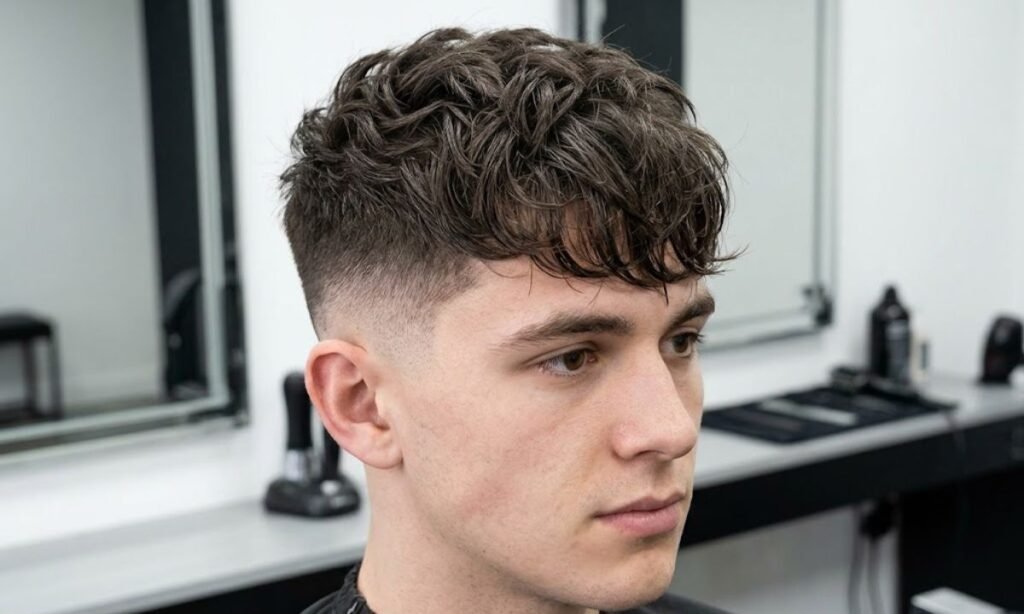
Picture a clean, even taper that fades gently into the sides and back.
The top looks soft and slightly messy, with visible pieces rather than a solid mass.
The fringe falls naturally and doesn’t poke your eyes.
Check three things before you leave the chair.
Is the taper the same height on both sides?
Does the fringe lie where you want it when you move your head?
Who Does a High Taper Fade Textured Fringe Suit?

The short answer is most guys.
The longer answer depends on your hair type, hair density, and head shape.
Let’s break it down.
Which Hair Types Work Best?
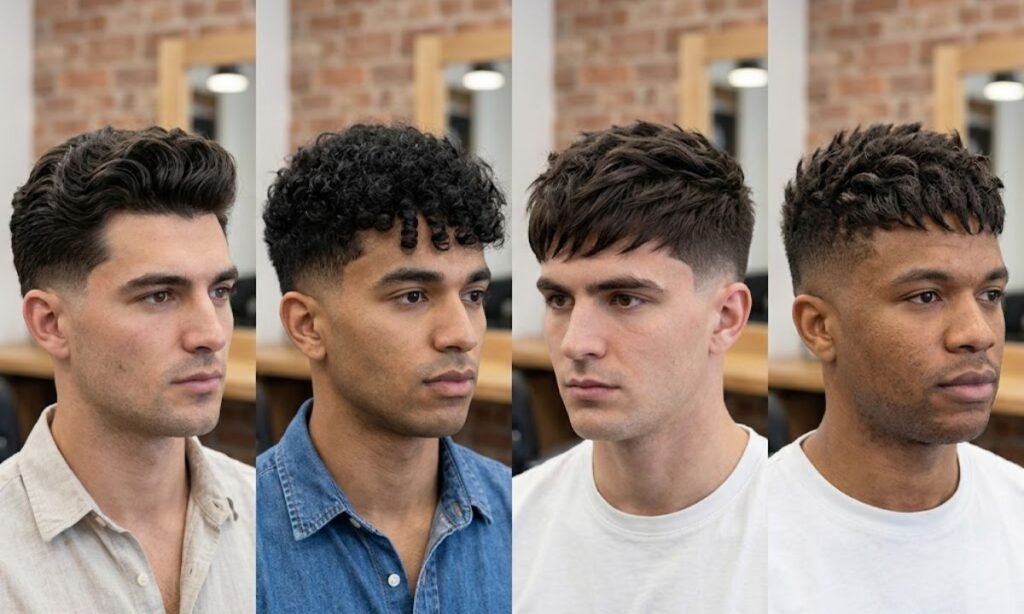
Wavy hair is the easy winner.
It already has natural texture, so the fringe falls into place with little effort.
A light styling cream is often all you need.
Straight hair works well too, as long as the top has enough layers.
Without them, the fringe lies flat and looks like a bowl. A high taper fade for straight hair shines when you add texturizing spray and a touch of matte clay.
Curly hair and coily hair create the most striking version.
The curls add natural volume and the tight sides give them a clean frame.
A high taper fade with curly fringe is one of the most requested combinations for good reason.
How Do Hair Density and Growth Patterns Affect the Cut?

Thick hair holds a fringe beautifully but can feel heavy.
Your barber should remove weight inside the top so it doesn’t puff outward.
A textured fringe for thick hair works best with generous thinning.
Thin hair and fine hair need a lighter touch.
Don’t let the barber thin it out, because there isn’t much to spare.
A textured fringe for thin hair looks best with a shorter fringe and a little extra hair volume from a blow dryer.
Growth patterns matter just as much.
A double crown or a strong cowlick can push the fringe in directions you didn’t pick.
Tell your barber about them first, and they’ll cut with the pattern instead of against it.
How Should Face Shape and Forehead Size Influence the Choice?

The fringe changes how your face reads.
A fuller fringe softens a long face or a high forehead.
A shorter, lighter fringe keeps a round face from looking even rounder.
Here are quick pairings:
- Oval face: almost anything works, so choose by hair type.
- Round face: keep the sides tight, add height on top, and angle the fringe sideways.
- Square face: a softer, choppier fringe balances a strong jaw.
- Long face: go for a longer, fuller fringe to shorten the look of the forehead.
- High forehead or receding hairline: a side swept fringe hides the edges naturally.
Who Should Think Twice About This Cut?
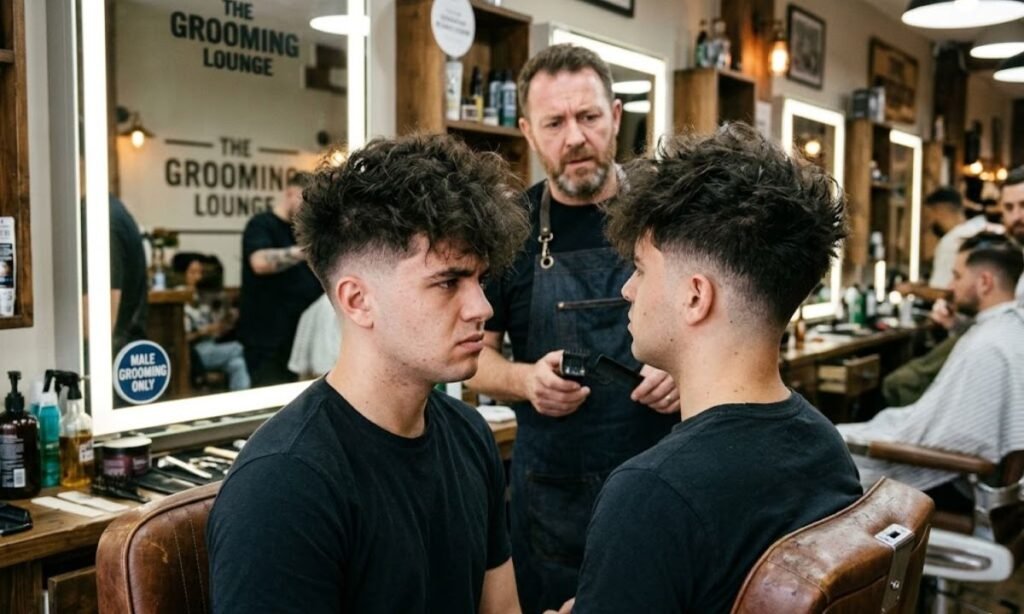
If your hairline is receding fast, a very high taper can make the temples look bare.
A mid taper or a softer low taper is kinder in that case.
The top can also stay a little longer to cover the corners.
If you hate any form of styling, be careful.
This haircut looks best with a minute or two of product every day.
Without it, the fringe can flop and look unplanned.
If your job demands a very conservative look, check the dress code first.
The cut is clean, but the messy top may read as casual in some offices.
A shorter fringe and smoother finish solve that.
High Taper vs Mid or Low Taper vs High Fade: What’s the Difference?

Barbers throw around these terms like everyone knows them.
Most customers don’t, and that’s how haircuts go wrong.
Here’s the plain version.
High vs Mid vs Low Taper With a Textured Fringe

A high taper starts near the temple and gives the sharpest contrast.
A mid taper fade starts around the ear and feels balanced.
A low taper fade starts near the neckline and looks the most conservative.
With a textured fringe, the height changes how the top looks.
A high taper makes the top appear longer and fuller.
A low taper makes the whole haircut feel softer and more grown out.
| Taper type | Where it starts | Look | Good if you want |
|---|---|---|---|
| High | Temple and crown | Sharp, bold | Strong contrast |
| Mid | Around the ear | Balanced | A safe, versatile cut |
| Low | Near ear and nape | Soft, subtle | A conservative finish |
High Taper Fade vs High Fade vs Skin Fade

A taper and a fade aren’t the same.
A taper shortens gradually and usually leaves some length at the bottom.
A fade goes much shorter, often down to bare skin.
A high fade starts high and drops to skin fade at the bottom.
It’s dramatic and needs touch ups every two weeks.
A high taper fade without skin fade is gentler and grows out more gracefully.
A shadow fade sits in the middle.
It leaves a faint trace of hair at the bottom, so the finish looks soft rather than bald.
Many people who think they want a skin fade actually want this.
How Do You Ask Your Barber for a High Taper Fade Textured Fringe?
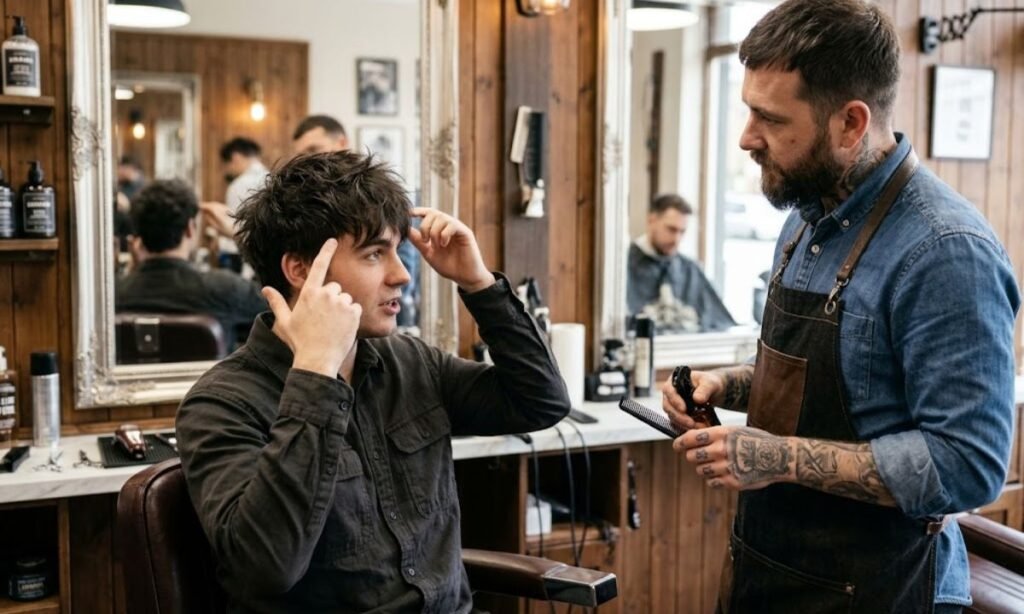
Most bad haircuts start with a vague request.
“Short on the sides, longer on top” fits a hundred different cuts.
A clear brief takes thirty seconds and saves you six weeks of regret.
The goal is simple.
You want your barber to picture the same haircut you see in your head.
So let’s give them the details.
What Details Should You Specify Before the Cut Starts?
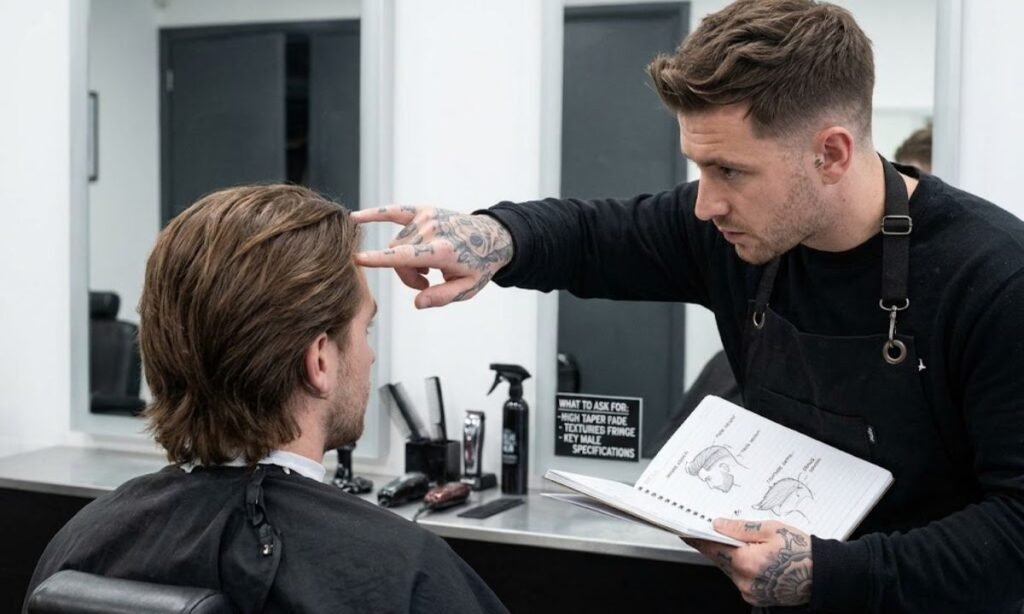
Start with the taper height.
Say “high taper” and point to where it should begin, usually near the temple.
Then say whether you want it to finish at skin or leave some length.
Next, name the clipper guard numbers if you know them.
A number 1 or 2 at the top of the taper is a common starting point.
If you don’t know the numbers, describe the finish with words like “soft” or “bare.”
Finally, talk about the top.
Give the fringe length in inches or by pointing to your eyebrow.
Ask for point cutting so the ends stay broken up.
Here’s your quick checklist:
- Taper height: high, starting at the temple
- Finish: skin, shadow, or soft with length
- Top length: around 3 inches, longer at the front
- Fringe: clears the eyebrows, cut with point cutting
- Neckline: rounded, squared, or natural
- Problem spots: mention any cowlick or double crown
What Reference Photos Should You Bring?
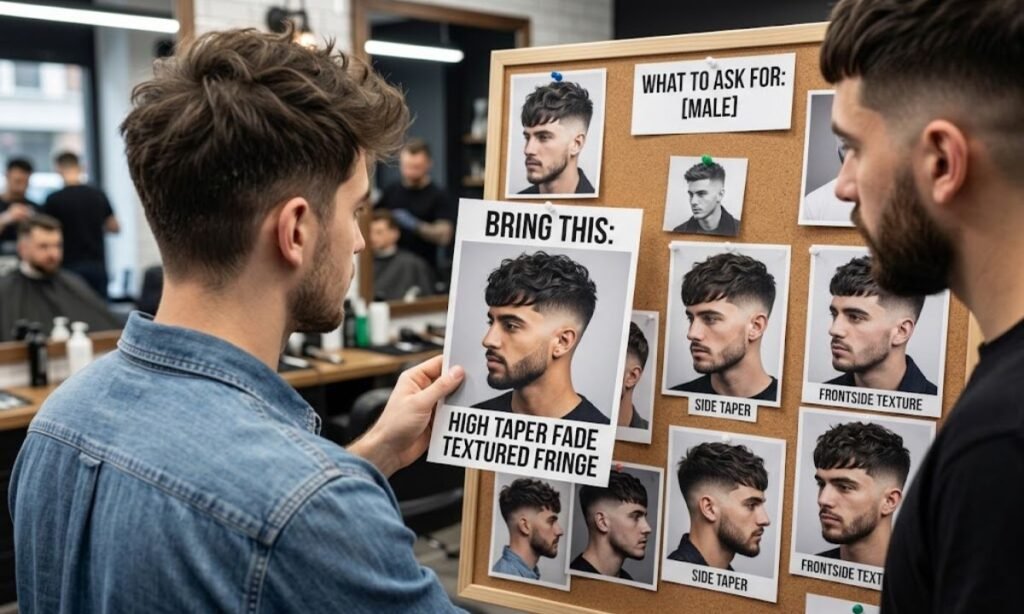
Bring two or three photos, not twenty.
Pick shots of hair that matches your texture, because a curly fringe won’t copy a straight one.
If you have thin hair, don’t bring a photo of someone with a thick mane.
Show the front, side, and back if you can.
The back view tells your barber how you want the nape finished.
It’s the angle most people forget.
Also mark what you don’t like.
A photo with a note such as “shorter fringe than this” is gold.
It turns a guess into a plan.
What Should the Barber Brief Sound Like?
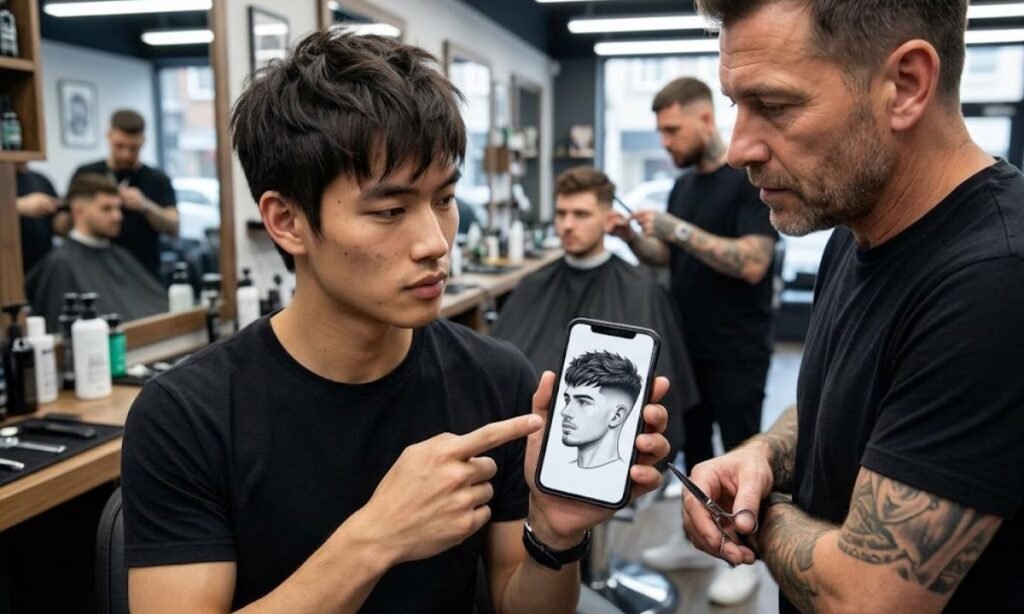
Keep it short and specific.
Here’s a version you can steal: “I’d like a high taper fade with a textured top. Number 1 at the temple, soft finish at the neckline. Keep about three inches on top, point cut the fringe, and leave the sideburns slim.”
That’s a how to ask a barber for a high taper fade script that works in any shop.
Then ask one question before the clippers start.
“Does that work for my hair type?”
A good barber will tell you honestly and might adjust the plan.
If you’re nervous, ask them to start longer.
It’s easy to take more off and impossible to put it back.
A second pass costs you nothing.
How Do You Style a High Taper Fade Textured Fringe?

This is where the cut either shines or sulks.
The good news is you don’t need ten products.
You need one or two and the right technique.
What Is the Fastest Daily Styling Routine?
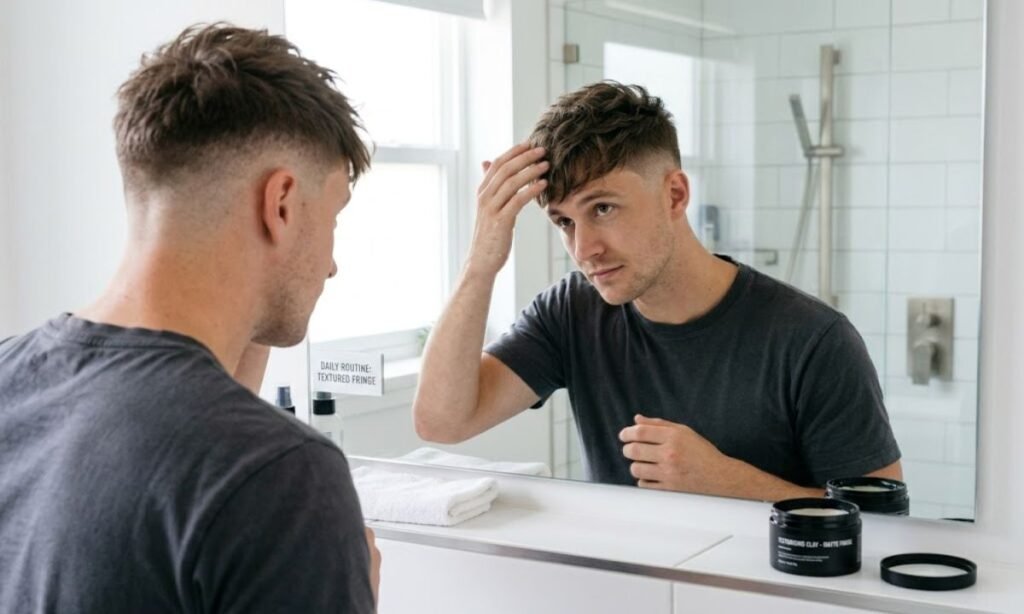
Start with damp, towel dried hair.
Push the fringe forward with your fingers, then rough dry it with a blow dryer on medium heat.
Stop when it feels about 90 percent dry.
Warm a pea sized amount of matte clay or hair paste between your palms.
Work it from the back to the front, then pinch and twist the ends of the fringe.
Finish with a quick spritz of texturizing spray if you want more grip.
That’s a two minute routine.
Once you’ve done it five times, you won’t think about it.
Here’s how to style a textured fringe without a mirror lecture.
Which Product Type Works for Each Hair Type?

The wrong product can undo a great cut.
Heavy wax weighs down fine hair, and a light cream disappears in thick hair.
Match the product to your hair, not to the label.
| Hair type | Best product | Why it works | Watch out for |
|---|---|---|---|
| Straight hair | Texturizing spray plus matte clay | Adds grip and lift | Too much clay looks greasy |
| Wavy hair | Styling cream | Defines waves, tames frizz | Skip heavy wax |
| Curly hair | Curl cream plus light hair paste | Holds curls without crunch | Don’t brush it dry |
| Coily hair | Rich cream or leave in conditioner | Locks in moisture | Avoid alcohol sprays |
| Thin hair | Light texturizing spray | Builds hair volume | Skip oily pomades |
| Thick hair | Hair paste or strong clay | Controls weight | Use a bit more than you think |
These are the best products for textured fringe in plain terms.
If you’re stuck, start with matte clay for most hair types.
Swap to cream if your hair runs dry or curly.
What Styling Mistakes Make the Fringe Flat or Clumpy?
The biggest culprit is too much product.
A golf ball amount turns a choppy fringe into a greasy lump.
Start small and add more only if you need it.
The second culprit is styling wet hair.
Product slides around on soaked strands and won’t hold a shape.
Wait until it’s damp or dry before you reach for clay.
The third mistake is combing it flat.
A comb is great for the sides, but your fingers do better on top.
That’s the secret to preventing flat hair without a salon visit.
How Do You Dry It Without Damaging Your Hair?
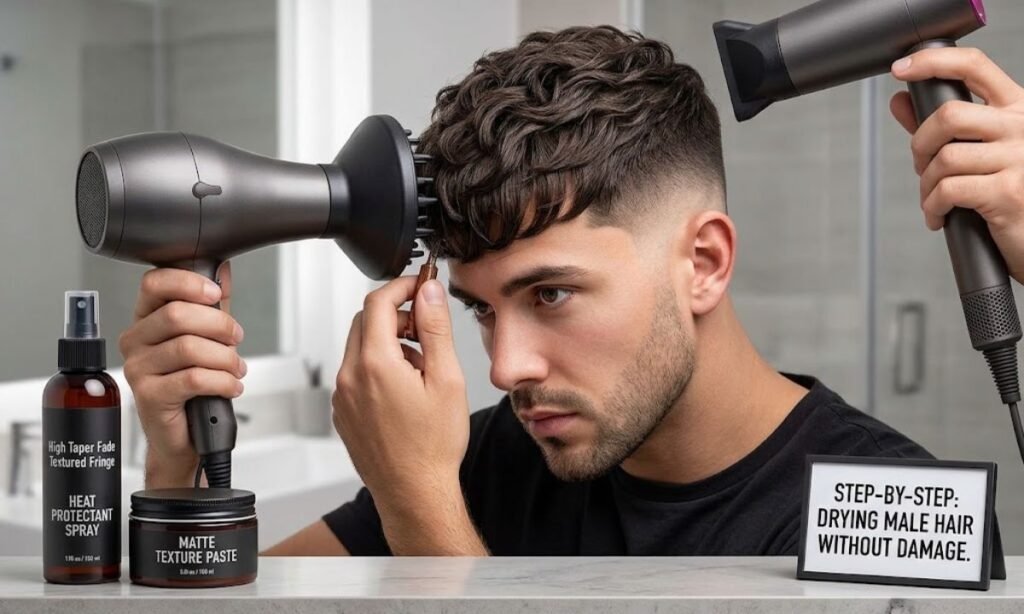
Keep the blow dryer a hand’s width away from your head.
Use medium heat instead of high, and keep the nozzle moving.
Hot, still air dries out ends and kills texture.
If you have curly hair or coily hair, use a diffuser.
It spreads the air so your pattern stays intact and frizz stays down.
You’ll end up with reducing hair frizz as a bonus.
Finish with a cool blast for ten seconds.
It sets the shape and adds a little shine.
It’s a tiny step that makes a big difference.
How Do You Maintain the Cut Between Barber Visits?

This haircut looks best at its freshest.
The tapered sides blur out within two weeks and look scruffy by week five.
A light routine keeps it sharp longer.
How Often Should the Taper and Fringe Be Refreshed?
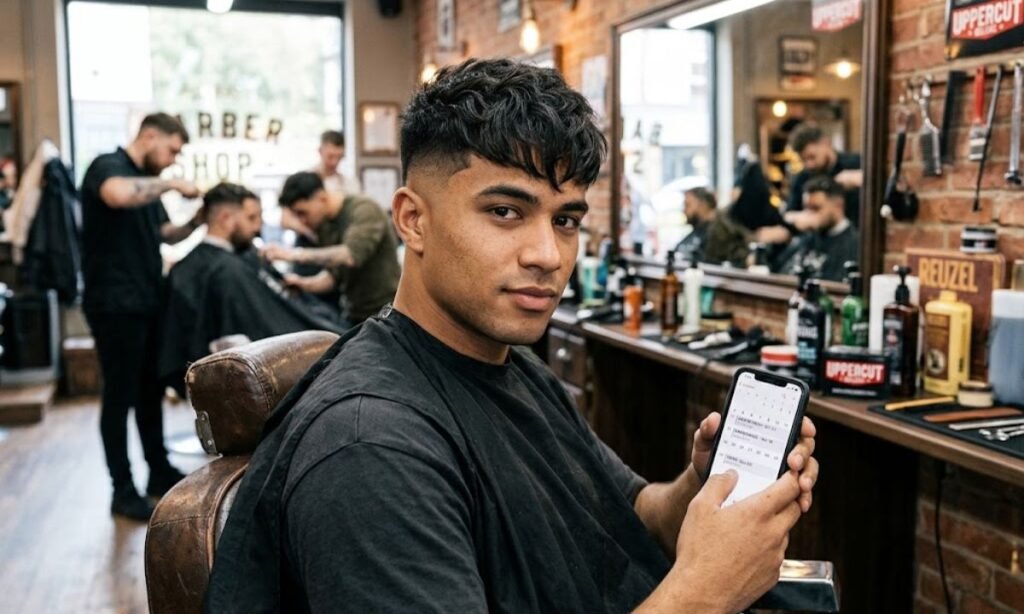
Book the taper every three to four weeks.
That’s how long it takes the sides to lose their clean shape.
If you wear a skin fade, go every two to three weeks.
The top can wait a little longer.
A fringe trim every six to eight weeks is plenty, unless your hair grows fast.
That answers how often to trim a high taper fade for most guys.
Growth speed matters.
Hair grows about half an inch a month on average, though it varies.
If your hair growth runs fast, shorten your visit gap.
What Can You Do Between Appointments?
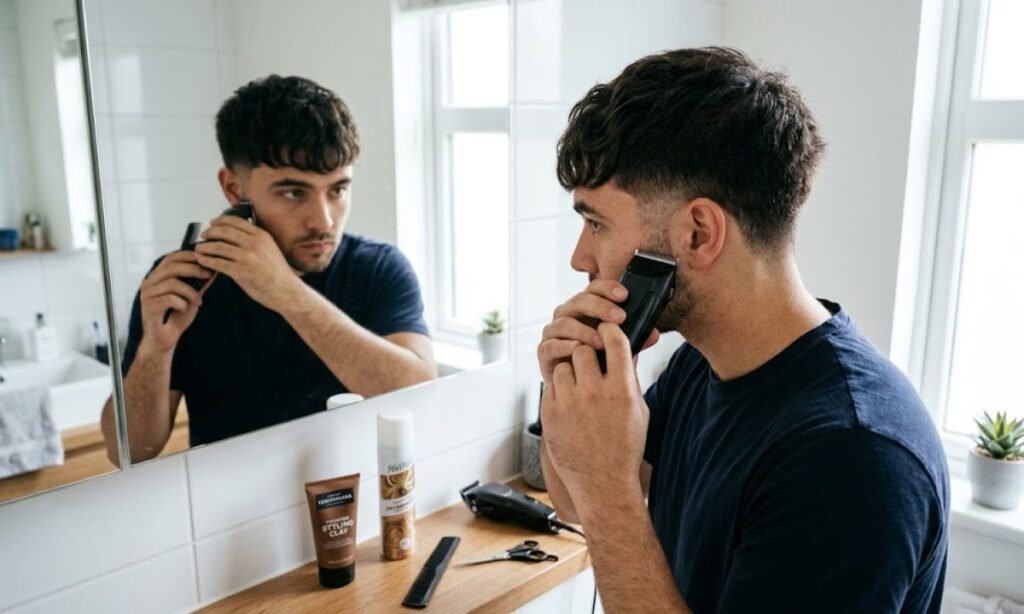
A quick taper fade touch up at home is possible but risky.
If you do it, only clean the nape and sideburns with a trimmer, and never touch the fade line.
One wrong pass leaves a visible gap.
Keep the fringe in shape with a rinse and light conditioning.
A bit of styling cream at night helps frizzy hair behave.
And trim stray hairs near the eyebrows with small scissors, not clippers.
If you need an in between fix, ask your barber for a ten minute neckline clean up.
Most shops offer it for a lower price.
It’s the cheapest way to stretch a haircut.
Which High Taper Textured Fringe Variations Are Worth Considering?
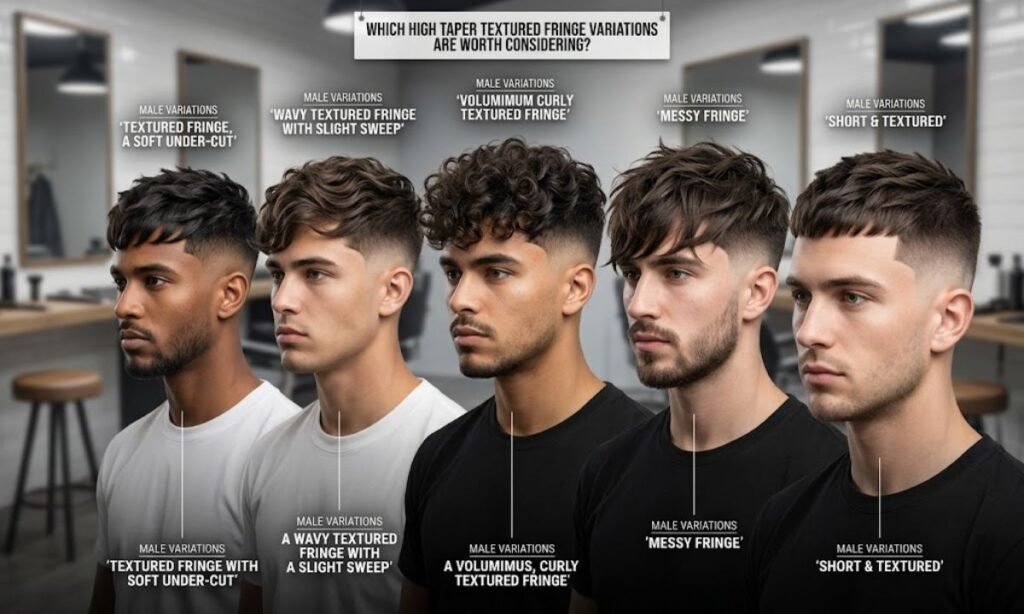
Once you’ve got the basics, you can customize the cut.
Tiny shifts in the top or finish change the mood completely.
Here are the options that actually matter.
Which Variations Change the Fringe Shape?
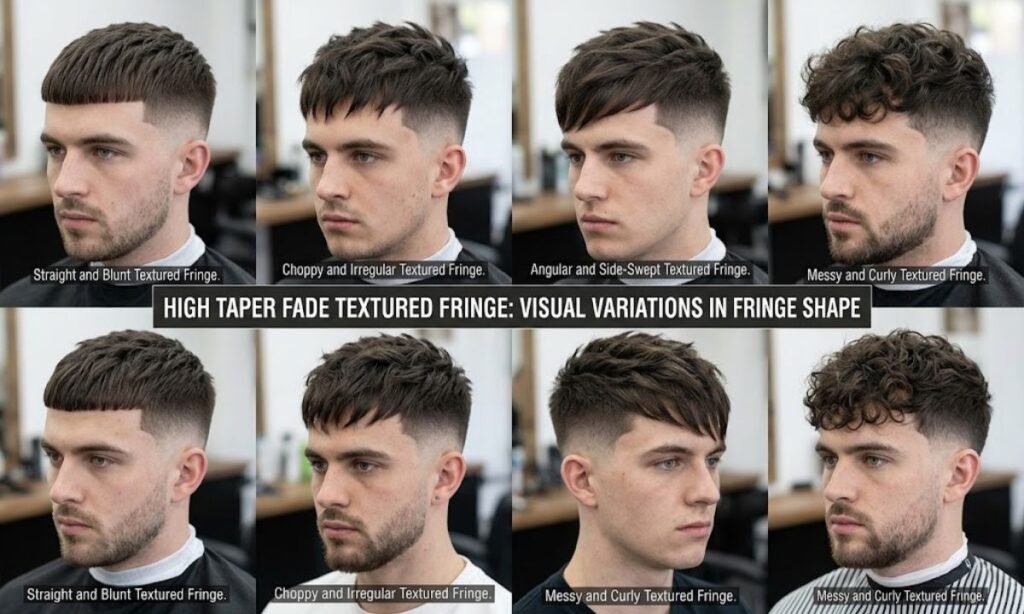
A messy textured fringe is the classic version.
It looks tossed and works best with clay and a bit of salt spray.
It’s the go to for a high taper fade with messy fringe.
A side swept fringe angles forward and across.
It covers a high forehead and gives a more polished feel.
It’s popular with office goers.
A French crop haircut is a shorter, blunter version.
It sits straight across the forehead and takes almost no styling.
Pair a French crop with taper fade if you want less effort.
An Edgar haircut goes the opposite way.
It has a blunt, straight cut across the front, a sharp line, and a strong taper.
It’s bold, graphic, and not for the shy.
Which Variations Change the Taper Finish?
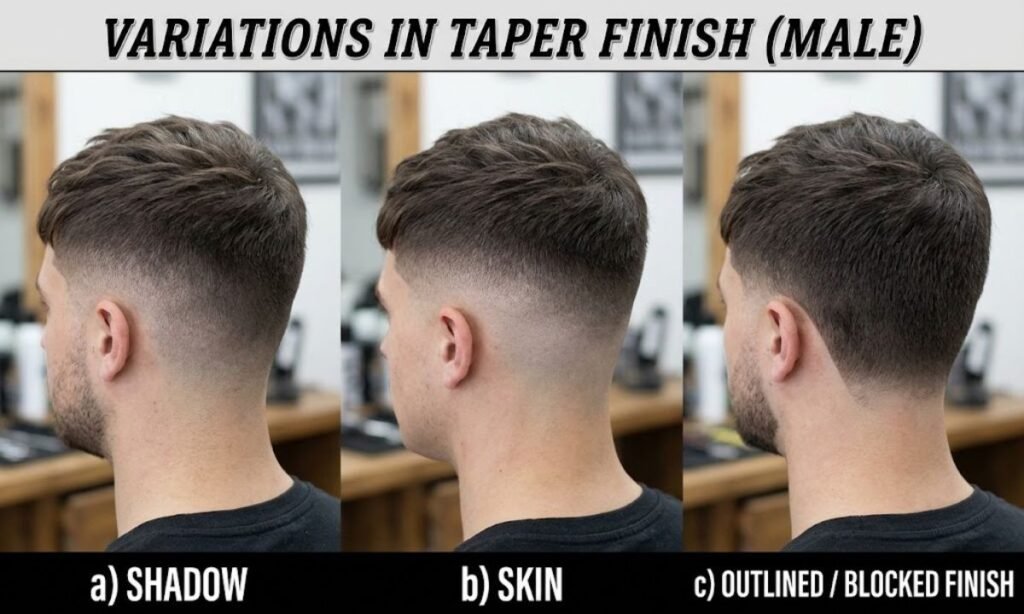
A skin finish drops to bare skin at the bottom.
It looks sharp but demands upkeep every two weeks.
This is the biggest commitment of the lot.
A shadow finish keeps a faint trace of hair.
It’s softer and forgiving, so it grows out gracefully.
It’s the safest middle ground.
A drop fade curves down behind the ear.
It adds shape and makes the head look more rounded.
A burst fade curls around the ear and leaves length at the back, which pairs beautifully with a textured fringe with burst fade.
Should You Get a High Taper Fade Textured Fringe?
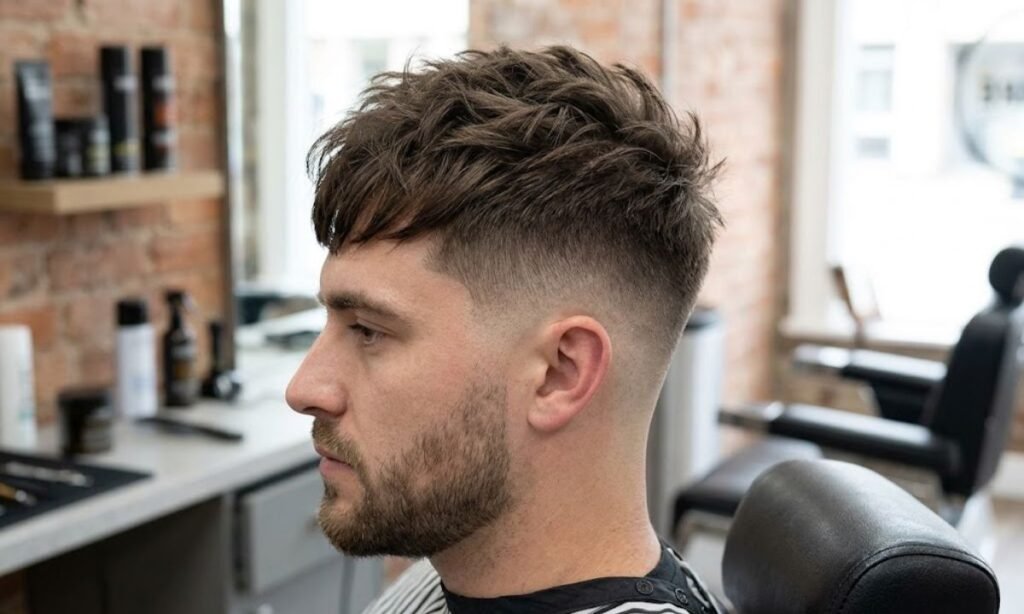
That depends on how you live more than how you look.
A great cut that doesn’t fit your routine will frustrate you.
Let’s weigh the pros and cons honestly.
What Are the Biggest Advantages?
The contrast makes you look put together with little effort.
The fringe covers a forehead you may not love.
The cut works on most hair textures, which is rare.
Styling is quick once you’ve learned your product.
It grows out gracefully, since the top carries most of the shape.
And it’s one of the few cuts that feels modern without trying too hard.
What Are the Trade-Offs?
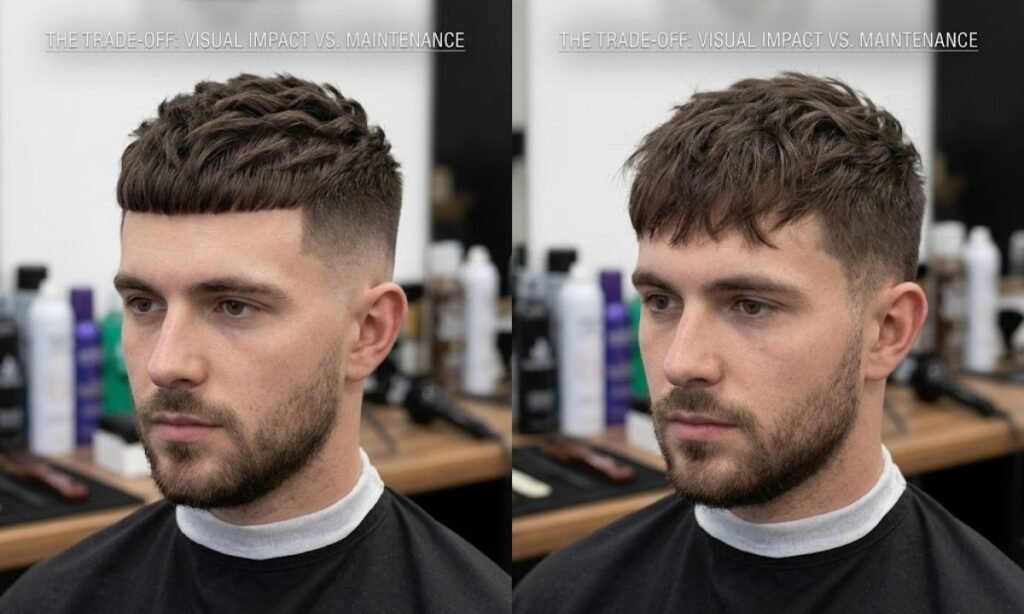
You’ll need regular trims to keep the taper clean.
That’s a cost of time and money over a year.
Skip two visits and the neat edges disappear.
The fringe also needs product to look right.
On a bad hair day, it can flop or look flat.
And if your hairline is receding, the high taper can highlight it.
What Are the Best Alternatives If It Is Not Right for You?

If the contrast is too strong, try a low taper fade with the same top.
It keeps the vibe but softens the sides.
It’s an easy switch for conservative workplaces.
If you hate styling, try a short crop or a buzz with a slight taper.
There’s almost nothing to do each morning.
If your hair is fine, a mid taper fade with a shorter, lighter fringe may suit you better.
What Does a High Taper Fade Textured Fringe Cost and How Long Does It Take?

Prices swing a lot by city and shop.
A standard men’s cut often costs 25 to 60 dollars, and a detailed fade can sit at the higher end.
Add a tip and you’ve got your real number.
Expect 30 to 45 minutes in the chair.
A skin finish or heavy detailing can push it past an hour.
Book ahead if you want a specific barber.
Over a year, the upkeep adds up.
At one visit every four weeks, that’s about thirteen cuts.
Budget for it, or pick a softer taper to stretch the gap.
Haircut Ideas to Show Your Barber
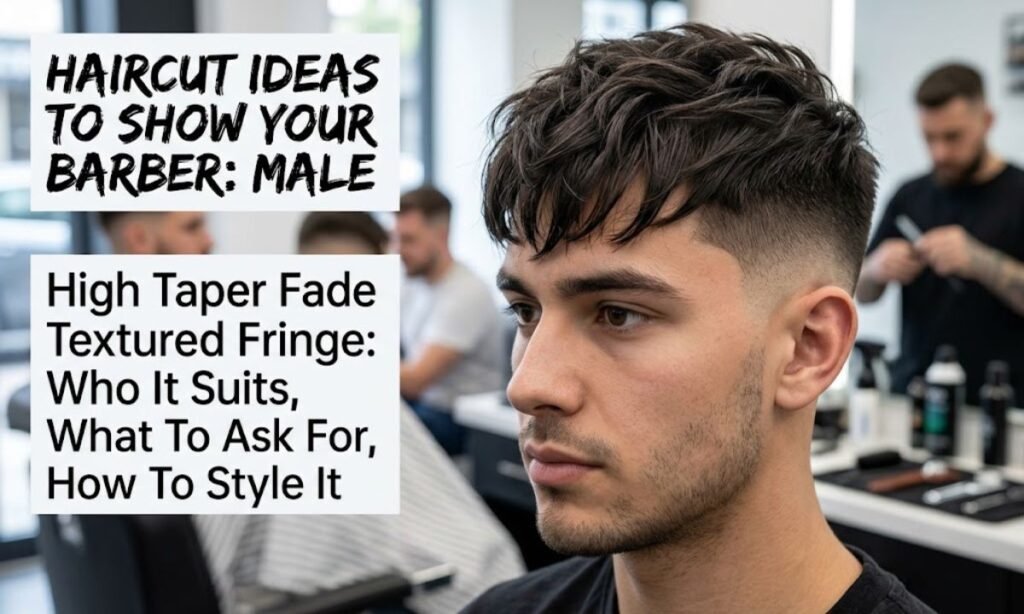
Sometimes words won’t do it, and a good picture helps.
Here are a few high taper fade haircut ideas to show.
Pick the one closest to your life, not your dreams.
- Clean and sharp: high taper, short fringe, matte clay, smooth sides
- Relaxed and messy: high taper, messy top, texturizing spray, longer fringe
- Curly and bold: high taper fade for curly hair, curl cream, longer top
- Office friendly: high taper with side swept fringe, hair paste, soft finish
- Low effort: French crop haircut, short fringe, shadow fade
These modern textured fringe hairstyles all share one idea.
Tight sides, soft top, and a bit of attitude.
The rest is just fine tuning.
You can also checkout this article as well: High Taper Fade Curly Hair: Styles, Barber Guide, and Maintenance
Frequently Asked Questions About the High Taper Fade Textured Fringe
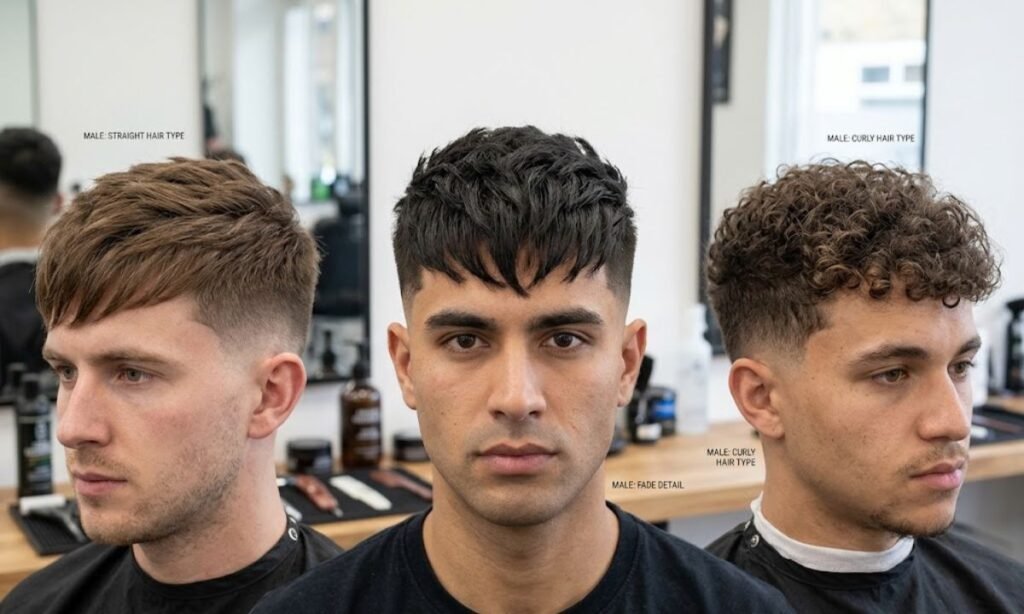
What Is a High Taper Fade Textured Fringe?
It’s a haircut with short, tapered sides that begin high on the head and a longer, choppy fringe on top.
The taper blends gradually, so the sides look neat without going fully bald.
The fringe is cut with texture so it moves and separates.
Does a Textured Fringe Suit Curly Hair?
Yes, and it’s one of the best matches.
Curls add natural texture and hair volume, so the fringe looks full and relaxed.
Just keep the length a bit longer, and use a curl cream.
How Do You Style a Textured Fringe?
Dry your hair about 90 percent, then add a small amount of matte clay or hair paste.
Pinch and twist the ends of the fringe with your fingers.
Finish with texturizing spray if you need more grip.
Is a High Taper Fade Easy to Maintain?
It’s moderate.
The daily routine is fast, but you need a trim every three to four weeks.
If you want something even easier, go for a low taper or a softer finish.
How Often Should You Trim a Taper Fade?
Every three to four weeks for the sides, and every six to eight for the top.
If you have a skin fade, go closer to two or three weeks.
Fast growing hair may need shorter gaps.
What Is the Difference Between a Taper and a Fade?
A taper shortens gradually and usually leaves length at the bottom.
A fade goes much shorter, often to bare skin.
Both blend smoothly, but a fade is bolder.
What Is the Difference Between a High Taper and a High Fade?
A high taper keeps some hair at the finish and looks softer.
A high fade starts at the same spot but drops to skin and looks sharper.
Choose the taper for easy upkeep and the fade for drama.
Can You Get a Textured Fringe Without a Skin Fade?
Absolutely.
A taper, a shadow fade, or a low taper all work with a textured fringe.
That’s the high taper fade without skin fade option, and it grows out better.
Which Hair Products Work Best for a Textured Fringe?
Matte clay and hair paste work for most people.
Styling cream suits wavy and curly hair, and texturizing spray helps thin hair.
Pick the lightest option that still holds.
Is a Textured Fringe Suitable for Straight Hair?
Yes, with a little help.
Straight hair needs layers and a bit of grip product so it doesn’t lie flat.
A high taper fade for straight hair looks great with a short to medium fringe.
Final Thoughts
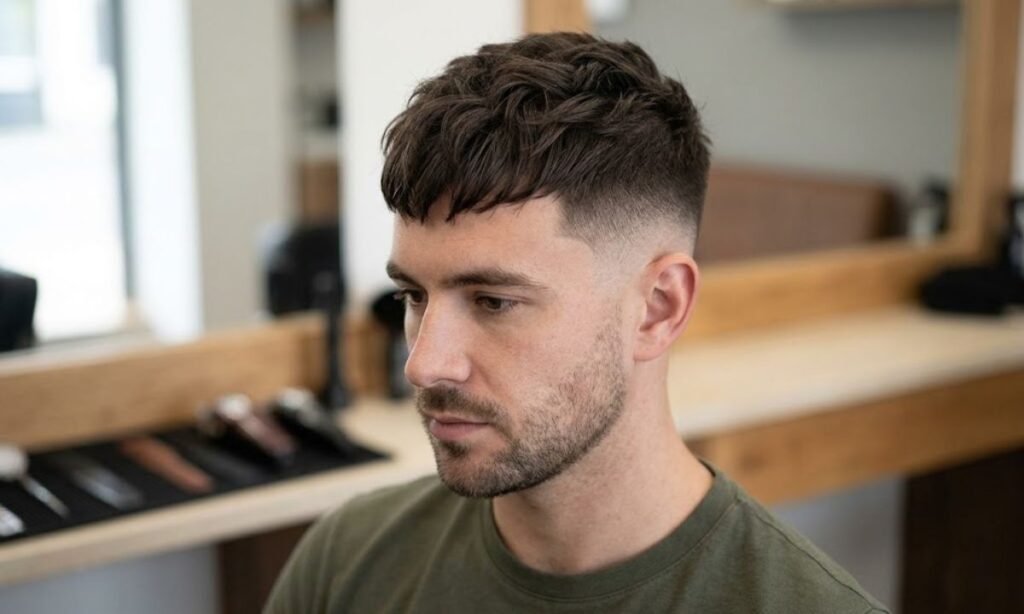
A high taper fade textured fringe is one of those haircuts that earns its popularity.
It’s clean at the sides, relaxed on top, and flexible across hair types.
With a clear brief and a simple routine, you can make it work for you.
The real trick is honesty.
Be honest about your hair, your hairline, and how much time you’ll spend on it.
Then pick the taper height and fringe length that match.
Now it’s your turn.
Have you tried this cut, or are you thinking about it?
Drop your questions or your own tips in the comments, and share this guide with a friend who’s stuck on his next haircut.

I’m Michael Charles, the creator of MegaCrazes—your source for fresh hairstyles, sharp haircuts, and simple hair-care inspiration. Find your style. Own your look.
1 thought on “High Taper Fade Textured Fringe: Who It Suits, What to Ask For, and How to Style It”