

Quick Answer
If you have a large forehead, your best bet is a haircut that adds forehead coverage without looking heavy or forced. Think textured fringe, a French crop, a Caesar cut, or a temple fade with forward fringe. These styles bring hair forward, cut down on forehead exposure, and balance out your facial proportions naturally.
You don’t need to hide your forehead like it’s a problem. You just need a cut that works with your hairline type instead of against it. A good barber, the right hair texture plan, and a bit of daily styling can change how your whole face reads in under ten minutes a day.
Most guys searching for this topic have already tried a few haircuts that didn’t work out. Maybe a fringe grew out weird, or a buzz cut made the forehead look even taller. That’s normal. Getting this right usually takes one or two tries with a barber who actually listens to what you’re describing.
Stick around, because we’re about to go through 24 real options, plus how to pick one based on your face shape, hair type, and hairline. No guesswork, no fluff, just what actually works in a real barber chair.
How Do You Know If You Have a Large Forehead?

Stand in front of a mirror and look straight on. If the space between your eyebrows and your hairline takes up more than a third of your face, you’re likely working with a prominent forehead. This gap is called brow-to-hairline distance, and it’s the number barbers actually look at, not just “does his forehead look big.”
Most faces split into three even sections. Hairline to brows. Brows to nose tip. Nose tip to chin. When that top third grows past the other two, you’ve got a high forehead. It’s not rare. It’s not bad. It’s just a proportion thing, and proportions can be adjusted with the right haircut.
Forehead height also depends on your hairline type. A straight hairline sits low and even. A rounded hairline curves gently. An M-shaped hairline or a widow’s peak can make your forehead look even taller because of how the shape draws the eye upward. High temples do the same thing. None of these are flaws. They’re just starting points your barber needs to know about.
Here’s a quick way to measure it yourself. Place two fingers stacked flat against your forehead, starting right above your eyebrows. If your forehead needs three or more finger-widths to reach the hairline, you’re dealing with a genuinely tall forehead, not just a perception issue. This little trick helps a lot of guys realize they’ve been styling around the wrong problem for years.
Genetics play the biggest role here, but hair loss can push things further. A thinning hairline or early receding hairline adds height gradually, sometimes so slowly you don’t notice until a photo catches you at the wrong angle. Either way, the fix is the same: pick a cut built for the hairline you actually have today.
What Are the Best Hairstyles for Men with Large Foreheads?
Here’s the deal. The goal with any of these cuts is horizontal interruption, basically breaking up that long vertical stretch of skin with hair, texture, or a fade line. Some styles do this with forward-styled cuts that physically bring hair down. Others do it with a skin fade or tapered sides that shift attention to the sides instead of the top.
Below are 24 styles that barbers actually recommend for guys dealing with a large forehead, thinning hairline, or just a high hairline they’d like to soften a bit. Each one lists who it suits best, so you’re not just picking a name off a list, you’re picking based on your actual hair and face shape.
1. Textured Fringe
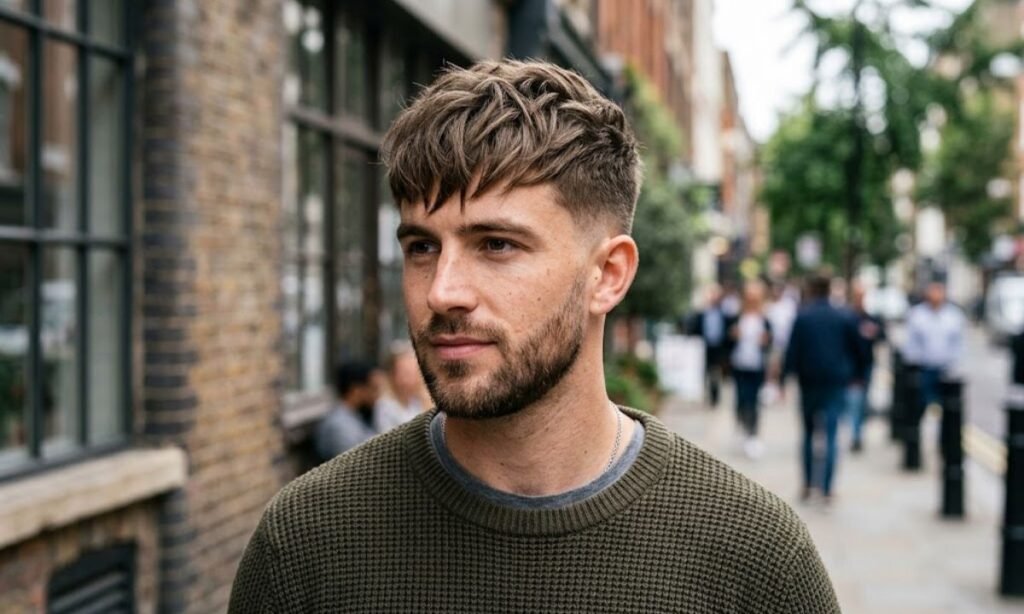
A textured fringe is the most popular fix for a large forehead, and it’s popular for a reason. Choppy pieces of hair fall forward to mid-forehead length, cutting the visual height of your forehead almost instantly.
Ask your barber for choppy layers on top with point-cut ends. This avoids a flat, blunt wall of hair and instead gives you movement that looks intentional. A bit of matte clay worked through damp hair holds the forward movement all day without turning greasy.
This style has stuck around for years because it’s genuinely adaptable. You can push it fuller for a night out or keep it light and casual for work, all without changing the underlying cut.
Barbers usually recommend a diffused, sun-in scissor technique here instead of a straight blunt cut. It keeps the ends soft, so the fringe blends naturally into the rest of the top instead of sitting like a separate piece glued on.
- Works with straight, wavy, and thick hair
- Pairs well with a low fade or low taper
- Needs a trim every 4 to 5 weeks to keep the fringe length right
2. Textured Crop with Fringe

This one takes the classic textured crop and pushes the fringe slightly longer for extra horizontal coverage. It’s a favorite among barbers because it looks tidy from the front and edgy from the side.
The sides stay short with a skin fade or mid fade, while the top carries enough length to style forward. You get a sharp hairline contrast between the fade and the fringe, which naturally pulls attention away from forehead exposure.
If you’re someone who likes a bit of edge without going too far, this crop hits that sweet spot. It photographs well too, since the layers catch light differently depending on the angle.
This one also travels well, meaning it holds its shape through a full workday without constant touch-ups, which matters if you’re someone who doesn’t want to carry product around for reapplication.
- Great for round and square face shapes
- Use sea salt spray for a beachy, undone texture
- Works with fine and medium-density hair alike
3. French Crop
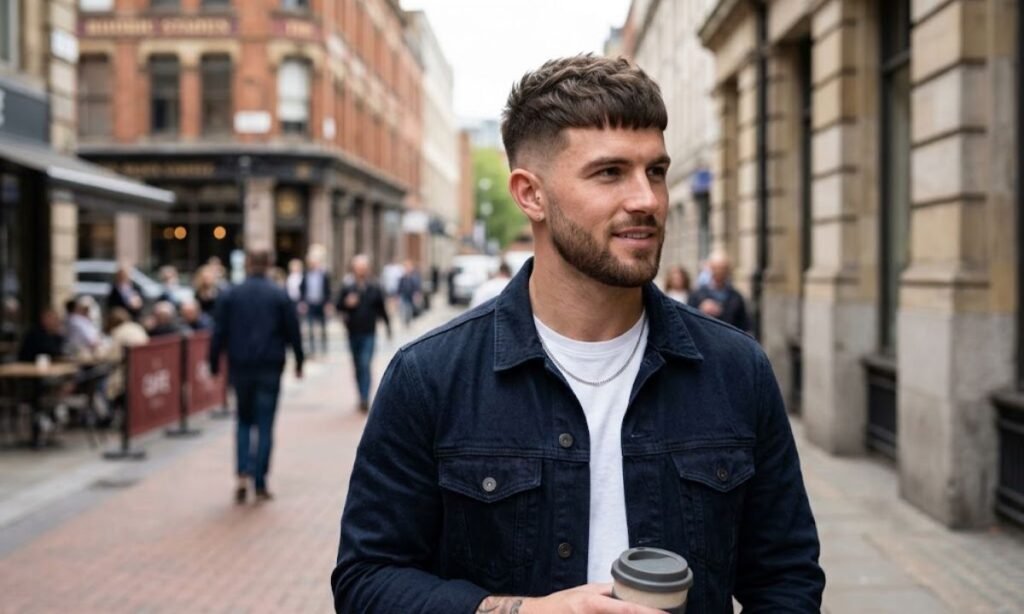
The French crop is a barbershop staple, and men with a high hairline love it because the fringe sits blunt and straight across the forehead. It’s clean, low-maintenance, and reads as put-together even on a bad hair day.
Sides are usually a taper haircut or fade, keeping the focus on that neat fringe line. A little wet-look gel or matte pomade keeps everything in place without the shine looking dated.
Plenty of guys pick this one specifically because it doesn’t scream “I’m hiding my forehead.” It just looks like a normal, sharp haircut that happens to solve the problem quietly.
It also transitions well from wet to dry styling, so even on a rushed morning, a quick towel dry and a comb through gives you a presentable result without needing the full styling routine.
- Best for guys who want minimal daily styling
- Suits thick and medium hair textures best
- A go-to for modern men’s hairstyles in 2026
4. Caesar Cut
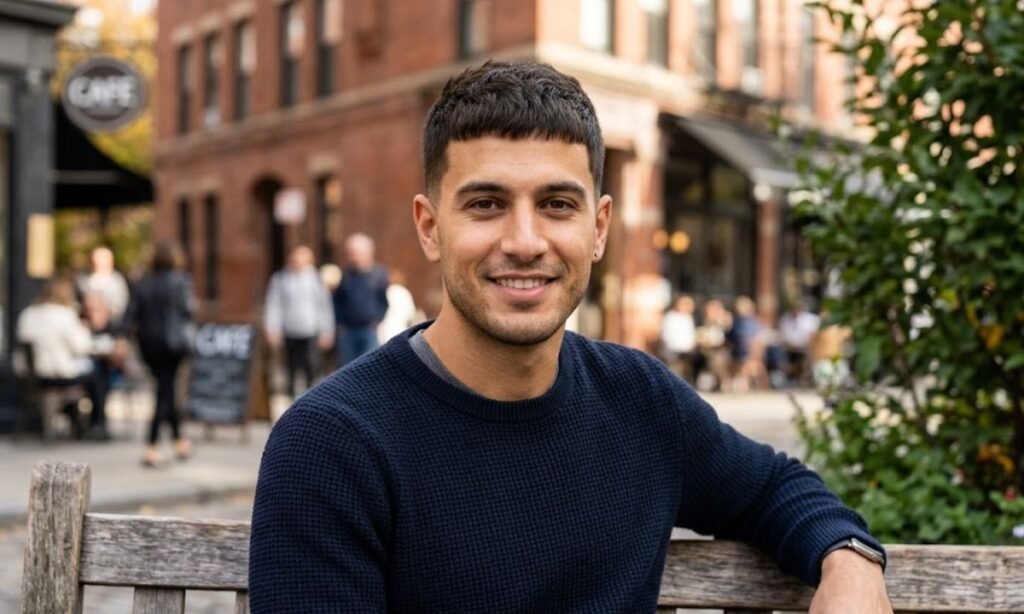
Named after the famous Roman haircut, the Caesar cut brings short, straight bangs forward across the forehead. It’s subtle but effective, especially for guys who don’t want a dramatic style change.
This cut works because it’s uniform in length all over, usually an inch or so, giving a soft forward direction to every strand. It’s one of the lowest-maintenance options on this list, and barbers can knock it out fast.
Because there’s no long layer to manage, this cut also grows out gracefully. You won’t hit that awkward two-week mark where everything looks out of shape.
It’s also a favorite among guys who wear hats or helmets regularly, since the short, even length holds its shape whether you’re pulling a cap on and off all day or riding a bike to work.
- Excellent for a receding hairline since it doesn’t draw attention to the crown
- Minimal product needed, just a light matte cream
- Works with straight and slightly wavy hair
5. Temple Fade with Forward Fringe
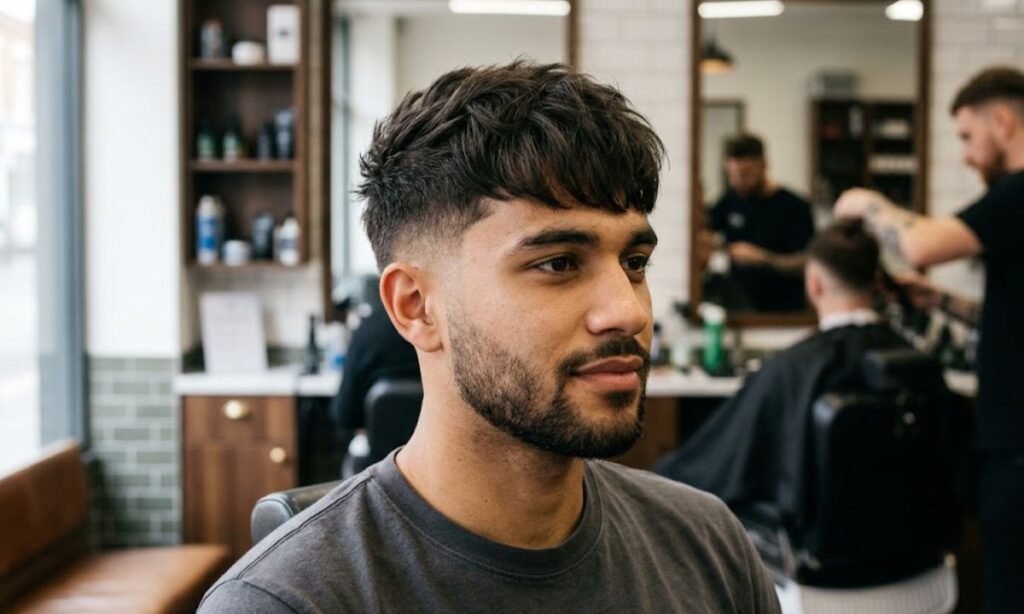
Combine a temple fade with a fringe pushed forward, and you get one of the sharpest looks on this list. The fade tapers sharply near the temples, drawing the eye sideways instead of up toward the forehead height.
Barbers often pair this with a natural lineup to keep the front edge crisp. It’s a bold, modern choice that works especially well if you also have high temples you want to soften.
The sharp contrast at the temple also helps frame the face, which is especially useful if your forehead width matches or exceeds your jaw width.
This combination tends to photograph exceptionally well from the side profile too, since the fade creates a clean line that a fully grown-out style simply can’t replicate.
- Ideal for square and oval face shapes
- Needs regular trims to maintain the fade line
- Pairs nicely with thick hair or wavy hair
6. Side-Swept Fringe

A side-swept fringe angles hair diagonally across the forehead instead of straight down. It softens a straight hairline and adds a bit of asymmetry that photographs really well.
This works especially well if your hairline is uneven or if you’re dealing with an early M-shaped hairline, since the diagonal sweep hides the unevenness better than a straight fringe would.
It also gives you a bit more flexibility day to day. Sweep it harder for a formal look, or let it fall looser for something more relaxed.
Guys who wear glasses often find this style especially flattering, since the diagonal line complements frame shapes better than a perfectly straight fringe tends to.
- Great with a deep side part underneath
- Curl cream helps if you’ve got natural wave
- Flattering for long and oval face shapes
7. Layered Fringe
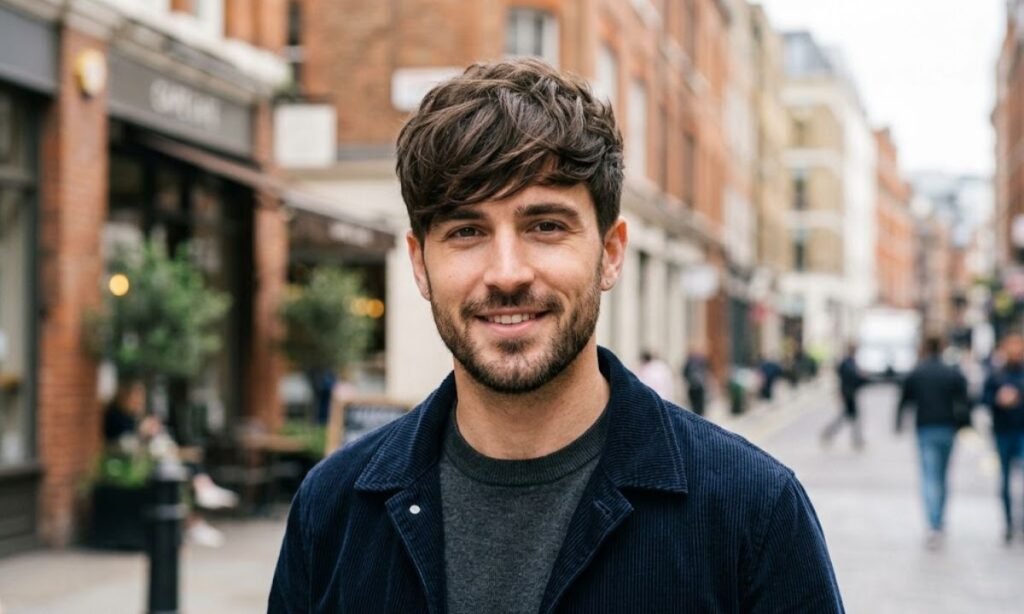
A layered fringe builds depth into the top section, so instead of one flat curtain of hair, you get several overlapping pieces. This adds volume and softness, both of which help balance a large forehead.
Layering also gives you options. Push it forward one day, sweep it sideways the next. It’s a flexible cut for guys who like to switch their look without committing to a full restyle.
Because the layers create their own texture, you don’t need heavy product to make this style look finished. A light cream is usually enough.
This is also one of the better long-term choices if your hairline is likely to change over the next few years, since the layered design can be adjusted gradually without needing a full restyle.
- Best on medium to thick hair
- Regular trims keep the layers from growing shapeless
- A leave-in conditioner helps manage frizz in the layers
8. Messy / Tousled Fringe

If polished isn’t your vibe, the messy fringe or tousled fringe gives you forehead coverage with zero fuss. Hair falls forward in a deliberately undone way, almost like you just woke up looking good.
This style thrives on texture. Ask your barber to add choppy layers with a razor or texturizing scissors, then finish with sea salt spray for that lived-in, matte finish.
It’s also one of the most forgiving styles on this list. Since it’s meant to look imperfect, a slightly uneven day doesn’t ruin the whole look the way it might with a sharper cut.
Guys who travel a lot or don’t always have access to their usual products tend to gravitate toward this style, since it still looks intentional even with minimal effort thrown at it.
- Perfect for casual, everyday wear
- Works with fine, wavy, or curly hair
- Low pressure style, forgiving if you miss a trim
9. Mod Cut
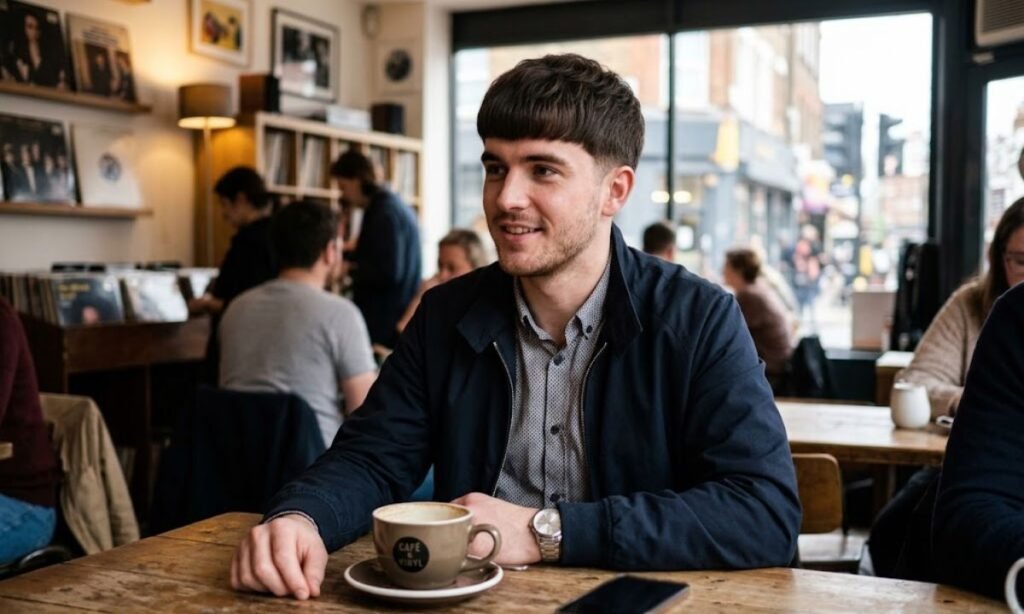
The mod cut borrows from 1960s British style, featuring a rounded fringe that sits just above the eyebrows. It’s a strong, graphic look that gives serious forehead coverage.
Because the fringe is fuller and more structured than a textured version, this cut suits guys with thicker hair who want maximum coverage with a retro edge.
It’s a distinctive choice, and it tends to draw compliments precisely because it stands apart from the usual crop-and-fade combinations everyone else is wearing.
It does require more frequent trims than most cuts on this list, simply because the geometric line at the bottom of the fringe grows out and softens faster than a textured edge would.
- Bold, distinctive, not for the shy
- Best with thick hair, struggles with fine strands
- Blunt ends give strong hairline contrast
10. Crew Cut
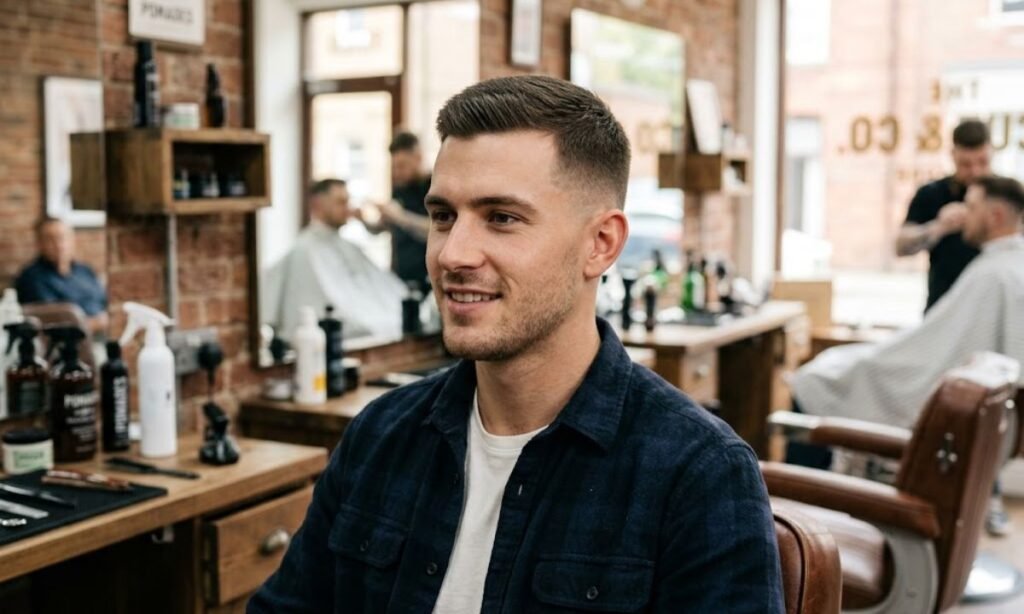
The crew cut is short on the sides and slightly longer on top, brushed forward for light coverage. It’s the cut you see on athletes and guys who want something sharp without any fuss.
While it doesn’t offer heavy coverage, the forward brush does soften the brow-to-hairline distance just enough to make a difference, especially paired with a good fade underneath.
It’s also one of the easiest cuts to maintain between barber visits, since there’s little length to grow out awkwardly.
Its no-nonsense reputation makes it a smart pick if you’re new to figuring out what actually suits your hairline type, since it’s hard to get badly wrong even with a less experienced barber.
- Extremely low maintenance
- Works for nearly every hair type
- A safe, classic choice for office environments
11. Crew Cut (Forward Styled)
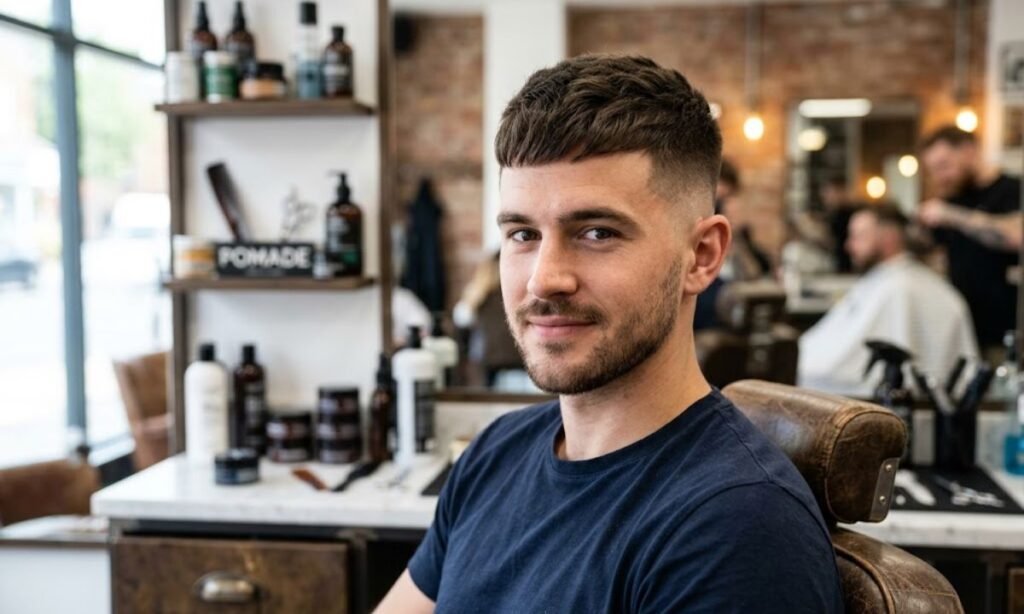
Take the standard crew cut and add intentional forward movement with product, and you get a slightly different result. This version uses a bit more length on top specifically so it can be pushed down toward the forehead.
A dab of matte clay worked through the top section, then pressed forward with fingers, gives you soft coverage that still looks masculine and clean.
If you’re not fully sold on committing to a fringe-heavy style, this version acts as a nice middle step that still delivers real coverage.
It’s also a smart pick if you switch between casual and professional settings often, since you can style it forward for the weekend and brush it back for a meeting without needing two different haircuts.
- Great transition style if you’re not ready for a full fringe
- Works well with a mid fade
- Suits round, oval, and square face shapes
12. Taper Haircut
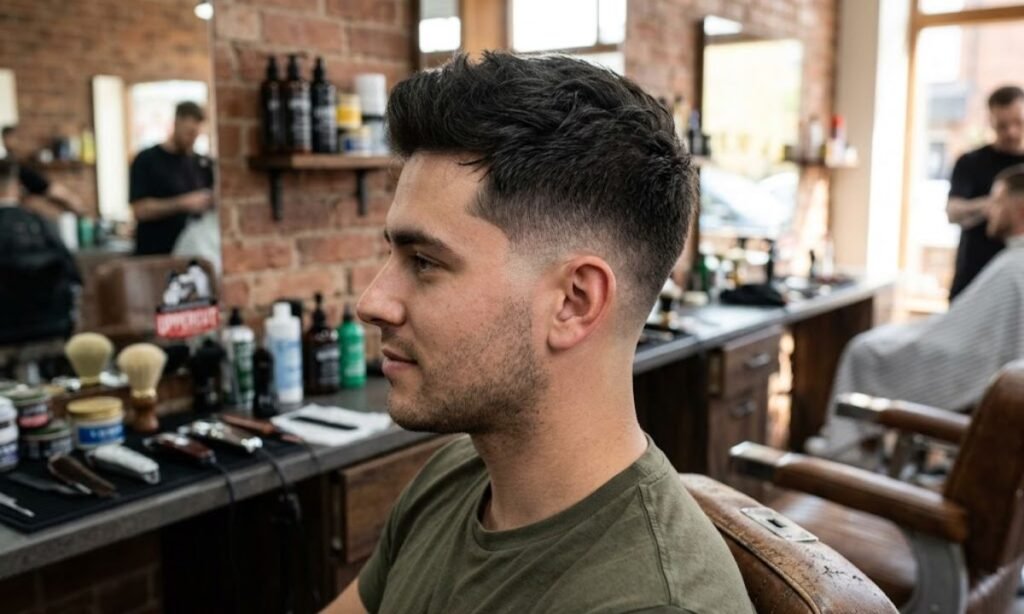
A classic taper haircut gradually shortens hair from the top down to the neckline, without necessarily changing what happens up top. Combined with slightly longer length on top styled forward, it becomes a solid forehead-friendly option.
Tapers are versatile. You can pair this with a fringe, a side part, or even a slick-back, depending on the day and the occasion.
Barbers love this cut because it ages well between appointments, and it works in nearly every professional setting without looking too plain.
If you’re still figuring out exactly which forehead-friendly style suits you long term, a simple taper gives you a neutral base to experiment with different top lengths and directions over a few appointments.
- Works for formal and casual settings
- Suits all hairline types
- A foundational cut most barbers can execute well
13. Side Part
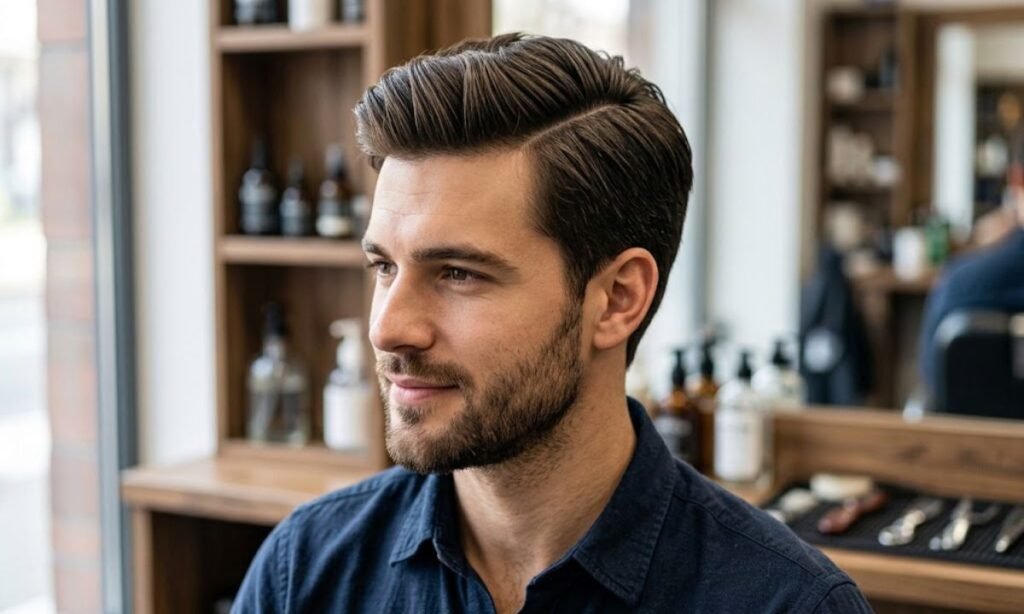
The classic side part pushes hair to one side with a defined line, giving you a polished, professional look. It doesn’t hide the forehead completely, but the diagonal line breaks up the space in a flattering way.
This is a strong pick if you want something that reads mature and put together, especially for interviews or formal events.
It’s also one of the more timeless options here, meaning you won’t feel like you’re following a trend that fades out in a year or two.
Older photos of your father or grandfather probably feature some version of this cut, and that staying power is exactly why it still shows up on every barber’s recommendation list today.
- Great with straight-back styling on off days
- Needs a comb and light hold product
- Flattering for long and oval faces
14. Deep Side Part
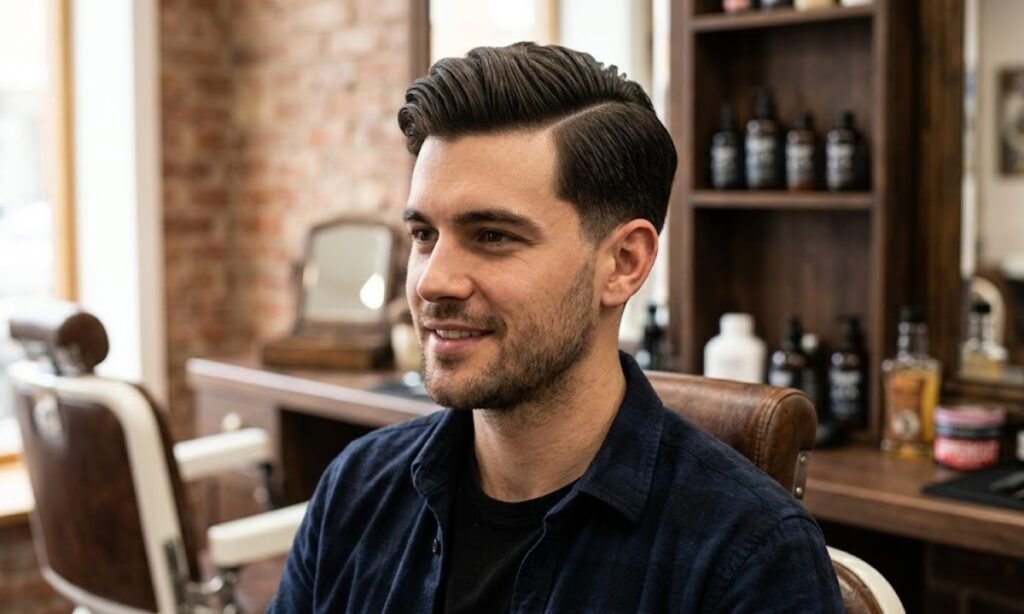
Take the side part and push the line further over for a deep side part. This creates a dramatic diagonal sweep across the forehead that adds real horizontal coverage.
The deeper the part, the more hair you’re bringing across the forehead, which is exactly what you want if your forehead exposure is on the higher end.
This style also has a sharp, dressed-up quality to it, making it a solid choice for weddings, interviews, or anywhere you want to look a step above casual.
Keep in mind this look needs a bit more daily upkeep than a standard side part, since the deeper angle tends to fall out of place faster without a strong-hold product backing it up.
- Works beautifully with thick, straight hair
- Pomade or wet-look gel keeps the part crisp
- A sharp, GQ-style option for 2026
15. Curtain Hairstyle

The curtain hairstyle parts hair down the middle and lets both sides fall forward, framing the face like, well, curtains. It’s a soft, effortless look that’s been trending hard the last few years.
Because both sides fall toward the forehead, you get natural coverage from two directions instead of one, which works especially well on a prominent forehead.
It’s a look that leans a bit more relaxed and stylish than sharp and structured, which makes it popular with a younger crowd chasing that off-duty model aesthetic.
Growing this one out takes patience, usually a few months of awkward in-between stages, but once it settles, it’s one of the lowest-effort styles to maintain day to day.
- Best on wavy or curly hair
- Curl cream enhances the natural fall
- Suits oval, square, and heart-shaped faces
16. Two-Block Cut
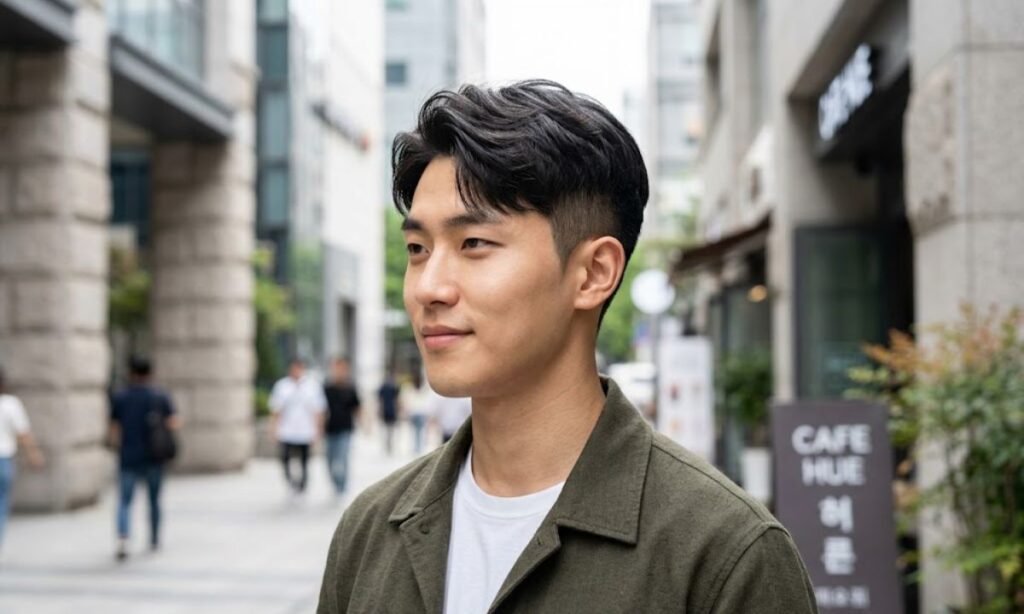
Originally a Korean style, the two-block haircut features short, faded sides with noticeably longer hair on top. That length on top gives you plenty of material to style forward for coverage.
This cut has become one of the most requested modern men’s hairstyles, and for good reason. It’s sharp, fashion-forward, and endlessly customizable.
You can restyle it half a dozen different ways depending on your mood, which makes it a favorite for guys who like variety without a new haircut every month.
It’s also become a popular choice for guys who follow international style trends, since it blends easily with Korean, Japanese, and Western grooming influences all at once.
- Great with a skin fade or low fade
- Top can be styled fringe-forward or swept back
- Works best on thick to medium hair
17. Shag Cut

The shag cut brings back 70s energy with heavy layering and a naturally undone fringe. It’s messy in the best way, and the layered structure adds real texture around the forehead.
If you like a rock-and-roll edge to your look, this is one of the more personality-packed options on the list.
It also tends to age gracefully between cuts, since the layered design already anticipates some natural growth and movement.
This cut works especially well for guys who want a large forehead to feel like part of a bigger, expressive style rather than something they’re managing around.
- Best on wavy or curly hair
- Needs regular trims to maintain shape
- Pairs well with a beard for extra balance
18. Modern Mullet

Yes, the modern mullet made the list. Short on the sides and front, longer at the back, this version keeps a soft fringe up front for coverage while the back does its own thing.
It’s a statement cut, not a safe one, but it genuinely works for guys with a large forehead who want the front fringe without a boring haircut attached to it.
The mullet has fully shed its old reputation and become a legitimate fashion pick, especially among musicians, creatives, and guys who like a bit of edge in their look.
Check your workplace culture before committing, though. This is one of the few styles on this list where the wrong environment can genuinely work against you professionally.
- Not for conservative workplaces
- Suits thick, straight, or wavy hair
- A strong pick if you like standing out
19. Buzz Cut

Here’s the twist. A buzz cut actually works for some guys with a large forehead, especially when the hairline type is even and the head shape is proportional. Instead of hiding the forehead, this style owns it completely.
Confidence does a lot of the work here. A buzz cut removes all distraction, so the forehead becomes part of a clean, symmetrical look rather than a standalone feature.
This is also the lowest-maintenance style on the entire list, which matters if you’re the type who’d rather spend zero minutes on your hair every morning.
If you’re unsure whether your face shape can carry this look, ask your barber for a slightly longer buzz first, around a number 3 or 4, before committing to something shorter and more permanent-looking.
- Best when paired with strong facial structure
- Extremely low maintenance
- Works well for a receding hairline
20. Buzz Cut with Beard

Add a full beard to the buzz cut, and suddenly your face has two strong focal points instead of one. The beard balances visual weight at the bottom of the face, which takes attention away from forehead height up top.
This combo has become a go-to for guys who want a rugged, no-fuss look that still feels deliberate.
The beard also adds definition to the jawline, which helps the whole face read as more proportional even without touching the hairline itself.
Growing a full beard takes time, usually a few months of patchy, awkward stages, so plan the transition around a period where you’re not too worried about how it looks mid-growth.
- Great for square and oval face shapes
- Needs consistent beard maintenance
- Pairs with any short taper haircut underneath
21. Big Forehead + Straight Hair

Straight hair large forehead combos actually have an advantage. Straight strands hold a clean fringe line better than any other texture, making cuts like the French crop or Caesar cut look extra sharp.
The downside is straight hair can look flat without help. A wet-look gel or light matte cream adds just enough texture to keep the fringe from looking pasted on.
Straight hair also tends to grow out cleanly, meaning your style won’t look drastically different two or three weeks after a trim.
One thing to watch for is flyaways, especially in dry climates. A tiny amount of leave-in conditioner smoothed through the fringe before applying gel keeps static and frizz from ruining an otherwise sharp line.
- French crop, Caesar cut, and deep side part all shine here
- Blow-dry with a round brush for extra lift before styling forward
- Regular trims matter more since straight hair shows growth fast
22. Big Forehead + Wavy Hair

Wavy hair large forehead pairings are honestly some of the easiest to style. The natural bend in the hair adds movement to a fringe without much effort, which suits textured or layered fringe cuts perfectly.
Curl cream or a light sea salt spray enhances the wave pattern, giving you that effortless, second-day look barbers charge extra for.
Wavy hair also hides small styling mistakes better than straight hair does, since the natural texture already looks a bit undone by design.
Scrunching a small amount of product upward while the hair is still damp, rather than combing it flat, helps preserve the wave pattern and keeps the fringe looking natural rather than forced into a shape it doesn’t want to hold.
- Textured crop, curtain hairstyle, and shag cut all work well
- Avoid heavy gels that weigh down natural wave
- Air dry when possible to keep the texture soft
23. Big Forehead + Curly Hair
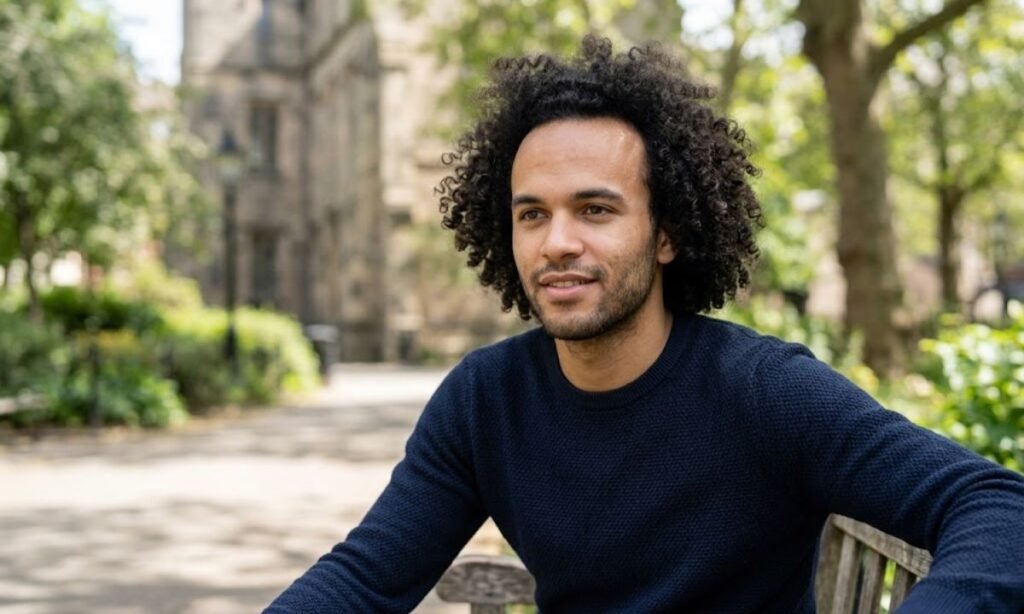
Curly hair large forehead combos need a bit more product know-how, but the payoff is worth it. Curls naturally create volume and shape, which softens the hard edges of a high hairline better than almost any other texture.
A good leave-in conditioner followed by curl cream keeps curls defined without frizz, letting the natural shape do the coverage work for you.
Curly hair also tends to shrink upward as it dries, so always judge the final length once it’s fully dry, not while it’s still wet in the chair.
Look for a barber who specifically understands curl patterns rather than one who defaults to standard scissor techniques. Cutting curly hair dry, section by section, usually gives far more predictable results than cutting it wet.
- Curtain hairstyle and shag cut are top picks
- Avoid cutting curls too short, as shrinkage changes the whole look
- Diffuse dry to keep curl pattern intact
24. Big Forehead + Receding Hairline
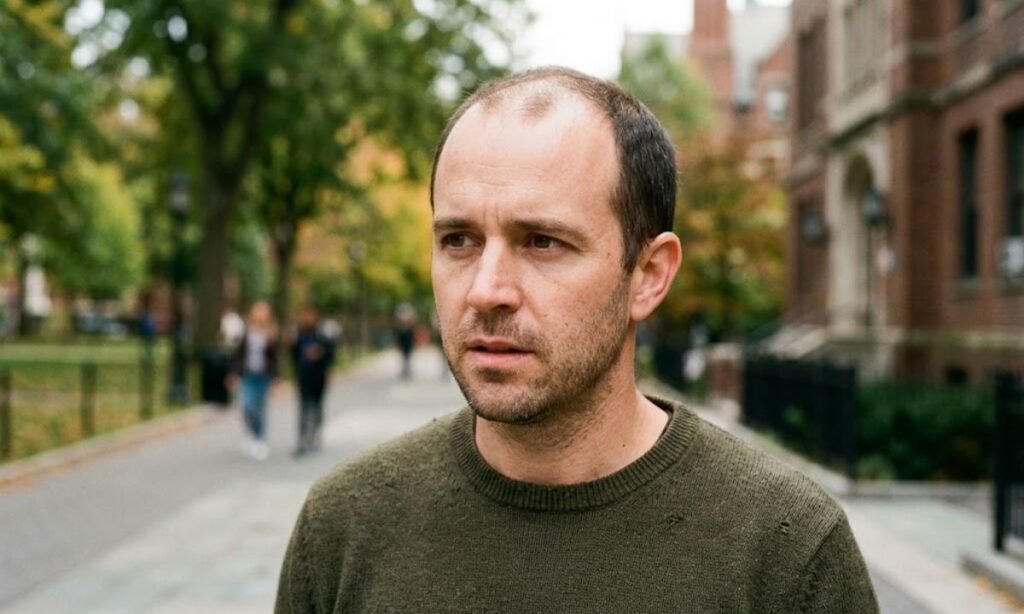
A receding hairline paired with a large forehead calls for a slightly different strategy. Instead of fighting the recession, the goal becomes creating balance elsewhere, usually through shorter overall length and strong sides.
The Caesar cut, buzz cut, and French crop all work here because they don’t rely on length that a receding hairline can’t support long term.
Trying to grow a long fringe over a receding hairline usually backfires, since thinning patches become more obvious the longer the hair grows.
It’s also worth talking to a dermatologist if the recession is progressing quickly, since certain treatments can slow things down. That’s a separate conversation from haircuts, but it’s worth knowing your options exist alongside styling choices.
- Shorter styles age better with a receding hairline
- A skin fade draws the eye away from the crown
- Beard growth can help balance overall facial proportions
25. Low Taper with Textured Fringe
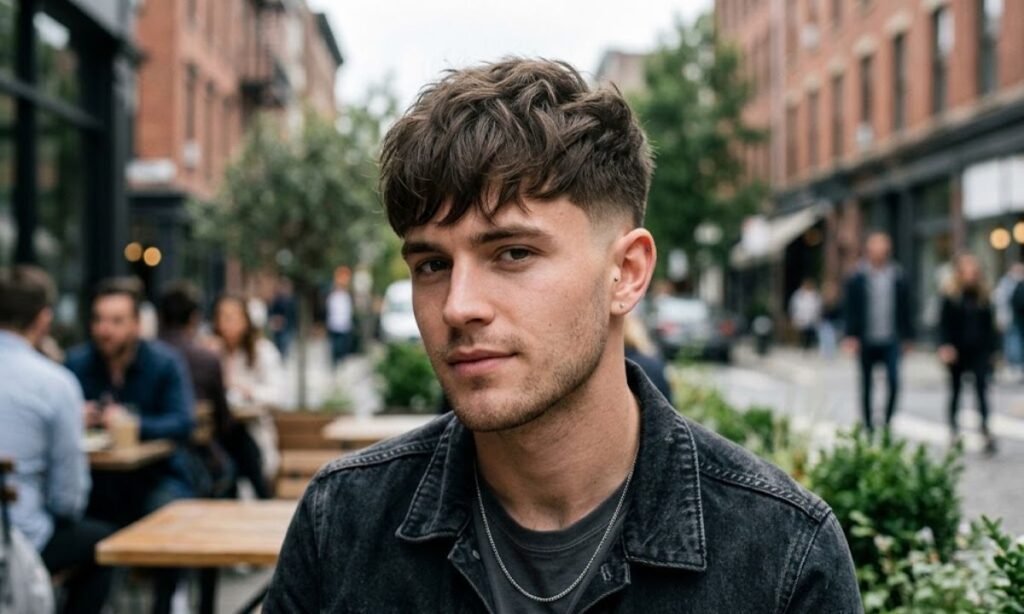
A low taper paired with a textured fringe gives you the best of both worlds, tight and clean around the ears with soft, choppy movement up top. It’s quickly become one of the most requested combinations in modern men’s hairstyles for 2026.
The low fade stays close to the skin near the hairline and ears, then blends gradually into longer length at the crown. This keeps the sides understated while all the forehead coverage work happens up top through the fringe.
Because the taper is subtle rather than sharp, this style suits guys who want something polished enough for the office but still textured enough to feel current. It’s a low-drama way to get real horizontal coverage without committing to a bold fade line.
- Great everyday option for round, oval, and square face shapes
- Works with straight, wavy, and medium-density hair
- A dab of matte clay on damp hair keeps the fringe forward without stiffness
Does Face Shape Change the Best Cut for a Large Forehead?
Yes, and this is where a lot of guys get their haircut wrong. A large forehead on a long face needs different handling than the same forehead on a round face, even though the forehead itself might be identical in size.
For a long face, you want width, not more length on top. Textured crops, two-block cuts, and side-swept fringes add horizontal bulk that shortens how long your face reads overall. Avoid adding height at the crown, since that only stretches the face even further.
For an oval face, you’ve got more flexibility since oval is already considered the most balanced shape. Curtain hairstyles, French crops, and deep side parts all work beautifully here, and there’s more room to experiment with bolder options like the mod cut.
A square face benefits from softer, textured fringes that break up strong jawline angles. Sharp, blunt fringes can actually make a square jaw look more boxy than it needs to, so texture matters more than precision here.
A round face does best with cuts that add height at the crown while keeping sides tighter, like a temple fade with forward fringe. This creates length instead of width, balancing out roundness in the cheeks and jaw. Avoid full, rounded fringes that add even more roundness to an already round shape.
A heart-shaped face, wider at the forehead and narrowing toward the chin, benefits from styles that reduce top-heavy volume, like a low-key French crop or Caesar cut. Piling on extra fringe volume here only exaggerates the width you’re already carrying up top, so lighter, closer-cropped options tend to look more balanced.
Your cheekbones and jawline matter too, not just the outline of your face. Strong, defined cheekbones can carry a bolder fringe or a fuller mod cut, while softer facial features usually look better with lighter, textured options that don’t compete for attention.
What Should You Avoid with a Large Forehead?
Some choices just work against you, no matter how good the haircut is otherwise. Slicking all your hair straight back with no fringe or horizontal coverage puts your forehead height on full display, which isn’t always the flattering choice it looks like in movies.
Very short buzz cuts without strong facial structure to back them up can also emphasize a prominent forehead rather than balance it. If your jawline and cheekbones aren’t particularly defined, going ultra short everywhere removes any competing focal point.
Skip center parts that split hair too evenly, especially if you already have a rounded hairline or widow’s peak. This style draws a straight vertical line right up the middle of your forehead, which is the opposite of what you want.
Avoid over-gelling any fringe style into a hard, shiny helmet. It looks dated fast, and it removes the natural texture that makes forward-styled cuts look effortless rather than forced.
Lastly, don’t ignore hair maintenance. Even the best forehead-friendly cut looks messy and loses its shape without regular trims. Aim for every 4 to 6 weeks depending on how fast your hair grows.
One more thing worth avoiding is picking a style purely off a celebrity photo without checking their hairline type against your own. Two guys can share the same haircut name and end up with completely different results simply because their starting hairline shape wasn’t the same to begin with.
How Should You Talk to Your Barber About This?
Walking into a barbershop without the right words can lead to a cut that misses the mark entirely. Bring a reference photo, sure, but also explain what you’re solving for. Say something like, “I’ve got a high hairline, and I want more forehead coverage without it looking like I’m hiding something.”
Good barbers appreciate specifics. Mention your hairline type, whether it’s straight, rounded, or showing early signs of an M-shaped hairline. This helps them plan the cut around your actual head shape instead of guessing.
It also helps to mention your daily routine honestly. If you know you won’t style your hair every morning, say so. A barber can cut a style that looks great with minimal effort, but only if they know that’s what you actually need.
Ask about maintenance too. A style that looks great on day one but falls apart without daily styling isn’t worth it if you’re not the type to spend ten minutes in front of a mirror every morning.
What Products Actually Help with Forehead-Friendly Styles?
Product choice makes or breaks a forehead-coverage haircut. Matte clay gives strong hold with zero shine, perfect for textured fringes and crops that need to stay forward all day.
Sea salt spray works best on wavy and curly textures, adding grit and definition without weighing hair down. It’s the go-to for messy, tousled looks that still need to hold their shape.
Wet-look gel suits straighter hair and sharper styles like the deep side part or French crop, giving a glossy, defined finish. Curl cream and leave-in conditioner are essential if you’re working with natural curl or wave, keeping frizz down while letting texture shine.
A blow dryer with a nozzle attachment can also change the game entirely. Directing warm air downward while brushing hair forward trains it to sit closer to the forehead over time, rather than fighting its natural direction every morning.
Whatever you choose, apply product to damp, not soaking wet, hair for the best control over forward movement and overall shape. Too much product on fully dry hair usually just sits on top instead of working through the strands properly.
How Often Should You Get a Haircut for These Styles?
Most forehead coverage hairstyles need a trim every 4 to 5 weeks to keep their shape. Fades and tapers grow out faster than the top length, so the contrast that creates hairline contrast starts to soften after about three weeks.
If you’re working with a fringe-heavy style, keep an eye on fringe length specifically. Once it passes your eyebrows, it stops looking styled and starts looking like it’s just growing out unintentionally.
Guys with a receding hairline should actually stick to shorter maintenance windows, since shorter overall styles show growth and unevenness faster than longer, layered cuts.
Setting a recurring reminder on your phone genuinely helps. Most guys don’t forget on purpose, they just lose track of the weeks, and a five-second nudge keeps the whole style looking sharp year-round.
Quick Comparison: Coverage Level by Style
Not every style on this list offers the same amount of forehead coverage, and knowing the difference helps you set realistic expectations before you sit in the chair.
High coverage styles include the textured fringe, mod cut, curtain hairstyle, and layered fringe. These bring the most hair forward and work best for a genuinely prominent forehead.
Medium coverage styles include the French crop, side-swept fringe, temple fade with forward fringe, and two-block cut. These soften the forehead without fully covering it, striking a balance between style and subtlety.
Low coverage styles include the Caesar cut, crew cut, side part, and buzz cut. These don’t hide much, but they use fade lines, structure, or confidence to shift attention elsewhere on the face.
Does Age Change Which Style Works Best?
Age matters more than people expect here, mostly because hairlines shift over time. A style that worked at 22 might not work the same way at 40, especially if a thinning hairline has crept in gradually.
Younger guys generally have more room to experiment with bold options like the modern mullet, mod cut, or shag cut, since hair density tends to be higher and the hairline hasn’t shifted much yet.
Guys in their late 30s and beyond often get better results from cleaner, shorter styles like the French crop, Caesar cut, or a well-maintained taper. These age well, require less daily effort, and adapt easily if the hairline continues to change.
There’s no rule saying older guys can’t wear bold styles, or younger guys need to play it safe. It really comes down to your current hair density, your hairline type, and honestly, how much time you want to spend styling each morning.
It also helps to reassess your style every couple of years rather than sticking with the same cut out of habit. Hair changes gradually, and a haircut that was perfect five years ago might not be doing your current hairline any favors today, even if it still feels familiar.
Best Styles by Where You’re Wearing Them
Context matters more than most guys realize when picking a forehead coverage hairstyle. A cut that looks sharp at a wedding might feel out of place in a corporate office, and something perfect for a night out could read as too casual for a client meeting.
For office and corporate settings, stick with the French crop, Caesar cut, taper haircut, or a classic side part. These styles offer enough forehead coverage to soften a prominent forehead while still looking buttoned-up and professional. Nobody in a boardroom is going to question a well-groomed side part.
For casual, everyday wear, the messy fringe, textured crop, or curtain hairstyle give you effortless coverage without looking like you tried too hard. These are the styles you throw on with a hoodie and still look put together.
For formal events like weddings or big interviews, the deep side part and temple fade with forward fringe strike a sharp, dressed-up balance. Both offer strong hairline contrast and read as intentional rather than thrown together.
For gym and active lifestyles, shorter options like the crew cut, buzz cut, or two-block cut make the most sense. Sweat and constant movement don’t play well with longer fringes that need regular restyling throughout the day.
For creative industries like design, music, or marketing, there’s usually more room to experiment with bolder choices like the modern mullet, shag cut, or mod cut. Workplaces in these fields tend to value personal style as part of the overall brand, so a distinctive haircut can actually work in your favor rather than against it.
Common Mistakes Guys Make When Styling a Large Forehead
The single biggest mistake is chasing a haircut because it looked good on someone else, without checking if it actually suits a large forehead or matching hairline type. What works on a guy with a low, straight hairline can look completely different on someone with an M-shaped hairline or high temples.
Another common misstep is over-styling. Piling on matte clay or wet-look gel until the fringe looks stiff and unnatural actually draws more attention to the forehead, not less. Product should support the style, not become the style itself.
Skipping regular trims ranks high on this list too. A textured fringe or French crop only works when the fringe length stays where it’s supposed to. Once it grows past a few weeks, the whole shape shifts, and the coverage that made the style work in the first place starts disappearing.
Guys also tend to underestimate how much a beard changes facial balance. Adding facial hair without adjusting the haircut can throw off proportions that used to look fine, since the added visual weight at the jaw changes how the forehead reads in comparison.
A less obvious mistake is ignoring how a haircut interacts with hats, headphones, or helmets you wear regularly. A fringe that looks perfect in the mirror can get flattened or pushed out of shape within minutes if you’re commuting with a beanie or cycling helmet every day, so it’s worth factoring your actual routine into the decision.
Lastly, plenty of guys never actually tell their barber about the specific problem they’re solving. Walking in and just saying “trim it up” leaves the barber guessing, when a simple explanation about forehead exposure or a receding hairline would lead to a much better result.
How Lighting and Camera Angles Affect Forehead Perception
Here’s something barbers rarely mention but photographers know well. Overhead lighting, the kind common in offices and most indoor settings, casts a shadow that emphasizes forehead height far more than natural daylight does. If your forehead looks larger in certain photos than it does in the mirror, lighting is often the real culprit.
Front-facing camera angles, especially from phones held slightly below eye level, also stretch the appearance of the upper face. This is why so many guys feel like their forehead “looks huge” in selfies but seems totally normal in person.
A style with strong forward-styled coverage, like a textured fringe or curtain hairstyle, holds up better under harsh lighting because it physically reduces the amount of exposed forehead, regardless of the angle. Slicked-back styles, on the other hand, tend to look their worst under exactly this kind of lighting.
If photos matter to you professionally, say for LinkedIn or work headshots, it’s worth testing your chosen style under a few different lighting setups before committing long term. What looks great in the barber’s mirror doesn’t always translate the same way on camera.
Video calls add another layer to this. Webcams typically sit below eye level and use flat, front-facing light, which is roughly the worst possible combination for minimizing a prominent forehead. Angling your camera slightly higher and adding a soft light source in front of you, rather than overhead, makes a noticeable difference during meetings.
Real Talk: When to Just Own It
Not every guy with a large forehead needs to spend energy covering it up. Plenty of well-known, confident men wear their forehead completely exposed and look sharp doing it. A buzz cut, especially paired with strong cheekbones or a defined jawline, can turn a forehead from something you’re minimizing into just another feature of a strong overall look.
Confidence genuinely changes how people perceive proportions. A guy who owns his haircut, whatever it is, tends to read as more put-together than someone constantly adjusting a fringe out of self-consciousness. If shorter styles fit your lifestyle better, there’s a real case for skipping the coverage strategy entirely.
That said, if you’d simply prefer more balance in your facial proportions, there’s nothing wrong with that either. Choosing a style for how it makes you feel, not just how it measures up on paper, is honestly the most important factor in this whole decision.
Think about it this way. Nobody walks around measuring strangers’ brow-to-hairline distance in real life. People notice confidence, grooming, and how well a haircut suits the rest of your look, not a single isolated feature. Whichever direction you choose, covering it or owning it, commit to it fully and it’ll read as intentional either way.
Finding a Barber Who Actually Understands This
Not every barbershop specializes in forehead-conscious cutting, and that’s fine, but it helps to know how to spot one that does. Look through a shop’s portfolio, whether that’s an Instagram page or photos on the wall, for examples of fringes, crops, or textured cuts specifically. A shop that mostly shows buzz cuts and basic fades might not have the scissor-over-comb skill needed for a precise textured fringe or layered fringe.
Ask a straightforward question during your consultation: “Do you do a lot of forward-styled fringes here?” A barber who immediately understands what you mean and starts asking about your hairline type is a good sign. One who looks confused or just shrugs probably isn’t the right fit for this specific request, even if they’re skilled at other cuts.
Word of mouth still works better than review scores for this particular need. Ask friends or coworkers with similar hair types and forehead sizes who cuts their hair, since a personal recommendation usually reflects real, repeated results rather than a single good visit.
Don’t be afraid to switch barbers if the first attempt doesn’t land. Hair grows back, and a slightly awkward month or two is a small price for finding someone who consistently nails the look you’re after going forward.
At-Home Touch-Ups Between Barber Visits
Even the best haircut needs a bit of upkeep between professional visits, especially for forehead coverage hairstyles that rely on precise fringe length. A small pair of thinning shears, used sparingly on just the very front pieces, can knock a few stray millimeters off an overgrown fringe without ruining the overall shape.
Trimming your own neckline and sideburns between fade appointments also helps the whole cut look fresher for longer. A cheap trimmer with a guard attachment handles this easily, and it’s a skill worth learning if you’re getting cuts every 4 to 5 weeks anyway.
Dry shampoo isn’t just for women’s hair care. A light dusting at the roots on day two or three absorbs oil and adds texture back into a fringe that’s started falling flat, buying you extra days before it looks like it needs a wash.
If your fringe starts falling into your eyes uncomfortably before your next appointment, a bobby pin tucked underneath the hair, not visible from the front, can hold things back temporarily without committing to a different style altogether.
How to Test a Style Before Fully Committing
Not every haircut needs to be a leap of faith. There are a few low-risk ways to preview a forehead coverage hairstyle before you actually sit in the barber’s chair and commit to it long term.
Start with your current hair, even if it’s not styled the way you want yet. Wet it down, push it forward with your fingers, and see roughly how much coverage you’d get from a fringe at your current length. This won’t be perfect, but it gives you a rough sense of whether a fringe-heavy style like the textured fringe or curtain hairstyle would actually suit your hairline type.
Apps that let you overlay different haircuts on a photo of your own face can help too, though take the results with a grain of salt. These tools are decent for general shape and length but rarely capture texture, hair density, or how a skin fade actually blends into your specific head shape.
The most reliable test, honestly, is asking your barber for a slightly conservative version first. If you’re considering the mod cut but you’re nervous about the bold fringe, ask for it slightly shorter and less structured on the first visit. You can always go bolder at your next appointment once you’ve seen how it looks and feels day to day.
Seasonal Considerations for Forehead-Friendly Styles
Weather changes how any haircut behaves, and forehead-focused styles are no exception. Humid summer months tend to add unwanted volume and frizz to fringes, especially on wavy hair or curly hair, which can push a carefully styled look into something messier than intended.
During humid seasons, lighter products like sea salt spray or a light curl cream tend to perform better than heavy, waxy pomades, which can feel greasy and clog under sweat. A quick blast of cool air from the blow dryer after styling also helps lock the shape in place before you head out the door.
Cold, dry winter air brings the opposite problem: static and flyaways. A small amount of leave-in conditioner worked through dry hair before styling helps tame this, especially for guys with straight hair or fine hair who notice individual strands lifting and separating in colder months.
If you’re someone who swims regularly, whether for fitness or just enjoying summer, chlorine and salt water can dry hair out fast, making fringes harder to control. Rinsing hair with fresh water immediately after swimming and applying a leave-in product afterward keeps the hair texture manageable enough to style properly once it’s dry.
FAQs
Does hair length affect how big a forehead looks?
Yes, quite a bit actually. Longer hair on top, especially when styled forward, physically covers more of the forehead and softens the brow-to-hairline distance. Very short cuts remove that coverage entirely, which is why buzz cuts only work well on guys with strong, balanced facial structure to compensate.
Do glasses change which haircut works best?
They can. Thick, dark frames draw attention to the eyes and brows, which can actually balance a large forehead nicely alongside a textured fringe or side-swept style. Thin, minimal frames don’t offer as much visual weight, so the haircut needs to do more of the balancing work on its own.
Does hair type matter more than the haircut itself?
Honestly, they work together. A great cut on the wrong hair type still won’t behave the way you want. Curly hair needs different product and cutting techniques than straight hair, even for the exact same style name. Always factor in your natural hair texture before picking a cut off a list, including this one.
Can hair color or highlights help disguise a large forehead?
A little, yes. Subtle highlights around the front hairline can create the illusion of softer, less defined edges, drawing less attention to the hairline contrast between skin and hair. It’s a smaller tweak, but combined with the right cut, it can make a noticeable difference in photos.
Is a “big head” the same thing as a large forehead?
No, and this trips people up a lot. A large forehead is about the vertical space between your brows and hairline. A “big head” usually refers to overall head circumference or size relative to your body. You can absolutely have a large forehead on a proportionally sized head, or a smaller forehead on a larger head. They’re related but separate measurements.
Will a hair transplant change which hairstyle works for me?
It can, over time. A transplant that lowers your hairline gradually reduces your forehead exposure, which opens up styles that weren’t previously realistic, like a fuller fringe or curtain hairstyle. Most surgeons recommend keeping hair on the shorter side for several months post-procedure anyway, so this is more of a long-term consideration than an immediate one.
Should I trust online face shape calculators before choosing a cut?
Use them as a rough starting point, not a final answer. Most calculators only look at outline and proportions from a single photo angle, missing details like your hairline type, hair texture, or how your features sit in profile. A real conversation with an experienced barber, ideally in person, will always give you more accurate direction than an app.
How long does it take to get used to a new forehead-friendly style?
Give it about two to three weeks. The first few days after a fresh cut often feel unfamiliar simply because you’re not used to seeing your face framed differently. Most guys report that once they’ve styled it themselves a handful of times, it starts feeling completely natural, and going back to their old look would feel strange instead.
Is it expensive to maintain these styles long term?
Not really, once you find your routine. Most forehead coverage hairstyles need one product, a matte clay, a sea salt spray, or a curl cream depending on your hair texture, and a haircut every 4 to 6 weeks. A small tube or jar of product typically lasts two to three months with daily use, so the ongoing cost is closer to a regular haircut budget than a full grooming overhaul.
Can these hairstyles work if I have thinning hair overall, not just at the hairline?
Yes, though the strategy shifts slightly. General thinning across the top calls for shorter styles that don’t rely on volume to hold their shape, like the Caesar cut, crew cut, or a clean taper haircut. Longer, fuller fringes can actually highlight thin spots rather than hide them, so keeping things shorter and letting a skin fade do the visual work usually gives a cleaner result.
Final Thoughts
A large forehead isn’t something to fix. It’s something to style around, the same way you’d style around a strong jaw or a particular curl pattern. The 24 cuts above give you real, barber-tested options across every hair texture, hairline type, and face shape combination out there.
Bring this list to your next barbershop visit, be specific about what you want, and don’t be afraid to try a few styles before landing on your favorite. Most guys need at least one adjustment appointment before a new style truly fits how they actually live day to day.
Men’s grooming in 2026 is all about working with what you’ve got, not against it, and a great haircut is one of the easiest ways to do exactly that. Pick a style from this list, have the conversation with your barber, and give it a real trial run before judging the result.
Your forehead is one feature among many that make up how you look, not the defining one. Once the right cut is in place, most guys stop thinking about it entirely and just get on with their day, which is honestly the whole point of finding a style that fits.

I’m Michael Charles, the creator of MegaCrazes—your source for fresh hairstyles, sharp haircuts, and simple hair-care inspiration. Find your style. Own your look.
1 thought on “25 Best Hairstyles for Men with Large Foreheads (2026)”