
Last updated: November 2026
Staring at your barber’s chair and wondering which cut to ask for?
You’re not alone, because most guys mix these two up.
Here’s the short version.
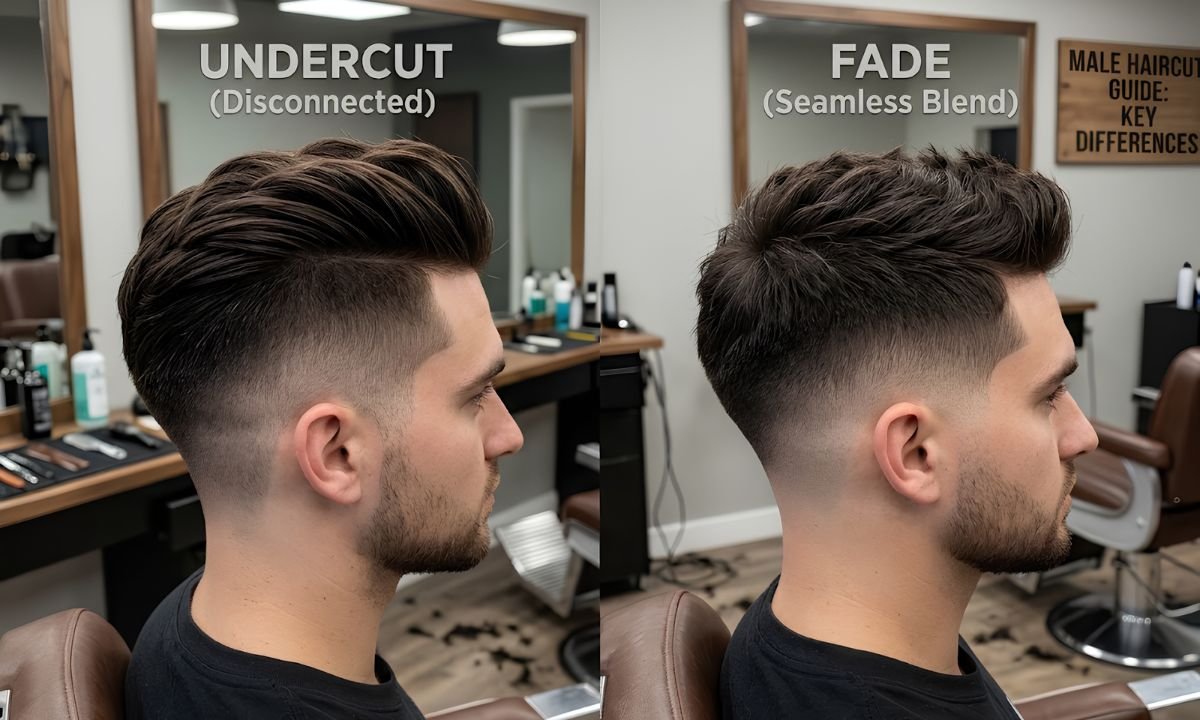
An undercut has short sides with a long top and a hard line between them.
A fade melts from short to long with no visible line at all.
Worried a fade won’t suit your hair type?
Unsure if an undercut looks too bold for the office?
This guide answers all of that in plain language.
Quick Answer
Pick an undercut if you want hard contrast and a bold, clean shape.
Pick a fade if you want a seamless blend that looks sharp and polished.
Thick or wavy hair usually loves the weight of a disconnected undercut.
Fine hair often looks fuller with a soft low fade and some root lift.
Need something for a conservative workplace?
A mid fade or connected undercut is the safer bet.
Both work for most face shapes once you adjust the top length.
Undercut vs fade: what’s the difference?

The difference comes down to one thing: the transition.
An undercut uses one-length sides and then stops, so the top section sits above a clear disconnected transition.
A fade uses graduated lengths.
The hair length shrinks bit by bit from the top length down toward the neckline, creating a fade gradient.
Think of it like stairs versus a ramp.
The undercut is the stairs, with a clear drop.
The fade is the ramp, with a smooth slide.
That’s why a side profile looks so different.
The undercut shows a defined edge near the temple and crown.
The fade shows a soft shadow climbing the back of the head.
What is an undercut haircut?

An undercut haircut is a style where the short sides sit far below a long top.
Barbers usually cut the sides with clippers and a single clipper guard, then leave the top alone.
The look took off with vintage barbershop culture and keeps coming back.
It’s easy to see why: it’s clean, it’s simple, and it works with almost any men’s hairstyle.
Most guys pick between two versions.
The first is disconnected, and the second is connected.
The next two sections break them down.
What is a disconnected undercut?
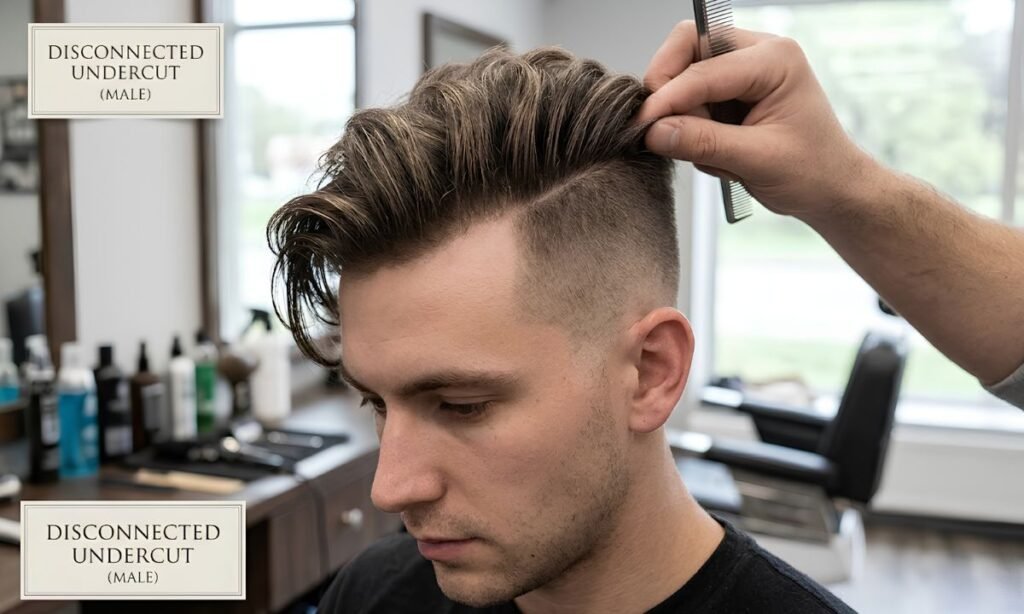
A disconnected undercut has no blending between the sides and the top.
The barber cuts the sides to one length, such as a number 2 guard (1/4 inch or 6 mm), and leaves the top much longer.
That sharp hard line is the whole point.
It creates hard contrast, so the slicked-back undercut or textured undercut really pops.
Here’s a quick example.
My friend Daniel wanted a bold look for his wedding photos.
He asked for a disconnected undercut with a long top, and the front view looked striking.
What is a connected undercut?
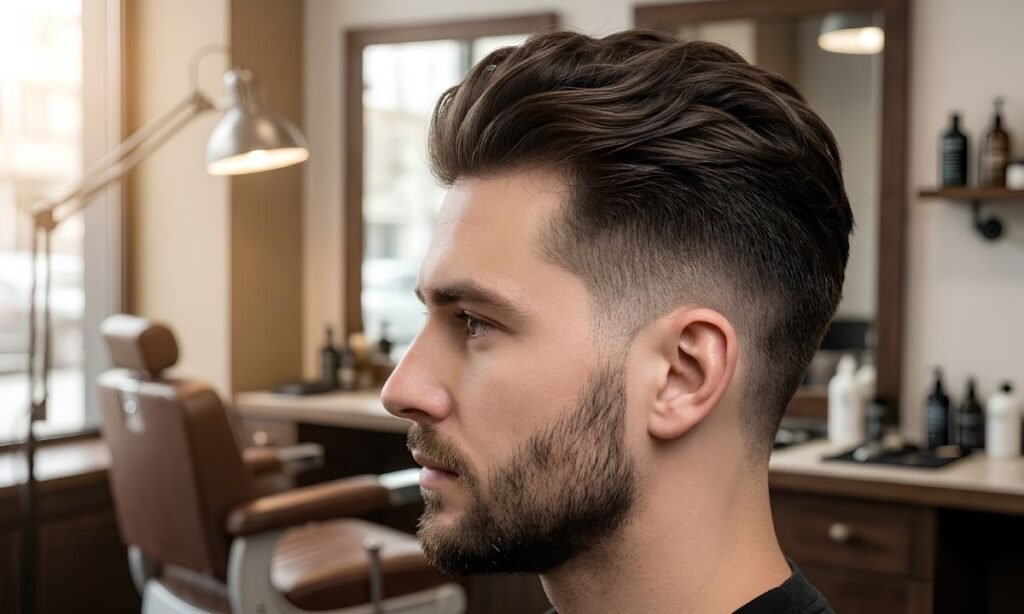
A connected undercut softens that hard line.
The barber blends the sides slightly into the top, so the disconnected transition becomes gentler.
You get the short sides and long top shape without the shock factor.
That makes it a great pick if you want a professional appearance with some edge.
Some barbers call this a faded undercut.
The sides still look short, but the blending technique hides the sudden drop.
What is a fade haircut?
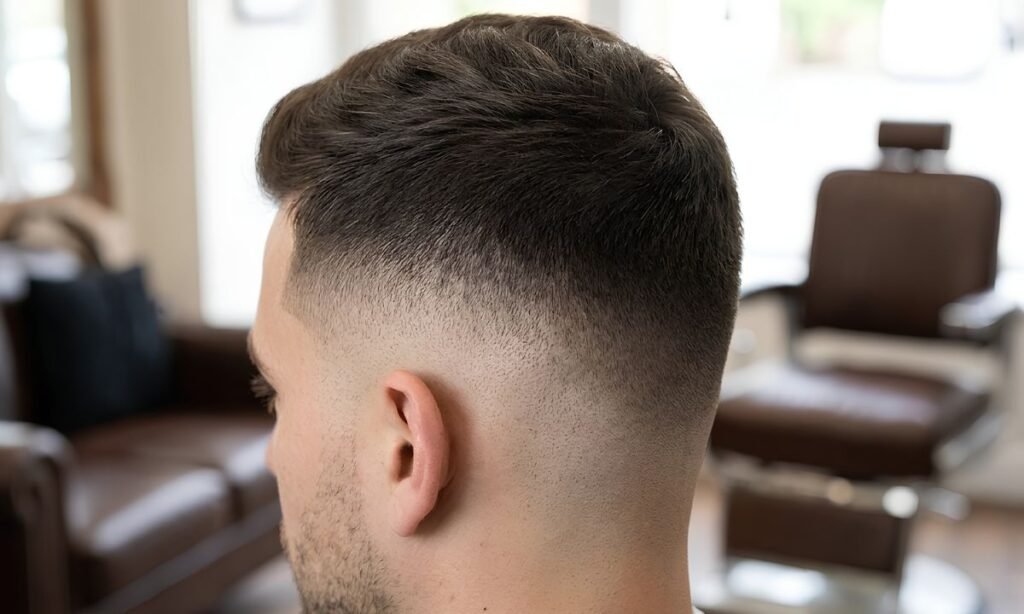
A fade haircut shrinks hair length gradually, from long at the top to very short or even bare near the bottom.
The barber uses clippers, a guide comb, and different guard sizes to build that fade gradient.
The goal is a seamless blend.
You shouldn’t see where one length stops and the next begins.
Fades are everywhere right now, from Great Clips chairs to high-end shops.
The taper fade and bald fade are two of the most requested versions.
How do low, mid, and high fades differ?
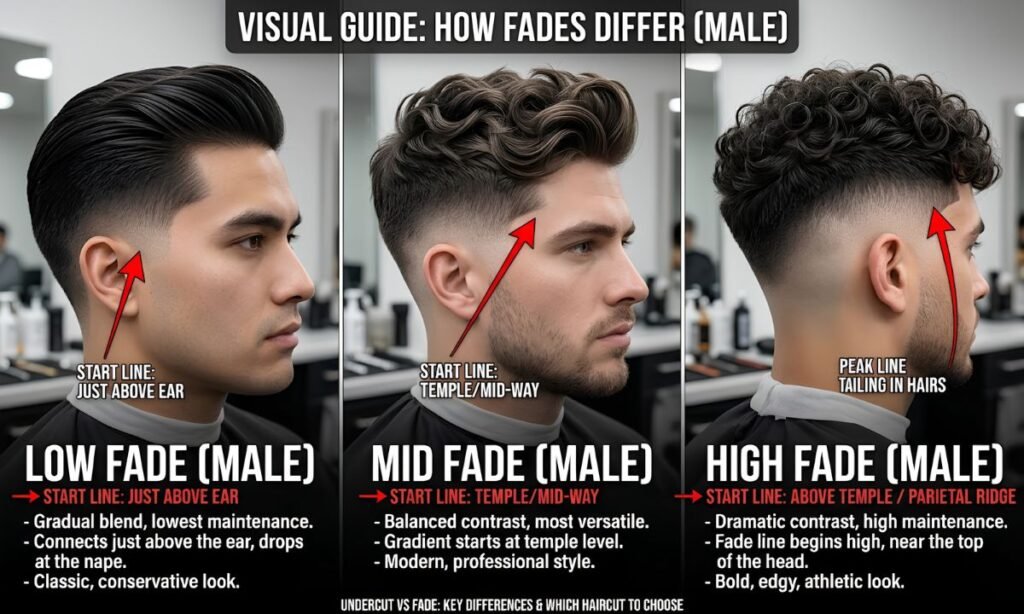
The only real difference is where the fade starts.
A low fade begins just above the ear and along the neckline.
A mid fade starts near the temple, and a high fade climbs toward the crown.
A low fade feels subtle and safe, and it works well for office jobs.
A mid fade is the all-rounder that most barbers recommend first.
A high fade gives more hard contrast and a bolder look.
It shows off your head shape more, so think twice if you’re unsure about it.
What’s the difference between a skin fade and a shadow fade?
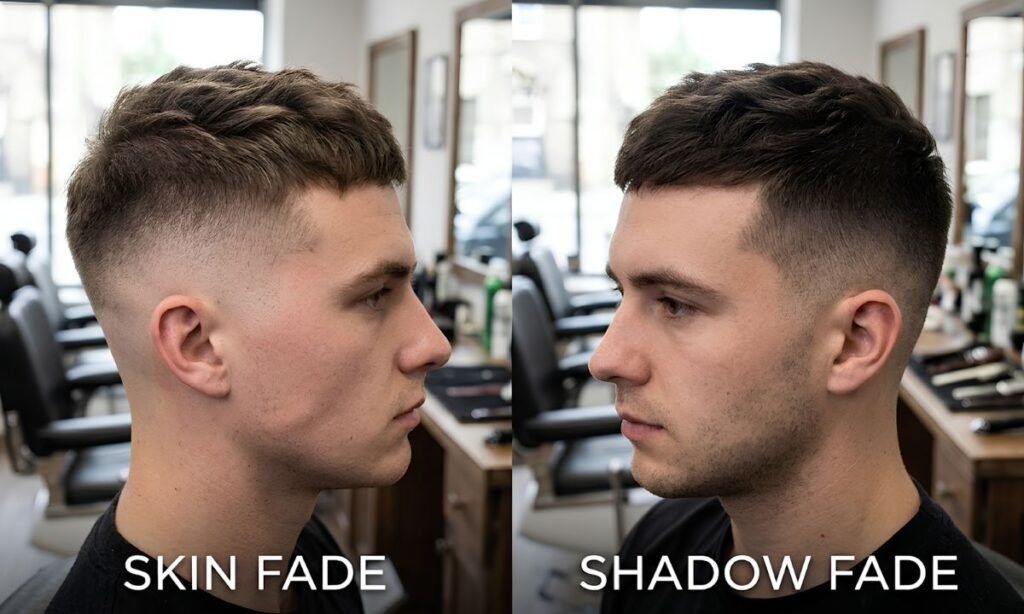
A skin fade (also called a bald fade) goes down to skin-level cut.
The barber removes everything at the bottom, so the scalp hair disappears completely.
A shadow fade stops just short of bare skin.
It leaves light stubble that creates a soft shadow effect.
If you want sharp and dramatic, go skin fade.
If you want softer and easier to live with, the shadow fade is your friend.
How Do Undercuts and Fades Differ in Barbering Techniques?
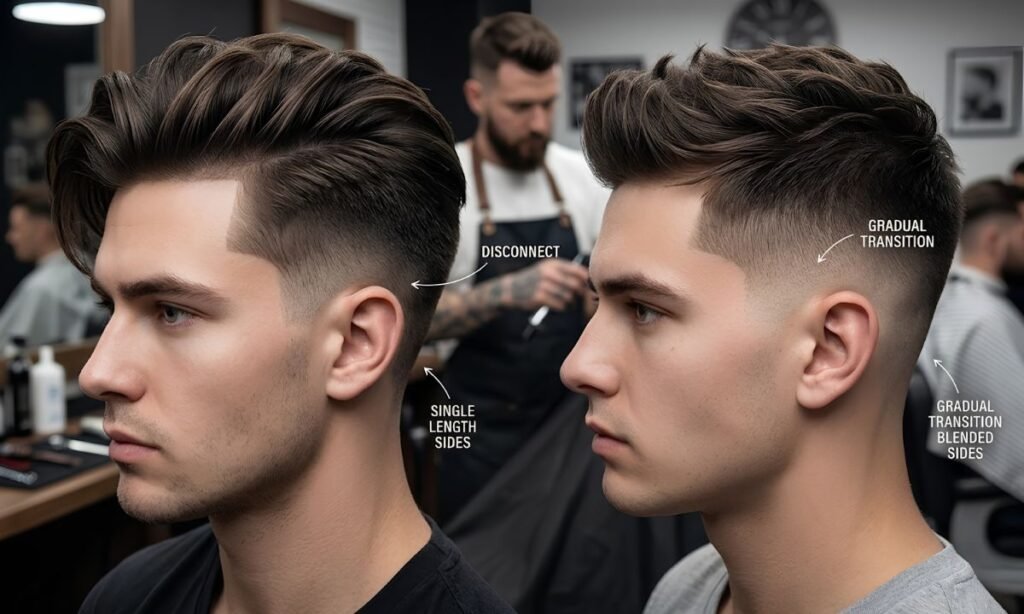
Both cuts start with clippers, but the technique changes quickly.
An undercut is faster and more mechanical, while a fade takes patience and a steady hand.
A good barber treats each one like a different recipe.
The ingredients look the same, but the method isn’t.
The next three sections explain how.
You’ll see why a fade costs more time in the chair.
How Are Clippers and Scissors Used for Each Haircut?

For an undercut, the barber often runs a Wahl clipper with one guard number across the entire side.
Then scissor-cut work on the top shapes the length and weight.
For a fade, the barber switches between several guard sizes.
They might start with a number 1 guard (1/8 inch or 3 mm) and move up to a number 3 guard (3/8 inch or 10 mm).
The clipper-over-comb technique often finishes the job.
It lets the barber fix tiny uneven spots and tidy the head rim.
Why Does Blending Matter More in a Fade?
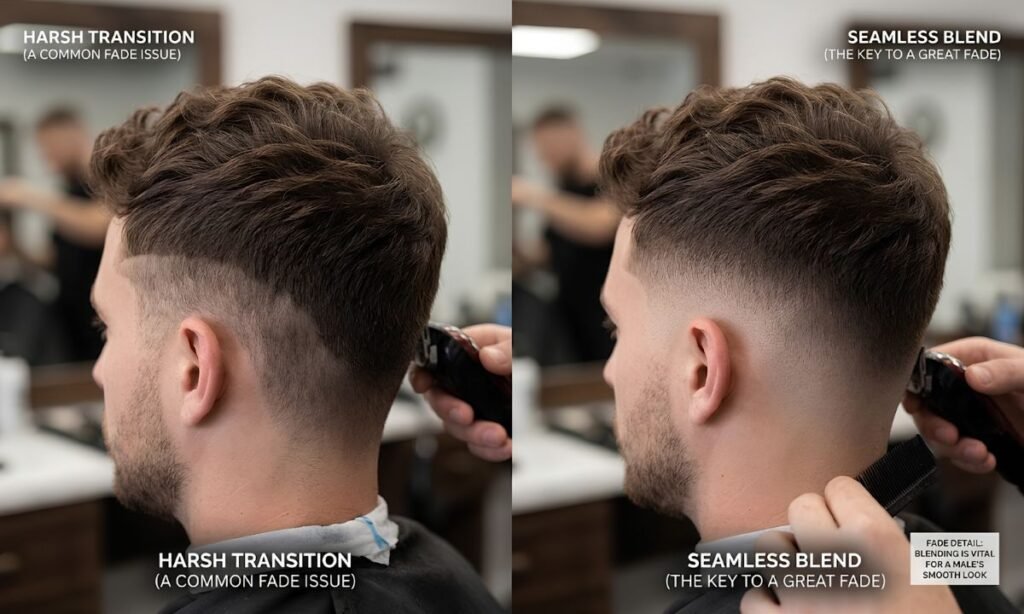
Blending is the heart of a fade.
Without it, you just have a clumsy disconnected look that doesn’t match what you asked for.
Barbers use an upward rocking motion with the clipper blade to flick away the line.
That tiny movement creates the seamless blend you see in great fades.
In an undercut, blending barely matters.
In fact, the sharp edge is the point.
How Does Hair Disconnection Change the Final Shape?
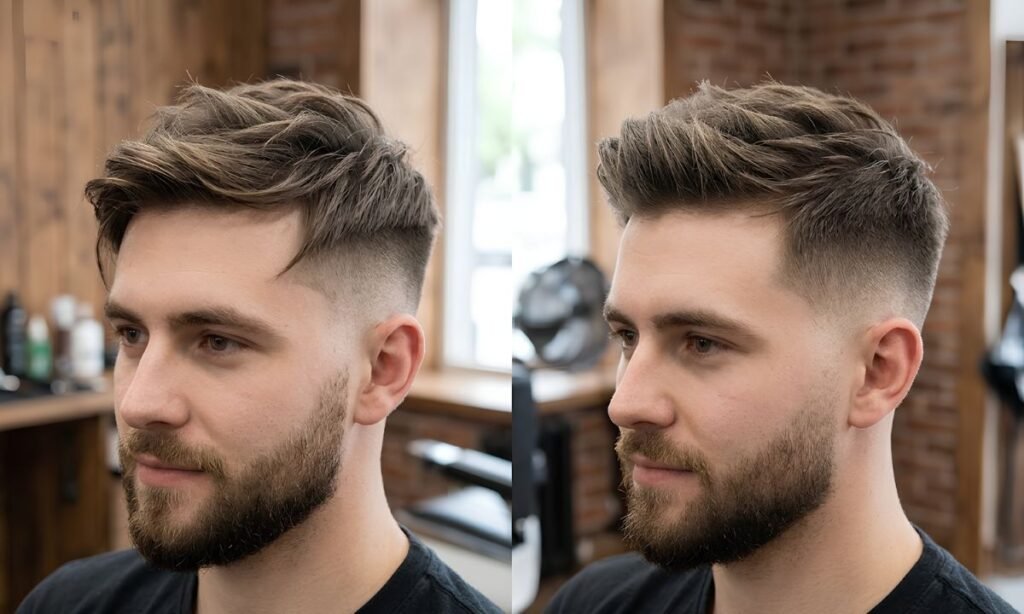
Disconnection creates a two-block cut feel.
Your head reads as two clear sections: a long top section and a short lower section.
This changes how light hits your head.
The contrast makes your hair volume look bigger and adds drama.
A fade spreads that change out.
The shape looks rounder and more natural, with a softer side profile.
Can you combine an undercut and a fade?
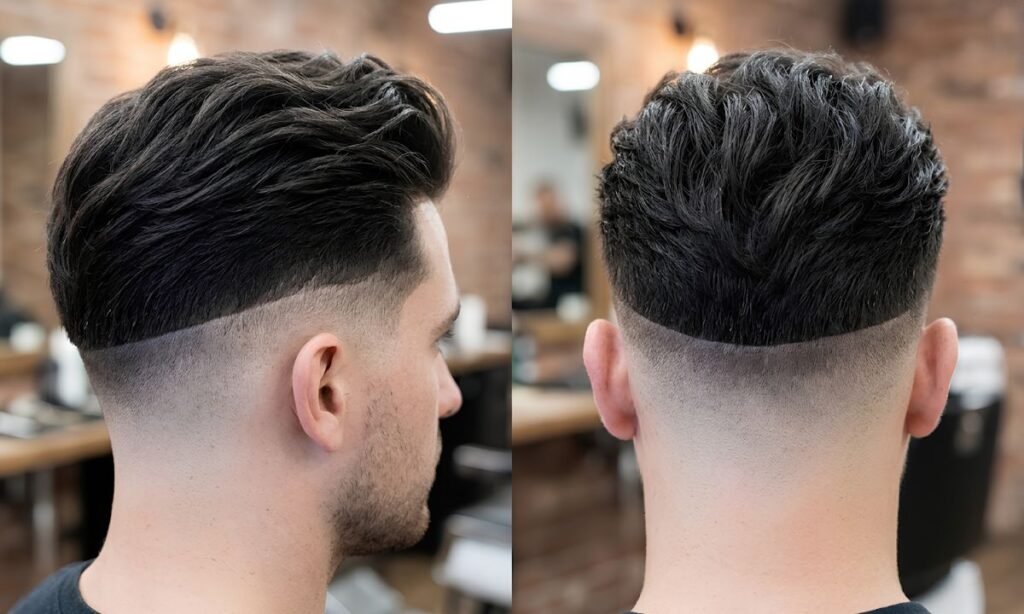
Yes, and many barbers do it daily.
The faded undercut is the hybrid, and it fits almost every taste.
The sides get a fade, such as a low fade undercut, mid fade undercut, or high fade undercut.
The top stays long and disconnected enough to keep that bold edge.
You can even push it further with a skin fade undercut or shadow fade undercut.
Just show your barber reference haircut photos so you both aim at the same result.
What Are the Most Popular Undercut and Fade Variations for Men?
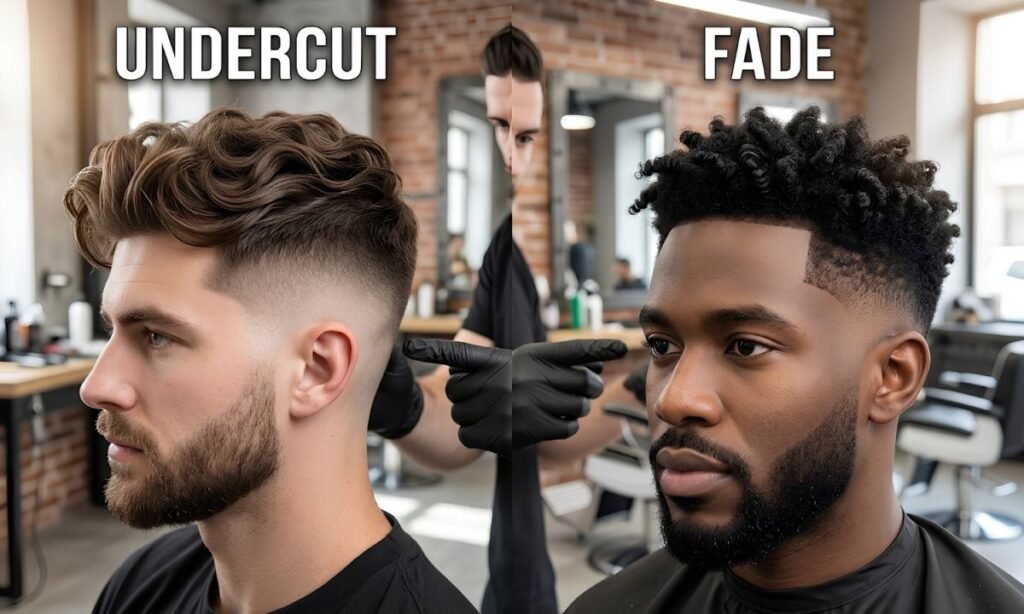
Once you know the basics, the variations get fun.
Some guys want a polished office look, while others want something louder.
Here are four popular styles that barbers cut every week.
Each one tweaks the formula in a slightly different way.
How Does an Undercut With a Hard Part Look?
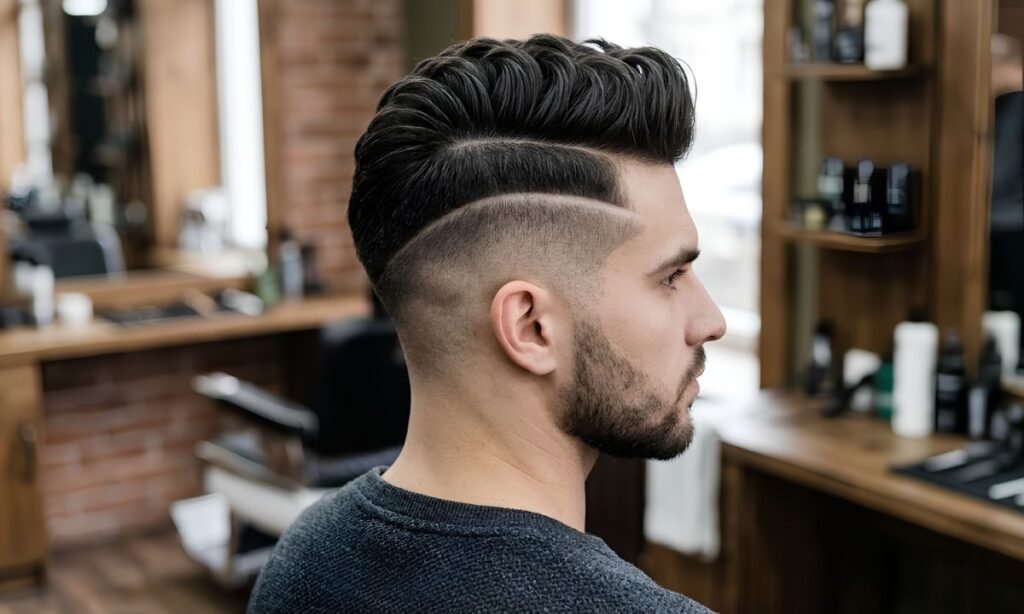
A hard part is a razor-shaved line that splits the top.
Pair it with a side-part hairstyle and the whole cut looks crisp, almost retro.
The sides stay short, so the hard line stays visible.
This style works well with water-based pomade like Suavecito for a clean hold.
It suits straight or slightly wavy hair.
Curly hair can work too, but it needs more careful shaping.
What Makes a Burst Fade Different From Other Fade Styles?
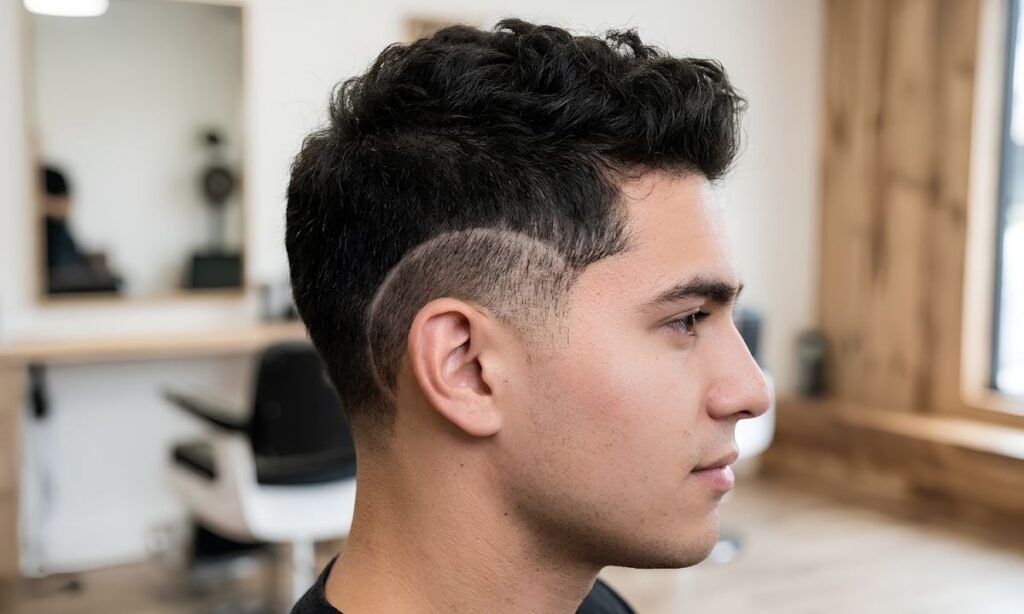
A burst fade curves around the ear in a half-circle shape.
The fade stays short around the ear and keeps length at the back.
That leaves room for a mullet, a fade mullet, or a curly top fade.
The back keeps its length while the sides stay trimmed neat.
If you like a trend-forward look, this one stands out.
It photographs well from the back view too.
How Does an Undercut With a Fringe Change Your Appearance?

A textured fringe falls forward over your forehead.
It softens the hard contrast of the undercut and adds a relaxed, youthful vibe.
It can also hide a receding hairline or high forehead.
That makes it a clever choice for guys with receding temples.
Use some hair clay or styling cream to keep the texture lively.
A fine-tooth comb helps shape the fringe before the product sets.
What Is the Difference Between a Drop Fade and a Regular Fade?
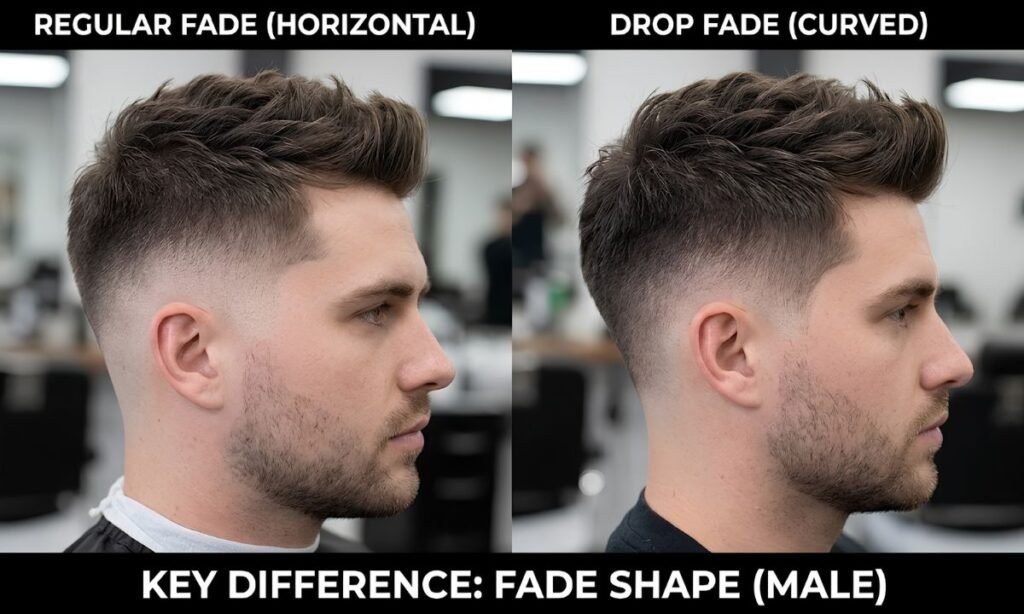
A drop fade curves down behind the ear.
The line follows the shape of your head shape instead of staying flat.
A regular fade keeps a straight horizontal path.
It looks tidy and classic, but it’s less sculpted.
The drop fade pairs nicely with the taper fade and textured top fade.
It adds subtle flair without feeling over the top.
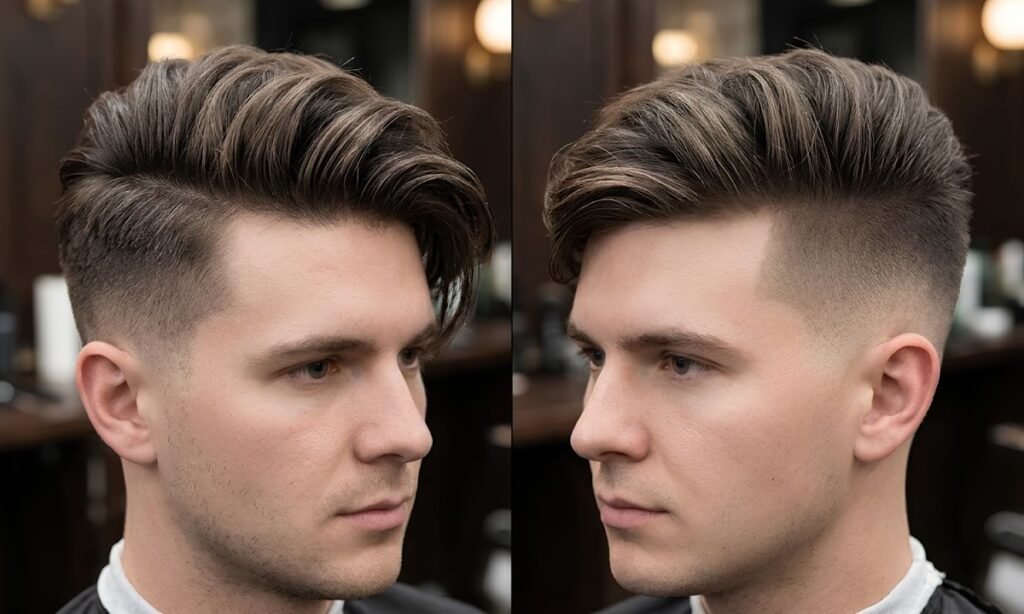
What do undercuts and fades look like side by side?
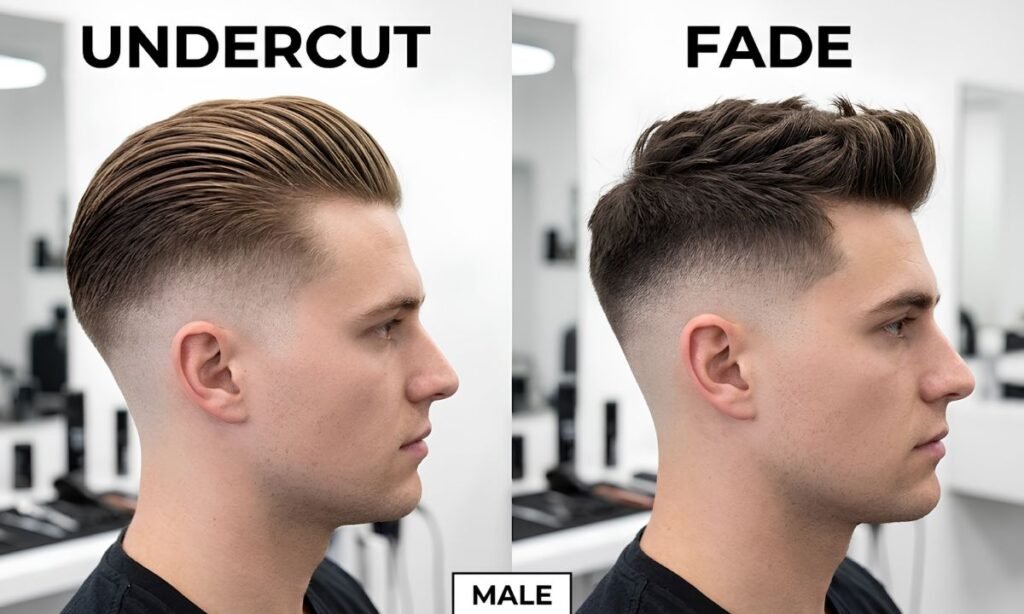
Seeing them next to each other makes the choice clearer.
The front view looks similar, but the side profile and back view tell a different story.
The undercut shows a clean block of short sides under a long top.
The fade shows a soft climb from skin to hair.
Two styling pairings show this well.
We’ll look at each one below.
Slicked-back undercut vs mid fade
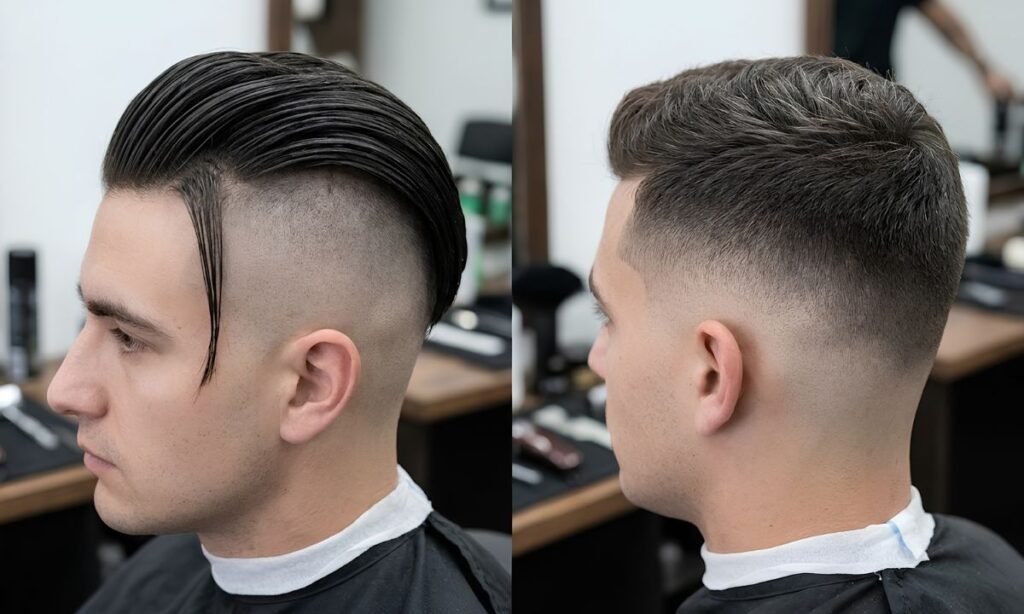
A slicked-back undercut looks bold, a bit vintage, and very sharp.
The hair sweeps back with water-based pomade, and the hard line frames the whole look.
A mid fade with a slick-back feels smoother.
The gradient flows, so the style looks modern, balanced, and a touch softer.
Choose the undercut for drama.
Choose the mid fade if you want polish without the attitude.
Textured undercut vs low fade
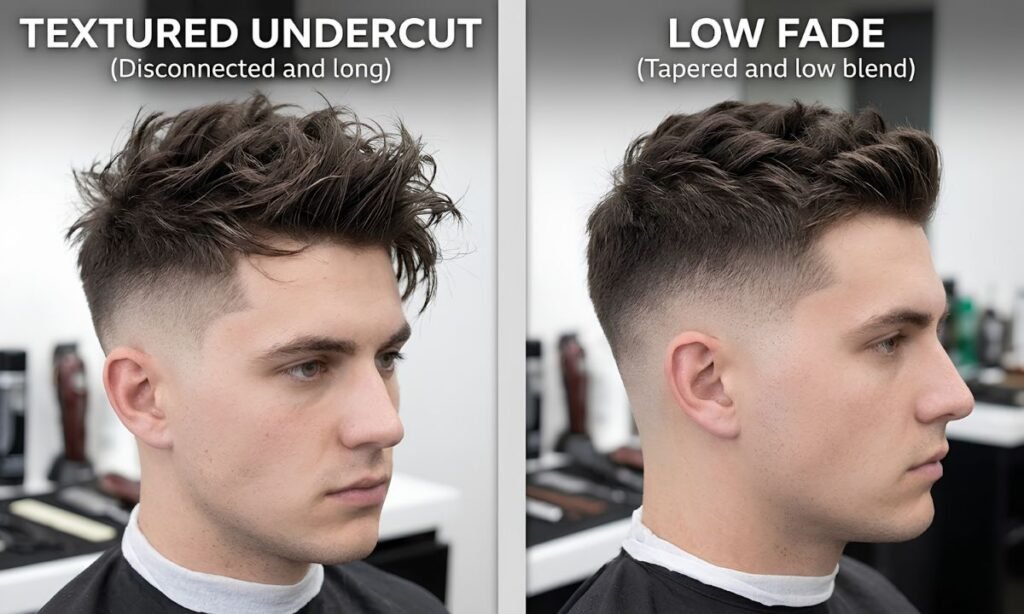
A textured undercut shows lots of movement on top.
The contrast with the short sides makes the hair texture look messy in a good way.
A low fade with texture keeps things subtle.
The top still shows personality, but the sides stay quiet and low-maintenance.
The textured undercut wins for statement looks.
The low fade wins for everyday ease.
What Hair Length Do You Need for an Undercut or Fade?
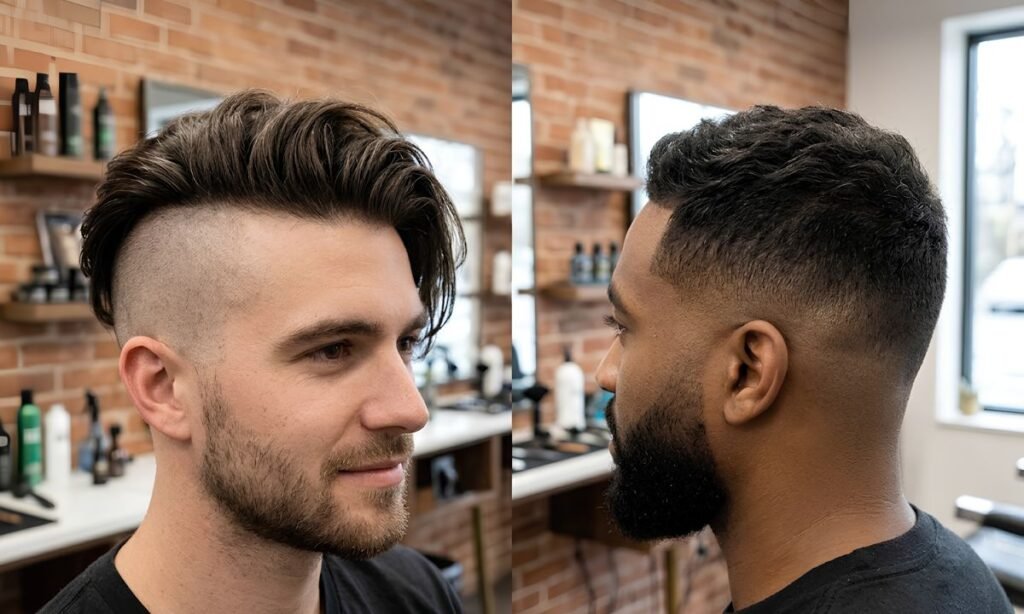
Length matters more than people think.
You can’t build an undercut from a buzz cut, and a fade needs some room to blend.
Your hair growth rate matters too.
Hair grows roughly half an inch a month, so patience pays off if you’re starting short.
Let’s look at how much length you need for each cut.
These numbers help you plan before your barber appointment.
How Long Should the Top Be for an Undercut?
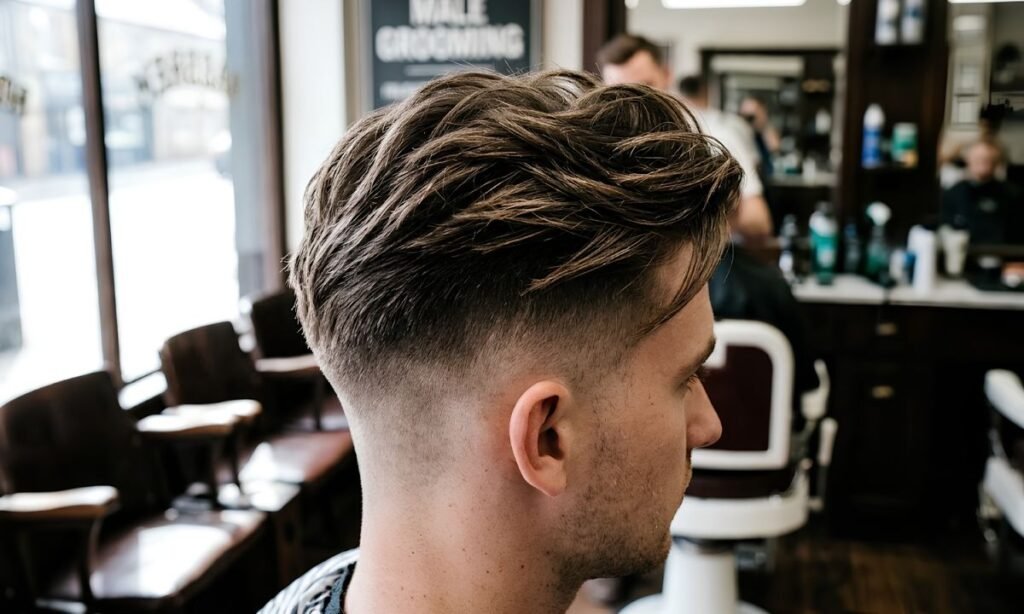
A good undercut needs at least 2 to 3 inches on top.
Less than that, and the contrast with the sides looks weak.
For a slick-back hairstyle, aim for 3 to 4 inches.
For a textured fringe, closer to 3 inches usually works well.
Longer lengths allow a man bun or top knot too.
That gives you even more styling choices.
Can You Get a Fade With Very Short Hair?
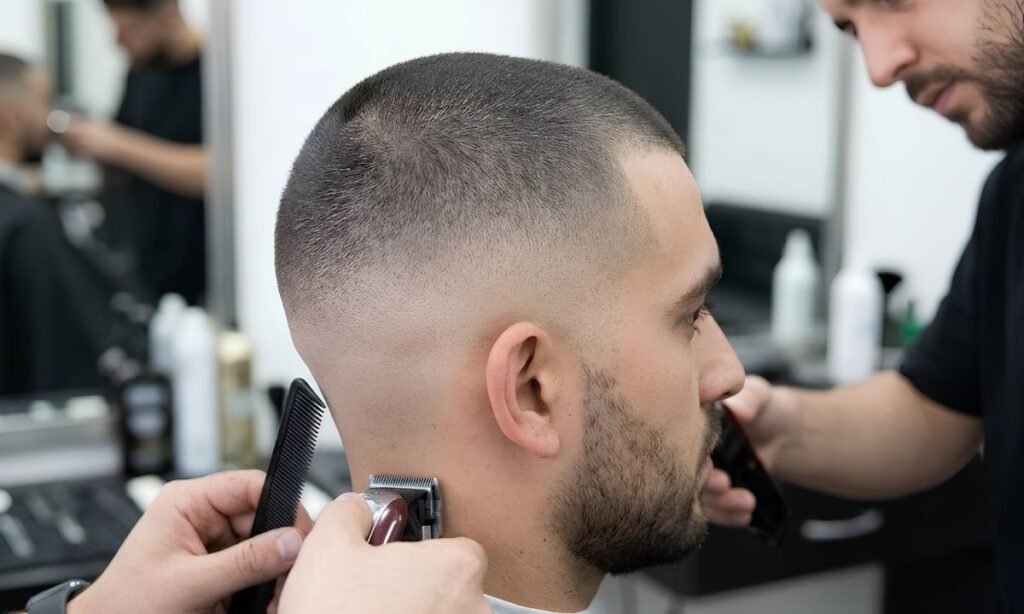
Yes, a short fade works with very little length.
The barber can fade from a number 3 guard (3/8 inch or 10 mm) down to skin.
If your top is only an inch long, you can still wear a bald fade with a classic taper.
A flat top also works well when the sides are short and the top stays crisp.
There’s also the long-top fade for guys who prefer more length.
That style keeps the top longer while the sides stay blended.
Does Hair Length Change the Final Look of Each Cut?

It really does.
Long top length makes an undercut dramatic, while shorter lengths make it look more like a two-block cut.
In a fade, extra top length adds a classic side-part hairstyle or slick-back option.
Shorter top length gives a cleaner, sportier shape.
Talk to your barber about both top length and side length.
That conversation shapes the final result more than any photo.
Which cut works best with your hair texture and density?
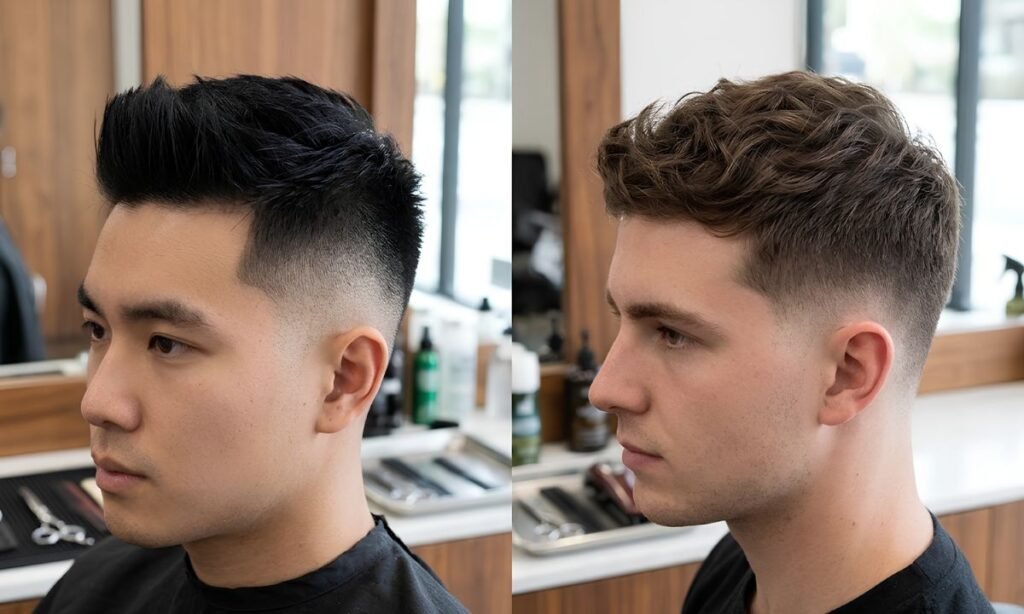
Your hair texture and hair density shape what looks good on you.
A cut that looks perfect on a friend can fall flat on your head.
Texture covers how straight or curly your strands are.
Density covers how many strands you’ve got per square inch of scalp hair.
The sections below match the cuts to common hair types.
Find the one that sounds like you.
Which is better for fine or straight hair?
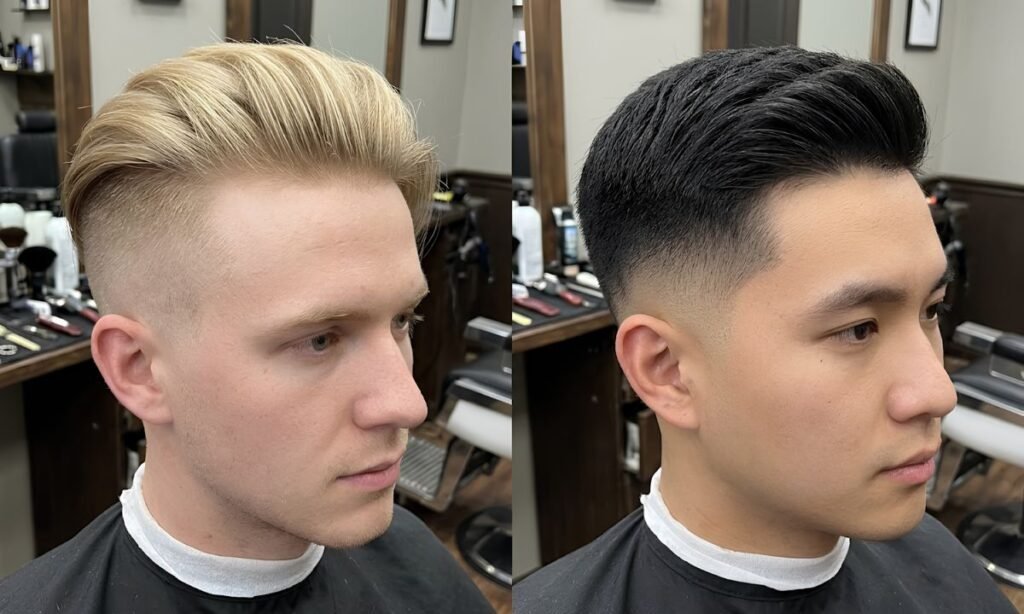
Fine straight hair can look flat when it’s cut with a harsh disconnected line.
A fade often works better, because the gradual change adds illusion of hair volume.
A low fade with a short, textured top is a safe starting point.
Use root lift spray and a quick blow-drying session for extra body.
If you love the undercut, keep the top moderately long.
That way, the contrast doesn’t expose how fine the strands are.
Which works better for thick or wavy hair?
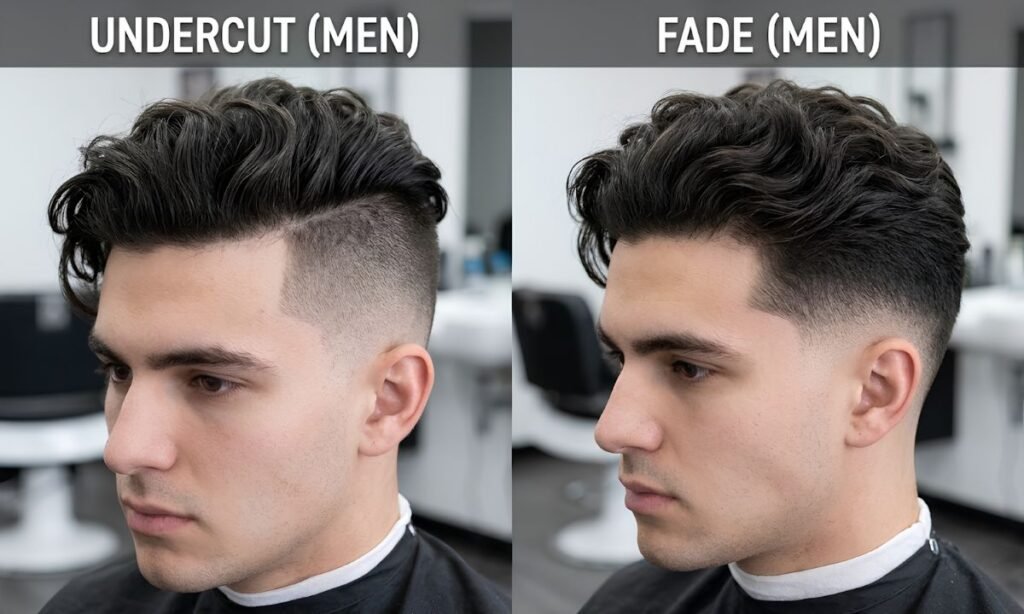
Thick straight hair and thick wavy hair suit the undercut beautifully.
The extra weight on top looks full next to the short sides.
A disconnected undercut removes bulk and keeps the shape under control.
You won’t deal with a puffy mushroom effect on the sides.
A mid fade also works well for high-density hair.
It keeps the sides slim while the top stays full.
Can curly or coily hair suit either cut?

Absolutely, and the results can look amazing.
Curly hair and coily hair look striking with a curly top fade, a skin fade, or a bald fade.
The fade frames the curls and highlights your natural hair texture.
The disconnected undercut works too, especially with a defined curl pattern.
Keep hair shrinkage in mind.
Curls spring up shorter when dry, so tell your barber your preferred final length.
Does an Undercut or Fade Make Your Hair Look Thicker?
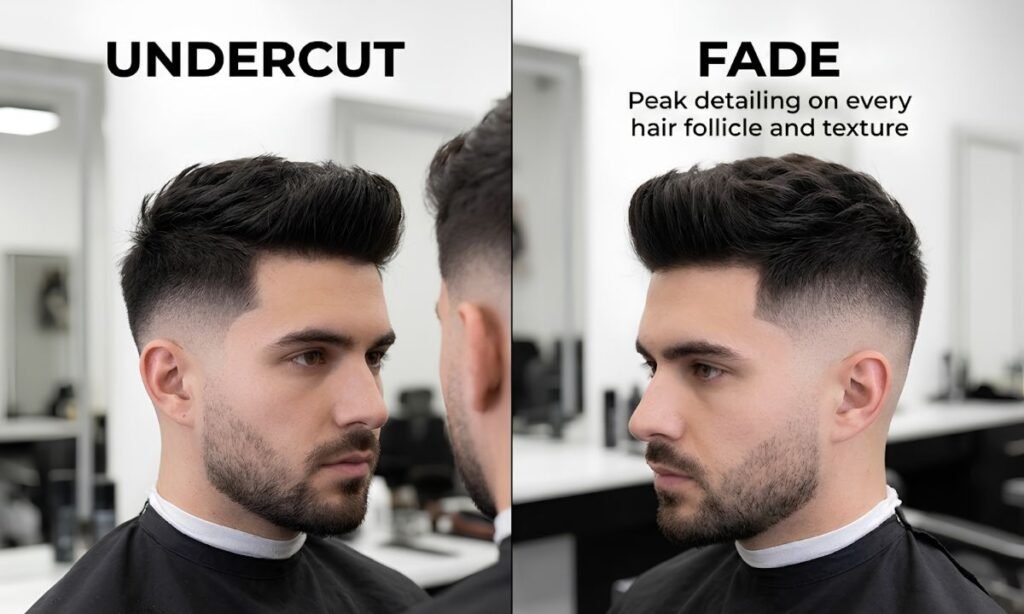
It can, but only if the cut is chosen with care.
Shorter sides create a visual trick that makes the top look fuller.
The size of your head shape and your hair density both play roles here.
A few small choices can make a big difference.
Let’s break down how each cut changes the look of hair thickness.
Spoiler: contrast is your friend.
Can Shorter Sides Create the Appearance of Fuller Hair?
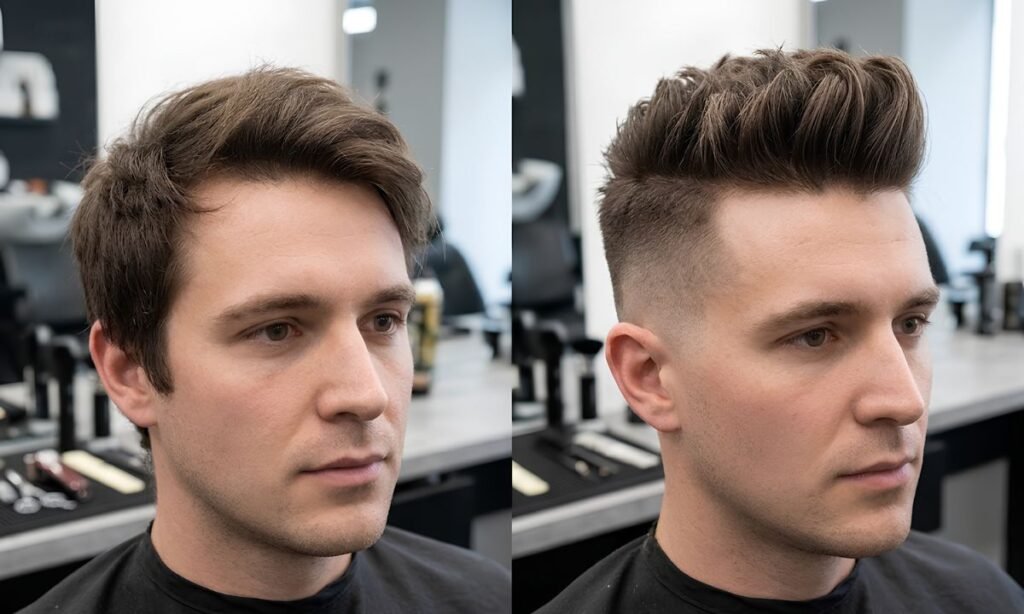
Yes, they absolutely can.
When the sides drop close to the scalp, the hair on top looks heavier by comparison.
This works like a frame around a painting.
The frame is plain, so your eye goes straight to the top section.
A fade keeps that effect soft and gradual.
An undercut makes it stronger and more obvious.
Does a Disconnected Undercut Expose Thin Areas?
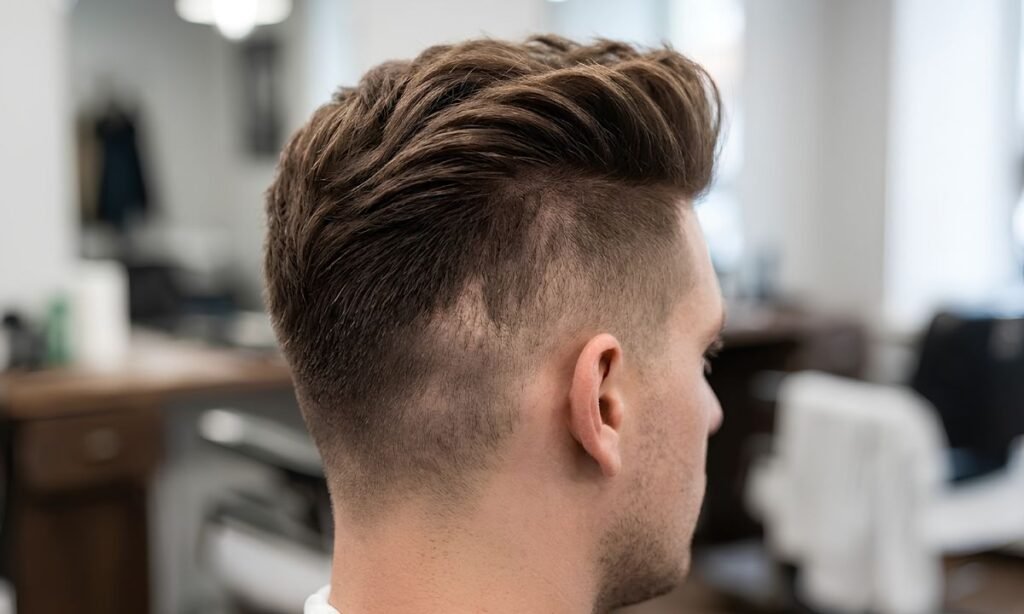
Sometimes, yes.
A disconnected undercut has no blending, so it can show hair thinning at the temple or crown more clearly.
If you’ve got low-density hair, think about a connected undercut or a fade.
These options soften the transition, so thin spots draw less attention.
Ask your barber to check your crown before you decide.
A quick look in the mirror saves a lot of regret later.
Which Cut Creates Better Visual Volume on Top?
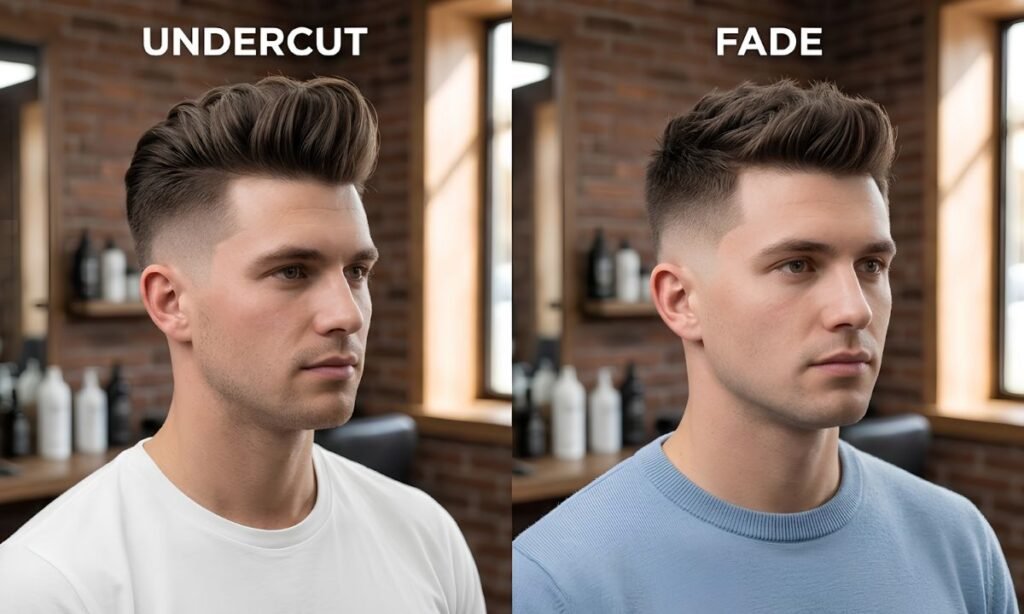
For pure drama, the undercut wins.
The contrast with the short sides makes the top look big and bold.
For natural-looking fullness, a fade is better.
It keeps proportions balanced and prevents a top-heavy look.
If you’re stuck, pick a faded undercut.
It gives you the best of both worlds.
Which haircut suits your face shape?
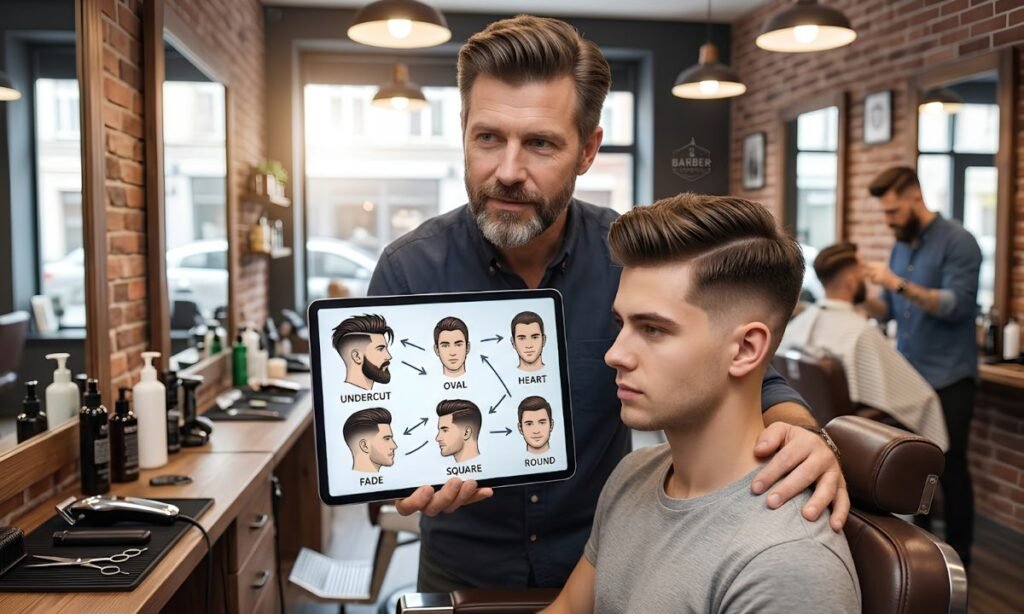
Your face shape and face proportions guide the cut more than any trend.
The right shape adds balance, and the wrong one can exaggerate what you’d rather soften.
A barber reads your jawline, forehead, and head shape before picking a plan.
You can do a quick version of this at home with a mirror.
Both cuts work across most faces.
The trick lies in the top length and the fade height.
How should round or square faces be considered?

A round face benefits from height on top.
A textured undercut or high fade with a taller quiff adds length and sharpens the outline.
A square face already has strong angles.
A low fade or mid fade with a soft side-part hairstyle keeps things balanced without extra edge.
Avoid a flat top if your face is very round.
It can make the jawline look even wider.
How should long or oval faces be considered?
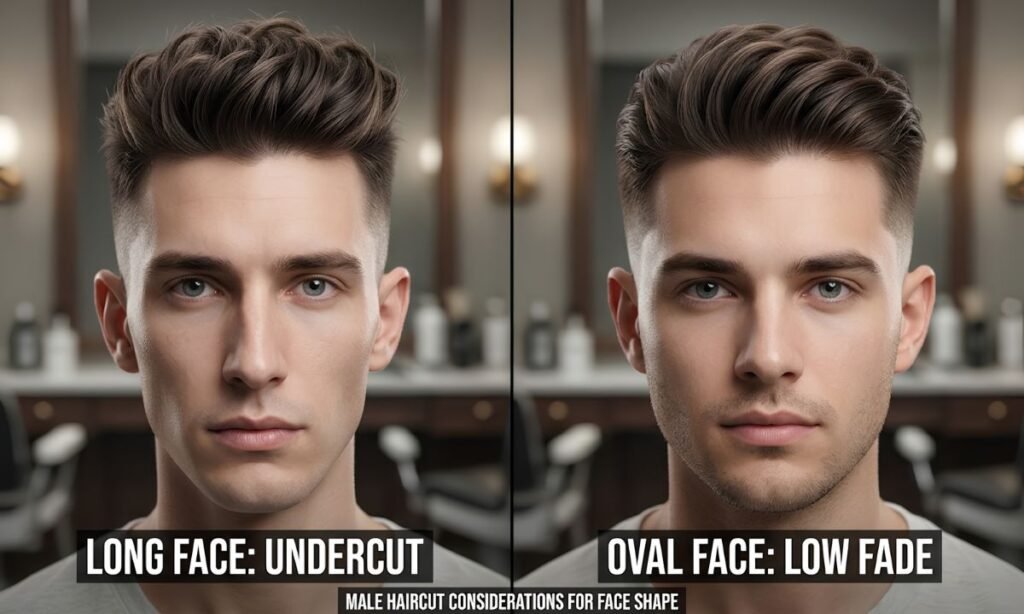
A long face needs less height and more width.
Try a connected undercut or mid fade with a textured fringe to shorten the look of your forehead.
An oval face is the lucky one.
Nearly every fade or undercut looks good, so let your lifestyle decide.
Skip ultra-tall tops on long faces.
They stretch the face proportions even more.
Is an undercut or fade better for thinning or receding hair?

For thinning hair, a fade usually wins.
The soft blend hides hairline recession and avoids the stark contrast that can highlight sparse areas.
A short fade with a textured top works especially well for receding temples and crown thinning.
Keeping the top shorter makes overall hair thinning less noticeable too.
Don’t write off the undercut completely.
A connected undercut with a textured fringe can still look sharp.
If the thinning is advancing quickly, a doctor or dermatologist can explain your options. Cleveland Clinic has solid, plain-language guides on hair loss causes.
A barber can shape the cut, but they can’t diagnose what’s behind it.
Which Haircut Offers More Styling Versatility?
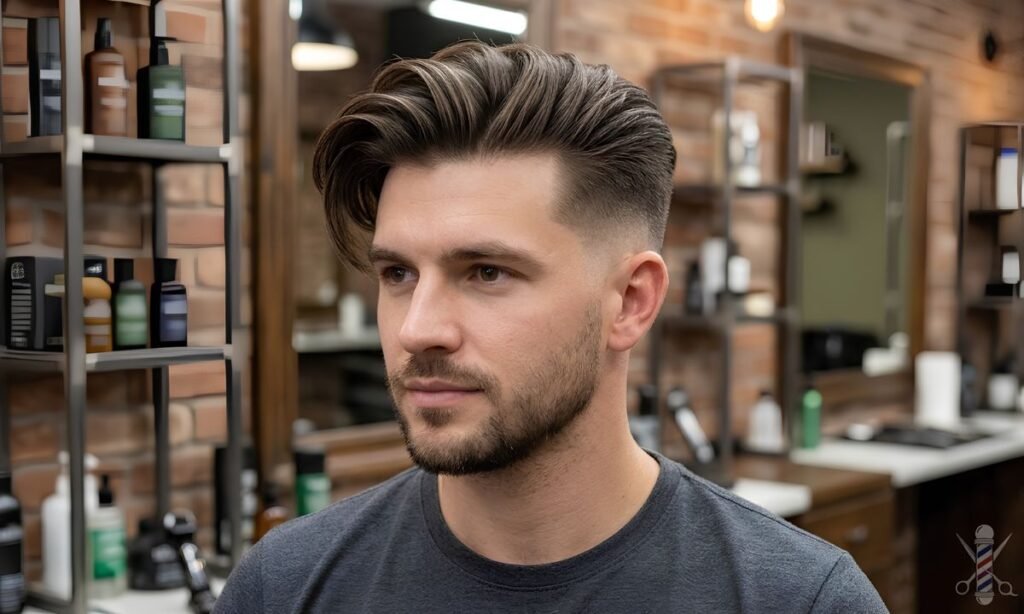
Both cuts give you room to play.
Still, one tends to be more flexible when you’re bored of your usual look.
The long top on an undercut gives you the most options.
A fade keeps the top shorter, so you’ve got fewer directions to explore.
Let’s look at three specific ways you might want to style your hair.
Each has a clear winner.
Which Cut Works Better With Slicked-Back Hairstyles?
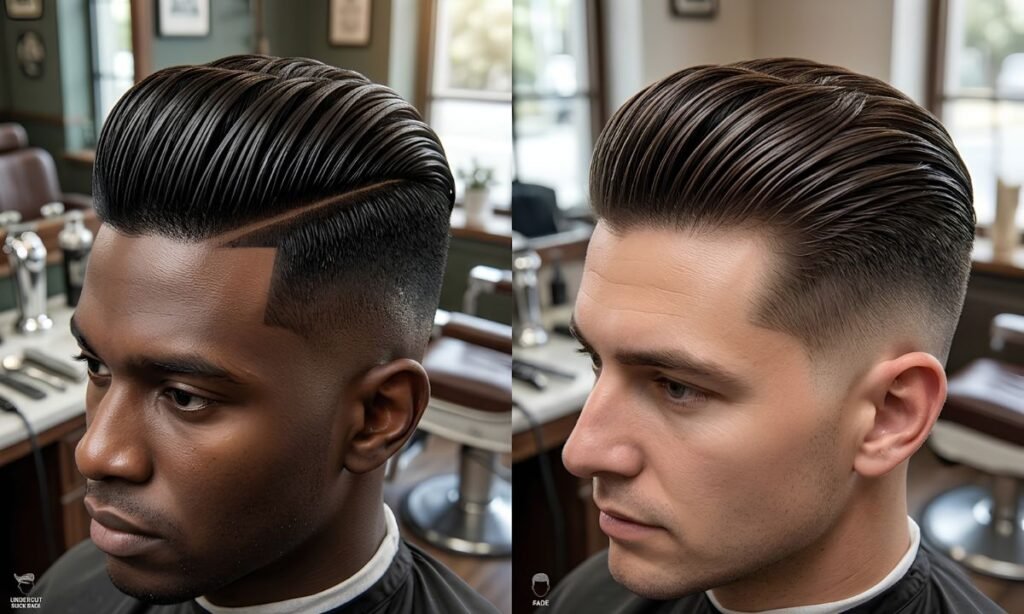
The undercut takes the crown here.
The slick-back hairstyle looks dramatic against short sides and a hard line.
A fade can still pull off the same style.
The look gets softer, so it feels more modern than vintage.
Use a water-based pomade for hold and shine.
Brands like Suavecito rinse out easily, which keeps your scalp happier.
Can You Style an Undercut or Fade With a Messy Top?
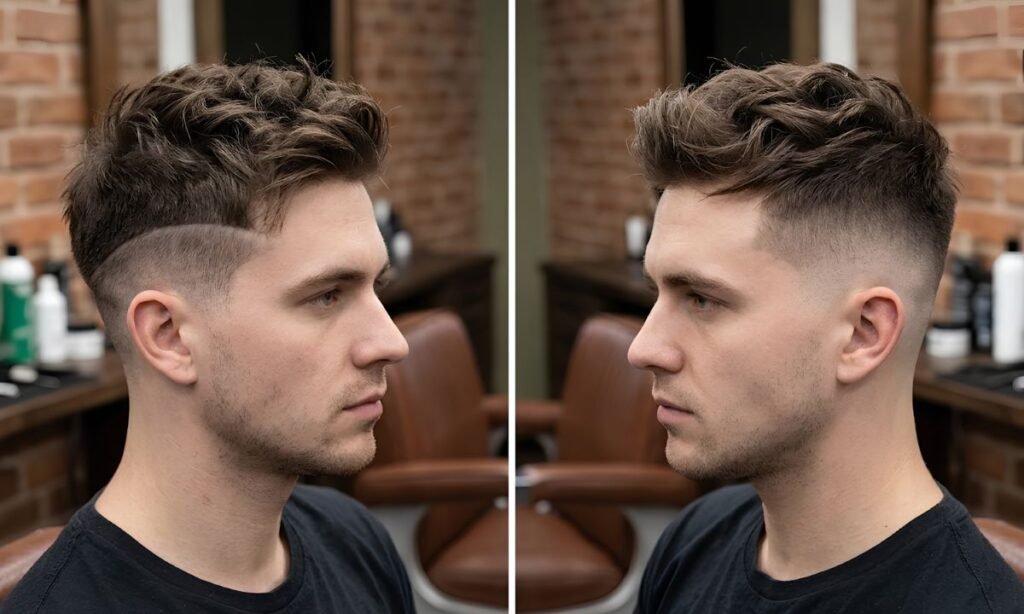
Yes, and it looks great on both.
A textured top with some hair clay gives you that effortless, just-rolled-out-of-bed vibe.
A messy undercut looks edgier because of the contrast.
A messy fade looks smoother and a bit more polished.
Rough-dry your hair with a blow-drying session for lift.
Then finish with clay and shake it out with your fingers.
Which Haircut Allows More Changes in Your Everyday Look?

The undercut gives you more range.
You can slick it back, push it forward, wear a man bun, or tie a top knot when it grows long enough.
A fade works best with shorter, tidier styles.
You can still switch between a side-part hairstyle, a quiff, or a flat top.
If you love changing things up, go undercut.
If you like consistency, a fade keeps life simple.
Which needs less maintenance: an undercut or a fade?

A fade needs more frequent visits.
The short bottom grows out fast, and the gradient loses its sharpness within a couple of weeks.
An undercut is more forgiving.
Because it uses one-length sides, it keeps looking decent for longer, even as the hair grows.
Overall, the undercut is the easier low-maintenance men’s haircut.
But a low fade with a shadow finish can be almost as easy.
How often should you trim an undercut or fade?
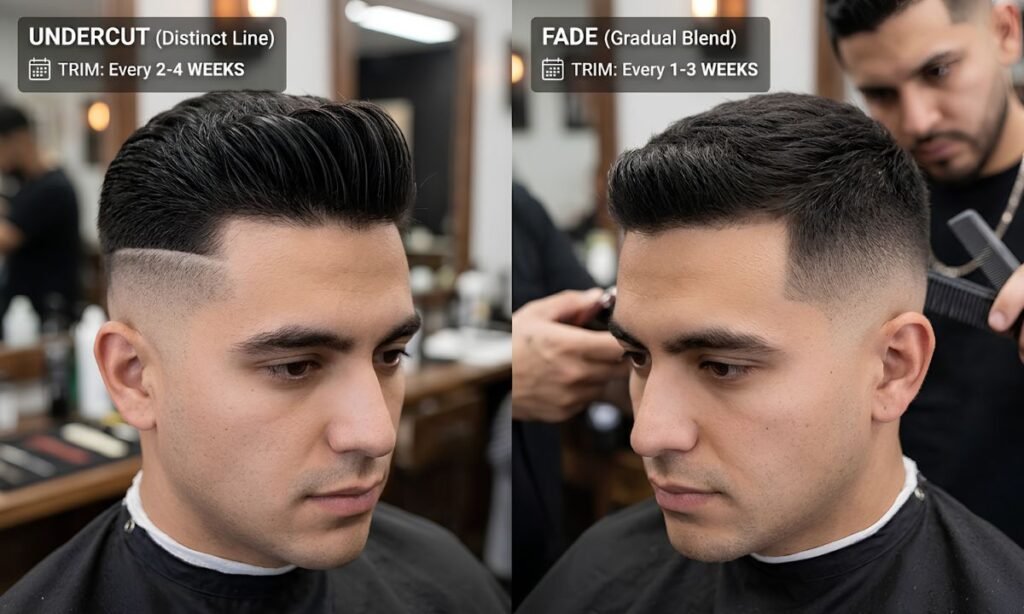
For a fade, book a barber appointment every two to three weeks.
A skin fade shows regrowth fastest, so it needs the tightest trim frequency.
For an undercut, every three to five weeks usually works.
The longer top can wait, and the sides grow out more evenly.
Your own hair growth speed matters.
Some guys grow faster, so adjust the schedule to match.
Which haircut is easier to style every morning?
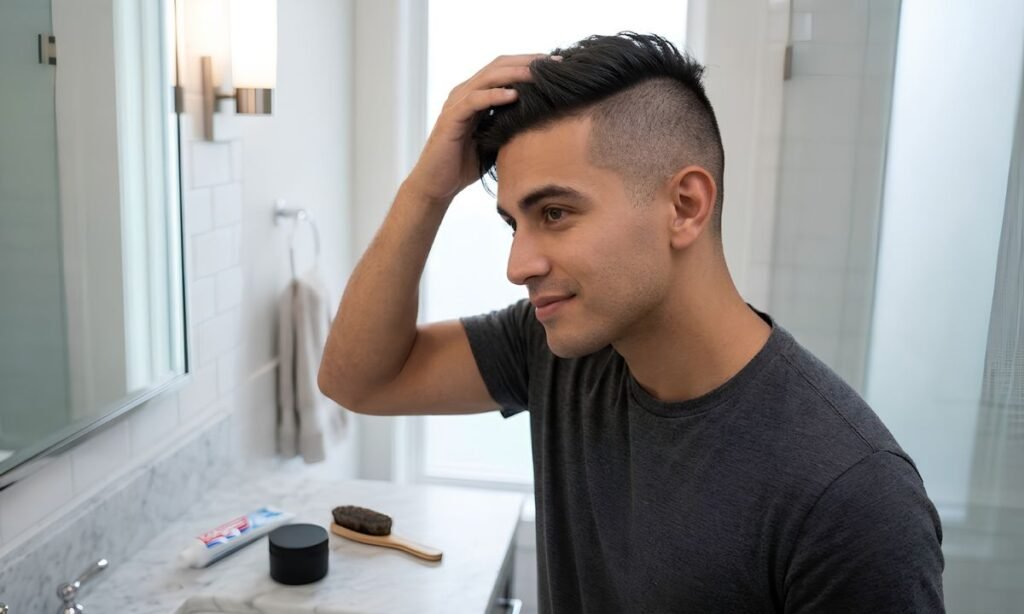
The fade wins for speed.
With a shorter top, you can finish in under five minutes using a bit of styling cream.
The undercut needs a little more effort.
A boar bristle brush, some water-based pomade, and a few minutes of shaping make it look right.
If mornings are tight, pick the fade.
If you enjoy the ritual, the undercut pays you back.
Which haircut is easier to grow out?
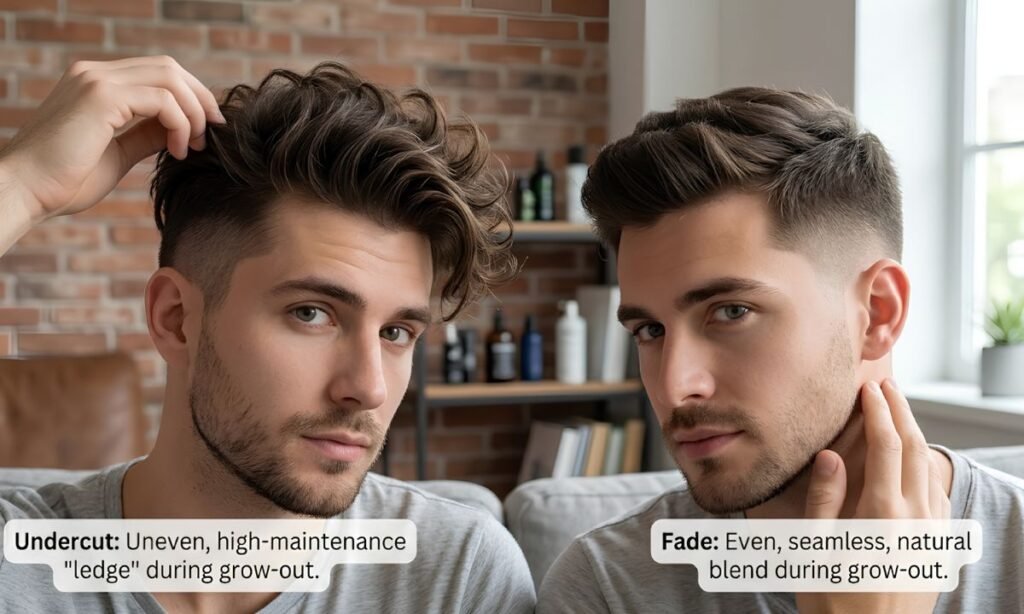
The fade grows out more gracefully.
The graduated lengths blend into each other, so the awkward phase is shorter.
The undercut can feel messier while it grows.
The sides start to puff out, and the disconnected transition gets blurry.
The best move is to schedule smaller trims along the way.
That keeps your hair regrowth looking intentional.
Hair moves through a hair growth phase, a resting phase, and a shedding phase.
That cycle explains why growth speeds can differ between guys, and why patience pays off.
Which cut fits your lifestyle and workplace?
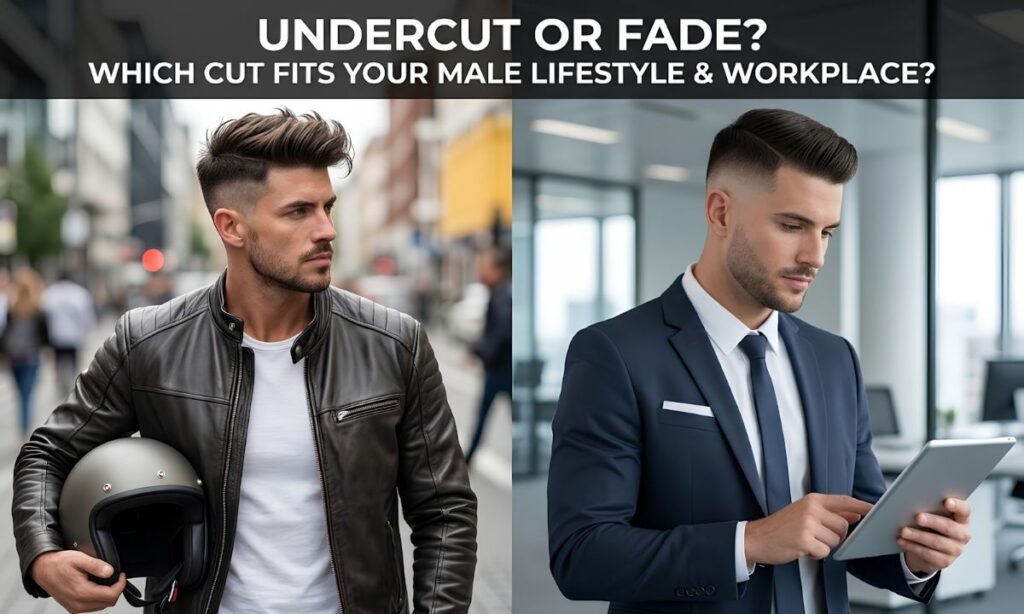
If you work in a conservative workplace, go for a low fade or connected undercut.
Both look neat and professional, and neither will clash with a grooming policy.
Creative jobs give you more room.
A bold disconnected undercut or skin fade can show personality.
If you play sports or work with your hands, a fade is easy.
It stays out of your eyes and needs little styling.
Travel a lot?
Pick whichever cut you can maintain on the road.
A short taper haircut is hard to beat there.
How do you ask your barber for Undercut vs Fade?
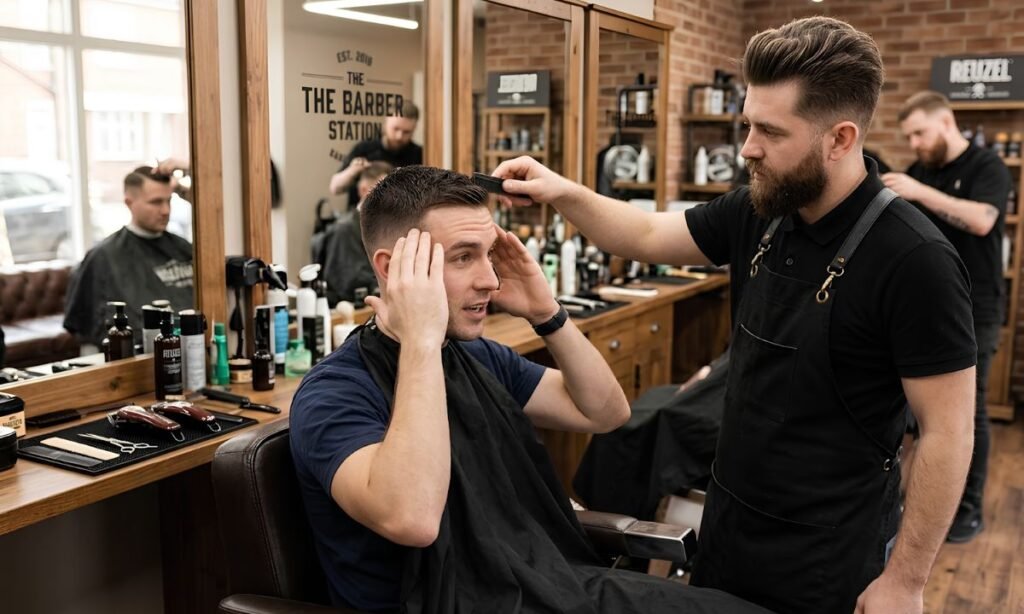
Talking to your barber can feel awkward.
A short haircut consultation and a few photos fix almost every problem.
Always bring reference haircut photos.
Sites like Men’s Health and barber channels such as Markcutit are great places to find ideas.
Be clear about guard size, fade height, and top length.
Good barber instructions save you from a surprise in the mirror.
What should you say for a disconnected undercut?

Try this: “I’d like a disconnected undercut with a number 2 guard on the sides and about three inches on top.”
Then add whether you want a hard part or a textured fringe.
Mention if you want the neckline cleanup squared or tapered.
It changes how the back view looks.
Ask your barber to leave the top long enough to style.
You can always trim more later.
What should you say for a low or mid fade?
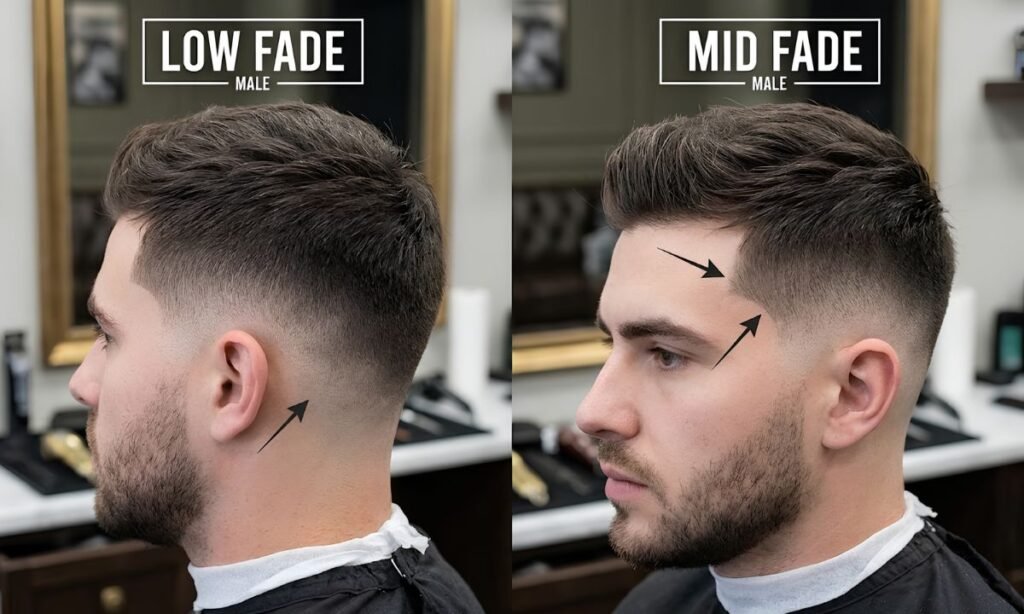
Try this: “I’d like a mid fade starting at a number 1 guard, blending into the top.”
Add whether you prefer a skin fade or a shadow fade.
Say if you want a taper lever adjusted for a cleaner finish.
Mention your preferred fade height too.
If you’re unsure, start with a low fade.
You can always go higher next time.
Guard Numbers Explained: What Do the Sizes Actually Mean?
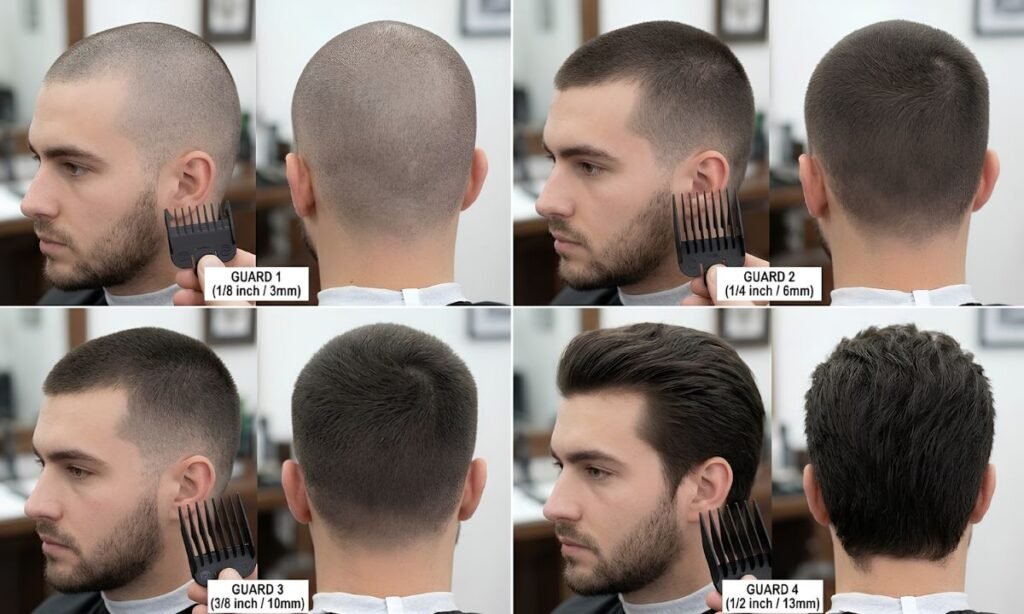
Guard numbers confuse everyone at first.
Here’s the simple version, based on common Wahl sizes.
| Guard | Length (inches) | Length (mm) |
|---|---|---|
| Half guard | about 1/16 | about 1.5 |
| Number 1 guard | 1/8 | 3 |
| Number 2 guard | 1/4 | 6 |
| Number 3 guard | 3/8 | 10 |
| Number 5 guard | 5/8 | 16 |
Lower numbers mean shorter hair.
For an undercut, most guys pick a number 2 guard or number 3 guard.
For a fade, the barber moves through several sizes.
They often start at the half guard or number 1 guard and finish at a number 3 guard or number 5 guard.
Styling Products That Actually Help
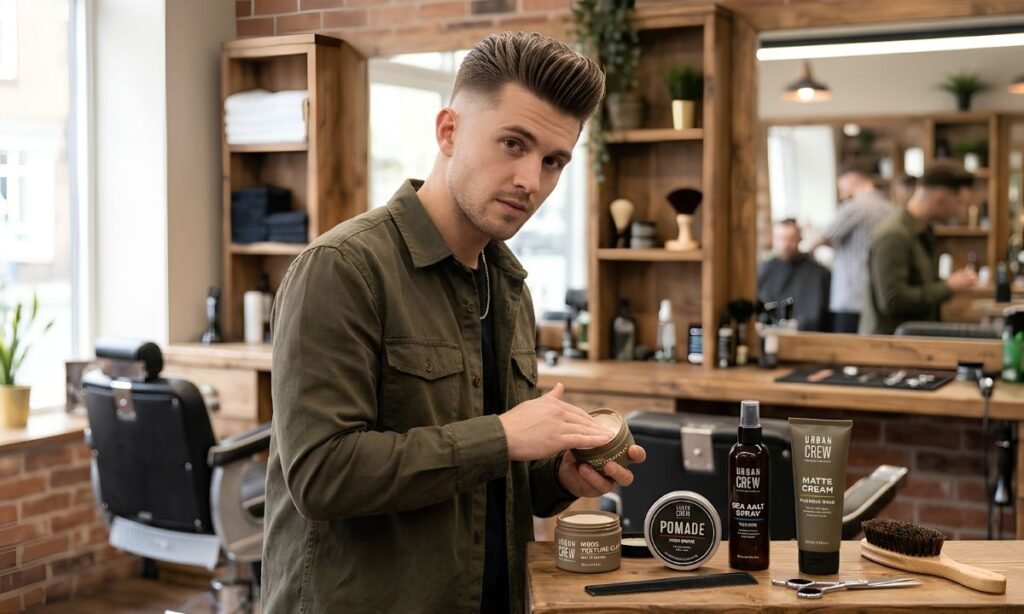
The right product makes any cut look better.
The wrong one leaves hair crunchy, greasy, or flat.
- Water-based pomade: Gives shine and hold, and rinses out easily.
- Hair clay: Adds texture with a matte finish, perfect for a textured undercut.
- Styling cream: Offers light control for a natural look on a fade.
- Root lift spray: Helps fine hair stand up.
Pair these with a fine-tooth comb or boar bristle brush.
The tool shapes the style, and the product locks it in.
Go easy on the amount.
Start with a pea-sized dab and add more only if you need it.
Common Mistakes Guys Make With Undercuts and Fades
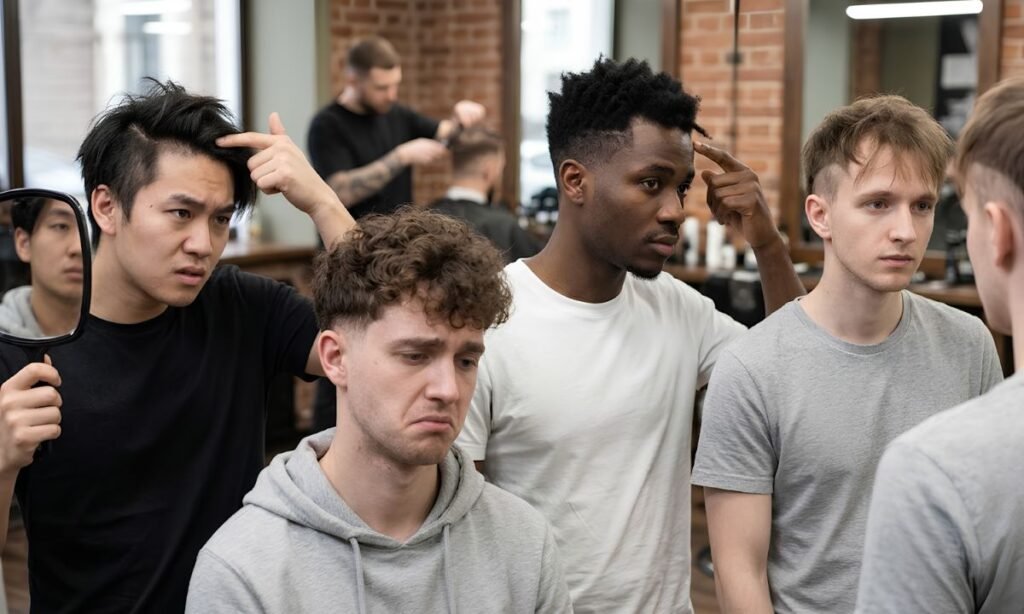
The biggest mistake is skipping the consultation.
Asking for “a fade” without picking a height leaves too much to guesswork.
Another mistake is going too short on top.
An undercut needs length to look intentional.
Some guys also ignore their hair texture.
A cut that fights your natural hair growth patterns will never sit right.
Finally, many guys wait too long between trims.
A fade that grows out for six weeks turns into a messy cut fast.
What alternatives should you consider?
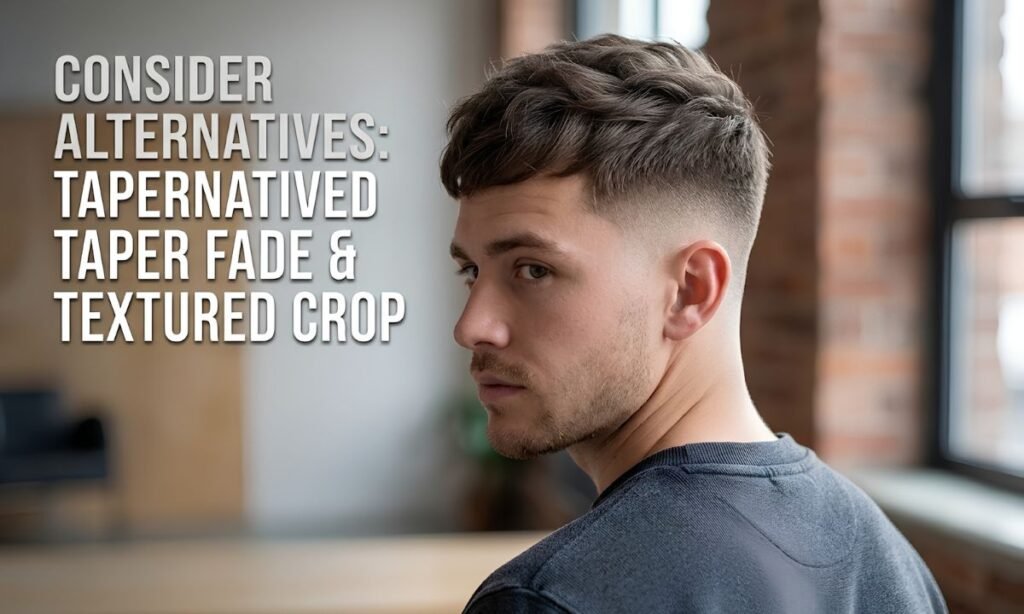
If neither cut feels right, you’ve still got options.
A classic taper, short back and sides, or scissor-cut sides give a softer look.
A taper haircut keeps the sides longer than a fade.
It works well for conservative workplace settings.
If you like trendy looks, try an undercut mullet or fade mullet.
Both mix retro vibes with modern edges.
The flat top and bald fade are other solid picks.
You can ask your barber for a quick demo on how each one would suit your head.
You can also checkout this article as well: Low Taper Fade Textured Top: 45+ Best Styles for Men in 2026
Undercut vs fade: frequently asked questions
Is an undercut better than a fade?
Neither is better across the board.
An undercut offers bold contrast, while a fade gives a smoother finish.
Is a fade better than an undercut for thin hair?
Usually yes.
The gradual blend hides hair thinning better than a hard line.
Can you combine an undercut and fade?
Yes.
A faded undercut gives you short, blended sides with a long top.
What guard number should I use for an undercut?
Most people choose a number 2 guard or number 3 guard.
Go shorter for more contrast.
How long should hair be for an undercut?
Aim for 2 to 4 inches on top.
Longer gives you more styling options.
Can you get a fade with long hair?
Yes, through a long-top fade.
The sides blend short while the top keeps its length.
Which haircut requires less maintenance?
The undercut needs fewer visits.
But a low fade can be pretty easy too.
Is an undercut suitable for a professional workplace?
A connected undercut usually is.
Check your grooming policy first, just to be sure.
Final thoughts on Undercut vs Fade
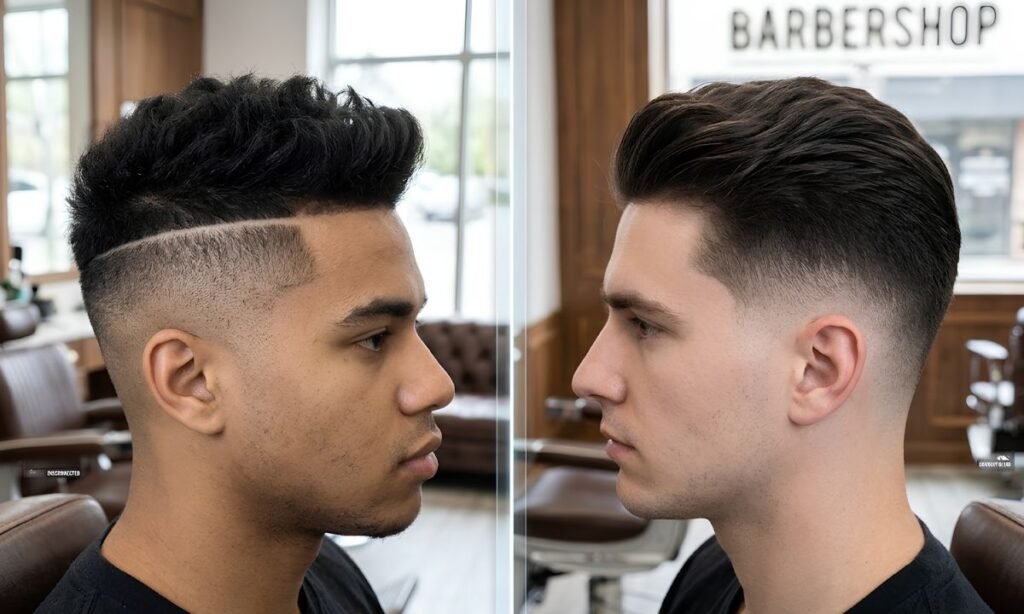
The undercut and fade both give you a sharp, modern look.
The real difference is how you want the transition to feel: bold or seamless.
Match the cut to your hair texture, hair density, face shape, and lifestyle.
The right choice should feel natural, not forced.
Still torn between the two?
Book a barber appointment, bring photos, and ask for advice.
A good barber will steer you right.
Which one are you leaning toward?
Drop a comment, share this guide with a friend who’s stuck on the same choice, and tell us how your next cut turns out.

I’m Michael Charles, the creator of MegaCrazes—your source for fresh hairstyles, sharp haircuts, and simple hair-care inspiration. Find your style. Own your look.