

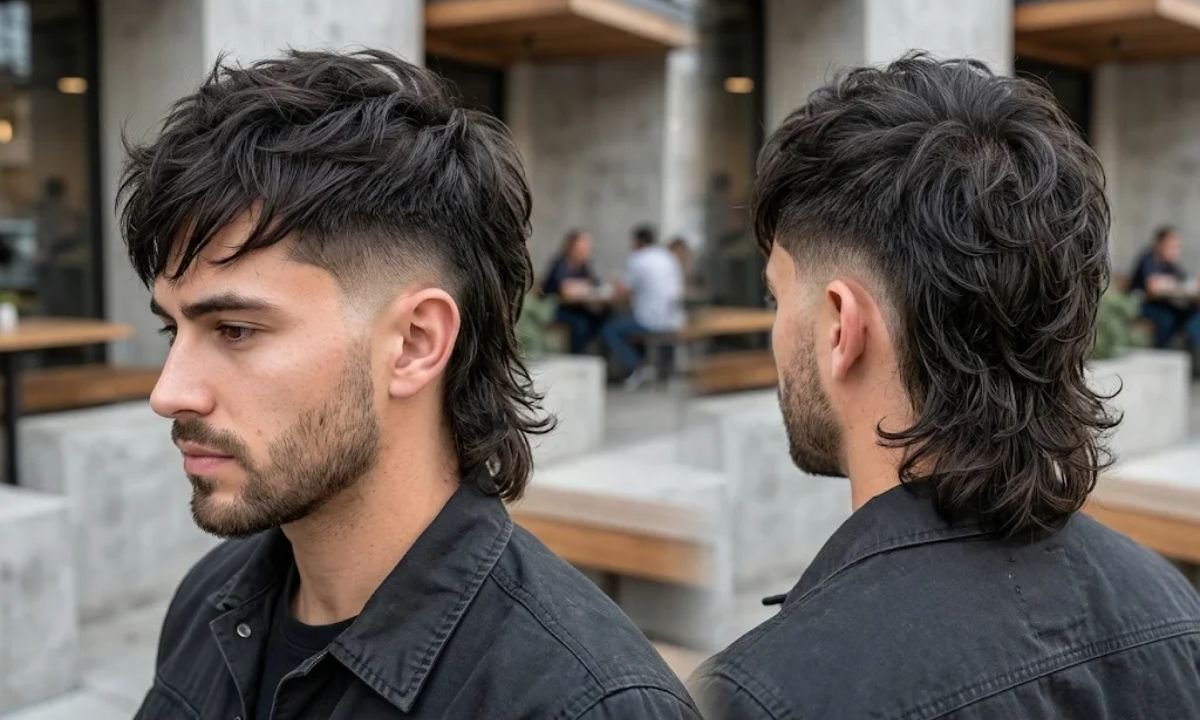
Updated November 2026. Written for guys who want the cut, the barber talk, and the daily routine in one place.
Will a mullet make you look like a 1985 hockey player? Will your barber actually get the curve right? Will it survive a Monday morning meeting?
Those are fair worries. Most guys who search for a burst fade mullet have all three on their mind. This guide answers them one by one, so you walk into the shop with a plan.
Quick Answer
A burst fade mullet haircut has short sides and a long back, with a curved fade around the ears that bursts outward instead of running straight around the head. It’s the modern mullet haircut that looks planned, not accidental.
The best picks in 2026 are the textured mullet with burst fade, the low burst fade mullet, and the layered mullet with burst fade. Ask for a guard number 1 or 2 base and a back length that suits your hair texture and density.
Below you’ll find 60 burst fade mullet styles, plus barber instructions, clipper guard sizes, products, and the mistakes that wreck this cut. Grab a coffee and scroll.
What Is a Burst Fade Mullet?
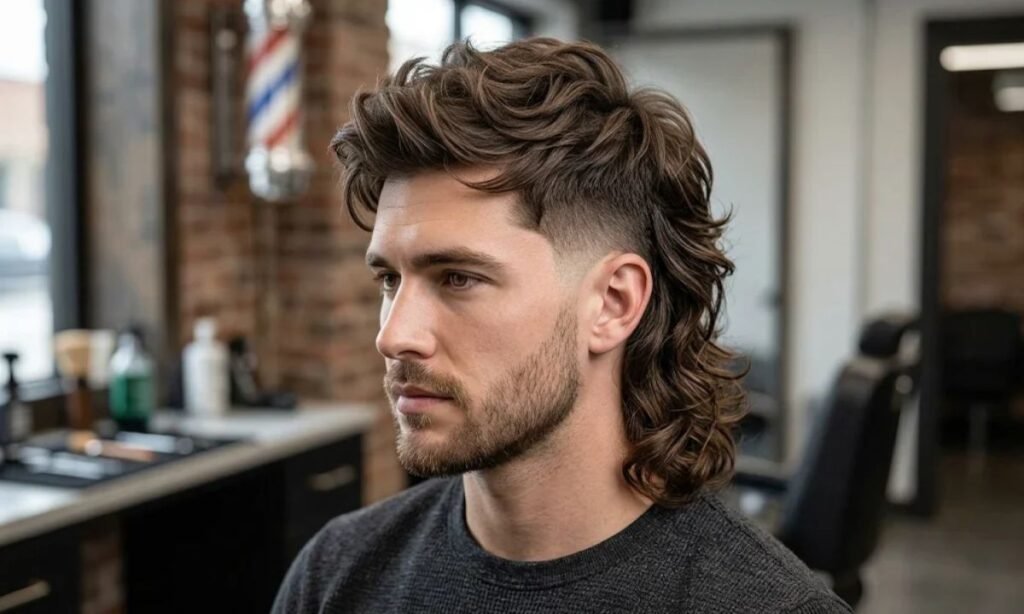
Picture a regular mullet, then picture the sides cleaned up with a curved fade shape around each ear. That’s the idea. The fade starts at the temple area, wraps the ear, and stops at the tapered nape instead of marching across the back of your head.
The back stays long. That longer section gives you the mullet tail and a clear mullet silhouette from the side profile and the rear view.
Barbers like this cut because it keeps the mullet shape but adds a clean fade finish where it matters. You get contrast without losing the party in the back. Think of it as the mullet that went to finishing school.
Why Choose a Burst Fade Mullet?
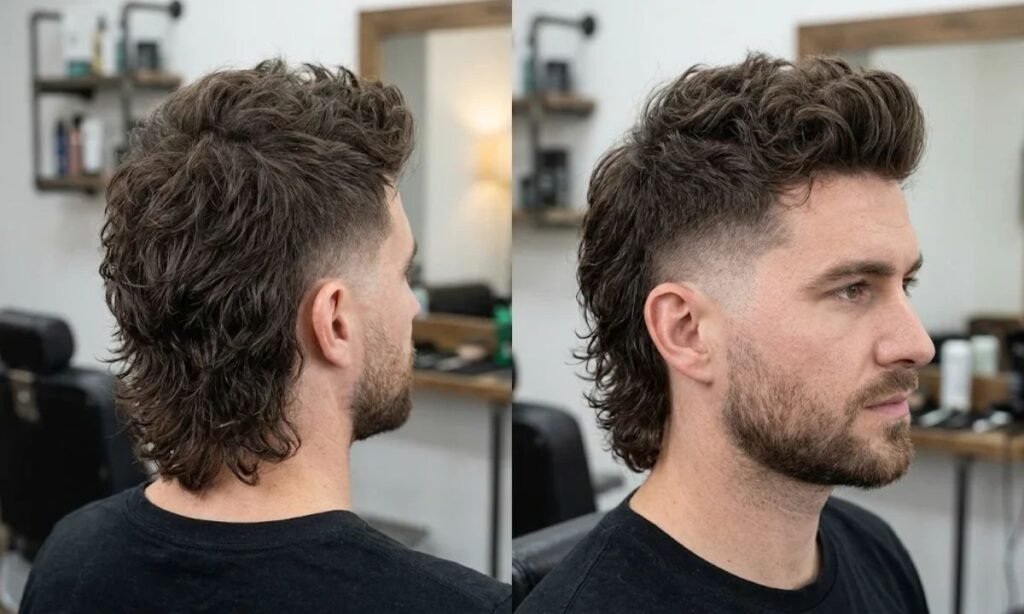
It gives you options. You can keep it subtle for work, or push it loud for weekends. The burst fade hairstyle adapts to your mood, your hair, and your boss.
It also frames your face well. The curved fade around the ears opens up the sides, while the longer back length balances the top volume. The result is a polished hairstyle even when the top is messy.
Finally, it’s forgiving during hair regrowth. A fade that grows out still looks intentional because the curve is small. That’s a big win if you hate booking every two weeks.
Face Shape and Head Shape Considerations

Good haircut proportions start with your skull, not a photo on your phone. The same cut can look sharp on one guy and awkward on another. Face shape suitability is the difference.
Look at your facial proportions in a mirror before you book. Check your forehead, jawline, and the width of your crown. Those three spots decide how tall the top should be and how wide the back can go.
Here’s the quick rule. Add height where you need length, and keep the sides tight where you need less width. A burst fade does both naturally, which is why it works for so many head shapes.
Which Burst Fade Mullet Proportions Suit a Round Face?
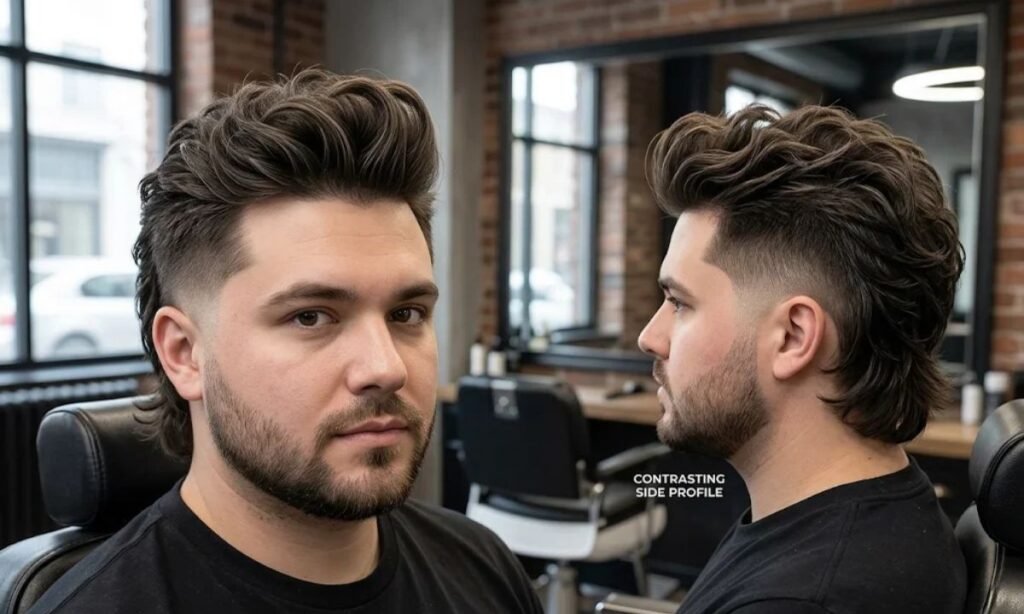
If your face is round, aim for top volume and a tapered nape. Height on top stretches the face, and a narrow back keeps the overall haircut silhouette from widening.
Pick a mid burst fade mullet with a short to medium back. A textured top with some fringe length also breaks up the circle. Skip a heavy, wide mullet tail because it adds width at the jaw.
Here’s a picture for you. Imagine a guy with a soft, round face who tried a puffy, shoulder-length mullet. He looked like a lollipop. A tighter back and more height on top fixed it in one visit.
How Does Head Shape Affect the Curve Around the Ears?

Your head shape controls where the curve looks best. A flatter back of the head needs a slightly higher burst to add roundness. A rounder skull can handle a lower, tighter curve.
Feel behind your ears. If the bone sticks out, a low burst fade mullet hides it better. If the skull is narrow, let the fade wrap a bit wider so the mullet neckline doesn’t look pinched.
Tell your barber about any flat spots or cowlicks. They’ll adjust the fade base length and curve to match your hair growth pattern. A good barber loves that kind of info.
55+ Modern Burst Fade Mullet Styles and Variations

There are more than 55 ways to wear this cut. Some change the fade. Others change the top, the back, or the finish. All of them share one thing: a curved fade around the ears with a long back.
We’ve grouped the styles so you can jump to what matches your hair type, your job, and your patience level. Each one comes with a short note on who it suits and how to ask for it.
Save a few as reference photos before you head out. You’ll see why in the barber section. For now, start with the basics.
Burst Fade Mullet Height & Finish Variations

Height and finish decide how bold your fade looks. Low reads quiet. High reads loud. The finish, whether skin or shadow, sets the contrast.
Think of fade height and fade contrast as two separate dials. You can turn one up and keep the other low. That’s how guys tailor this cut for an office or a night out.
Here are the seven core versions every barber should know.
1. Classic Burst Fade Mullet

This is the baseline. A medium curve around the ear, short sides and long back, and a smooth transition into the mullet tail. Nothing fancy, nothing wrong.
It works for almost anyone with average hair volume. If you’re new to the cut, start here. You can always push it harder at the next visit.
Ask for a burst fade mullet with a medium curve and a natural back. Your barber will know what you mean.
2. Low Burst Fade Mullet

The low burst fade mullet keeps the curve close to the ear and ends near the sideburn area. It’s the safest option for work and the most grown-out friendly.
The fade contrast stays soft, so the cut doesn’t scream. People notice the shape, not the fade.
If you want a mullet without drama, this is your pick. It’s also great for fine hair since it keeps weight where you need it.
3. Mid Burst Fade Mullet

The mid burst fade mullet sits halfway up the side of your head. It gives a clear fade without cutting into the crown structure.
This height balances most face shapes. It also shows off the burst fade curve from a side profile without looking aggressive.
Tell your barber to start the fade about an inch above the ear and curve it back. That’s the sweet spot for most guys.
4. High Burst Fade Mullet

The high burst fade mullet takes the curve up toward the temple and parietal ridge. It’s bold, sharp, and impossible to miss.
The contrast between bare sides and a long back makes the mullet silhouette pop. It suits guys with thick hair since the sides cut a lot of bulk.
Be careful, though. Taking the fade too high can leave the top looking tiny. Keep enough top length so it doesn’t look like a helmet.
5. Shadow Burst Fade Mullet
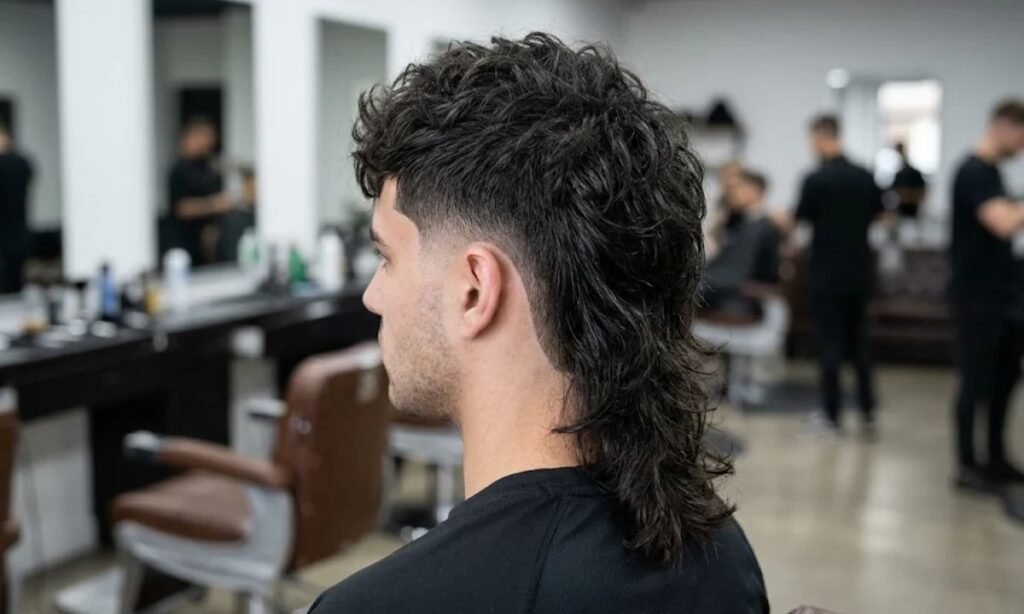
A shadow burst fade leaves a hint of hair at the base instead of skin. It looks softer, like a pencil sketch around the ear.
This is great if you want a clean look but hate the sharp skin line. It also grows out more gracefully.
Ask for a guard number 1 or a short shadow at the bottom and a long back. It pairs well with a natural finish on top.
6. Skin Burst Fade Mullet

The skin burst fade goes down to bare skin at the base. It’s the sharpest option and gives you the highest fade contrast.
That clean edge makes the long back stand out even more. It also lets a hair design or line up shine.
Expect to book more often. Bare skin fades lose their punch in about two weeks.
7. Tapered Burst Fade Mullet
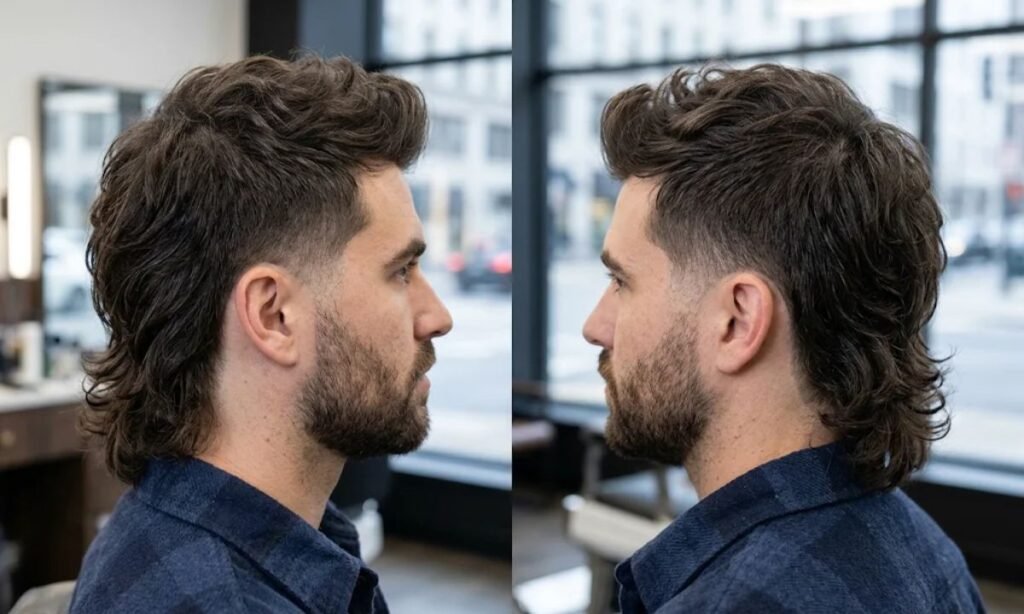
A tapered burst fade uses gentle fade blending instead of a hard drop. The hair gets shorter slowly, with no visible line.
This cut looks mature and clean. It’s a favorite for guys in client-facing jobs who still want a mullet.
Ask your barber for a longer fade transition and a tapered nape. You’ll get a polished hairstyle that still has personality.
Haircut Structure and Technical Details

Here’s where the cut is won or lost. The haircut structure includes where the fade ends, how long the back sits, and how the sideburns connect. Small errors show up fast in a mullet.
Understand these three spots and you can spot a good barber from across the room. You’ll also catch problems before they happen.
Let’s break them down.
How Far Should the Burst Fade Extend Behind Each Ear?
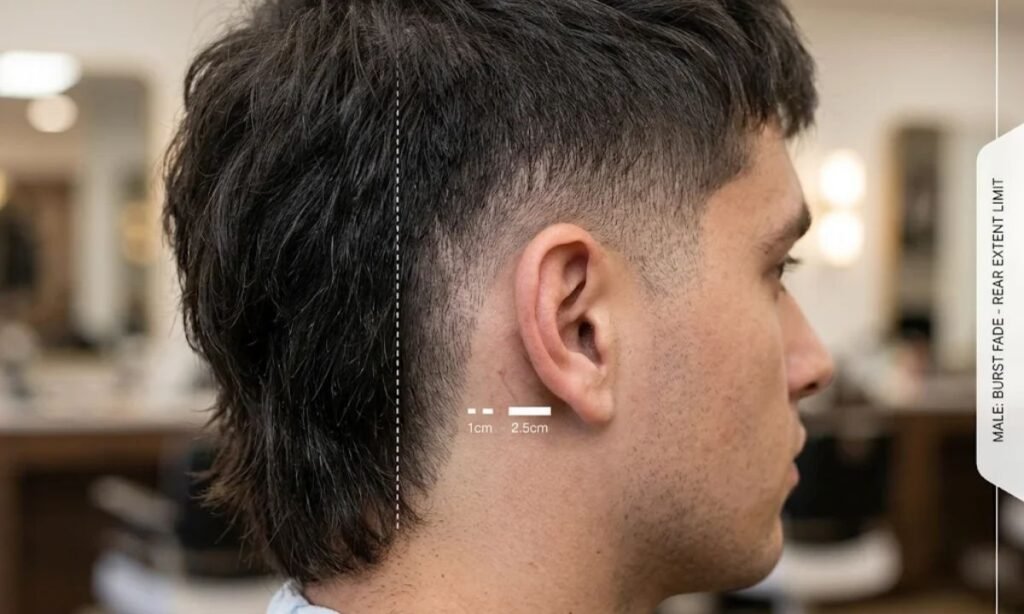
A good rule is about one to two inches behind the ear. The curve should follow the natural bone behind your ear and stop before the tapered neckline.
Go farther back and you lose the long section. Stop too early and the fade looks like a patch.
Your fade around the ear should feel like a smile, not a ring. Check it in the mirror from the rear view.
Where Should the Longest Point of the Mullet Backline Sit?
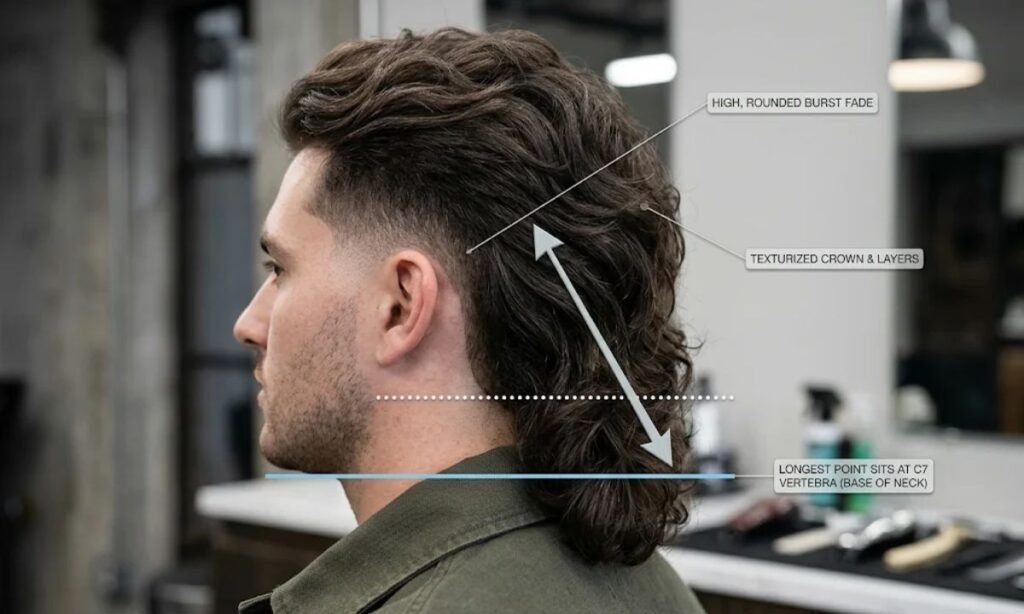
For most guys, the longest point sits right at the center of the nape. It should land between the base of the skull and the top of the shoulders.
This mullet tail length depends on your hair growth rate. Slow growers should go shorter at first.
If you’re asking how long should the back of a mullet be, start with two to four inches below the nape. You can grow it from there.
How Should the Sideburns Connect With the Burst Fade?
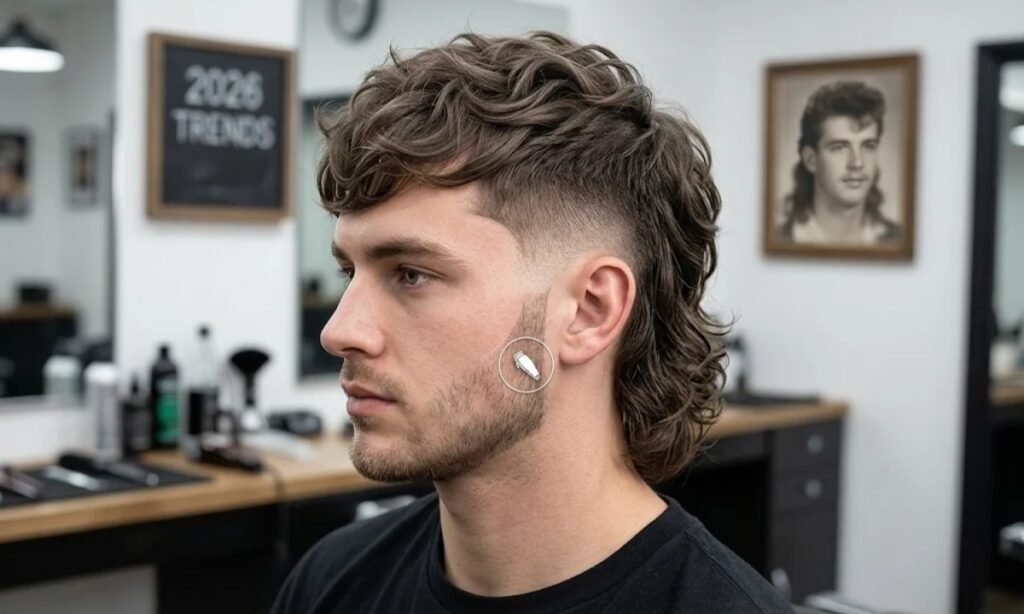
The sideburn area should flow into the fade without a hard stop. A clean connection means the fade wraps up and over the sideburn smoothly.
Sideburns that sit too long look messy. Sideburns that are cut too short break the curve.
Ask your barber for a tapered sideburn that matches the fade base length. It’s a small detail with a big payoff.
Different Mullet Lengths
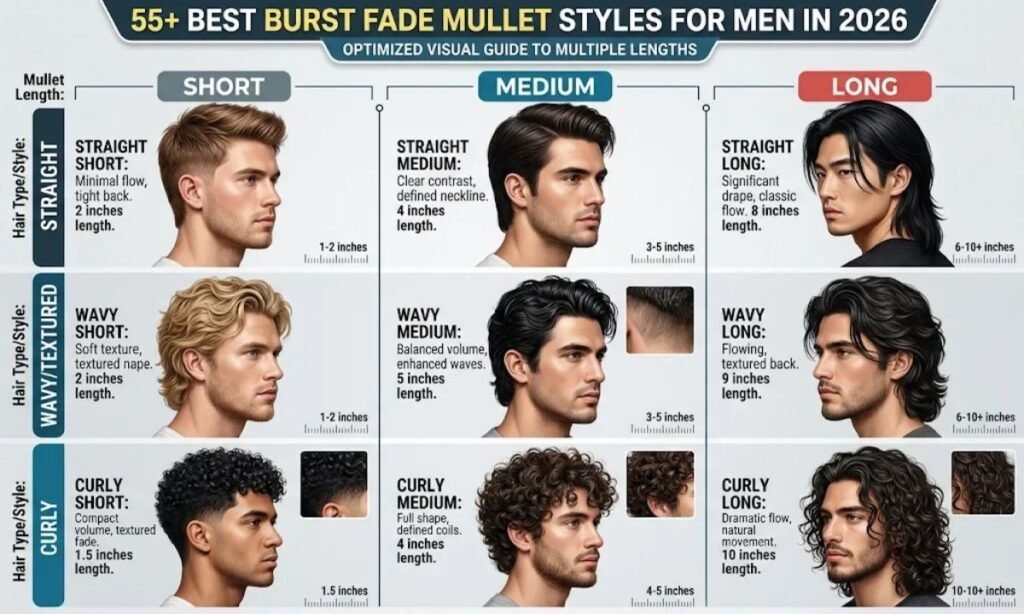
Length changes the whole personality of the cut. A short version feels crisp. A long version feels loose and wild. Your hair texture and density also play a big part here.
Pick a length based on your hair, your job, and how much time you’ll spend styling. The haircut length in inches matters more than the name.
Here’s how each one looks and who it suits.
8. Short Mullet with Burst Fade
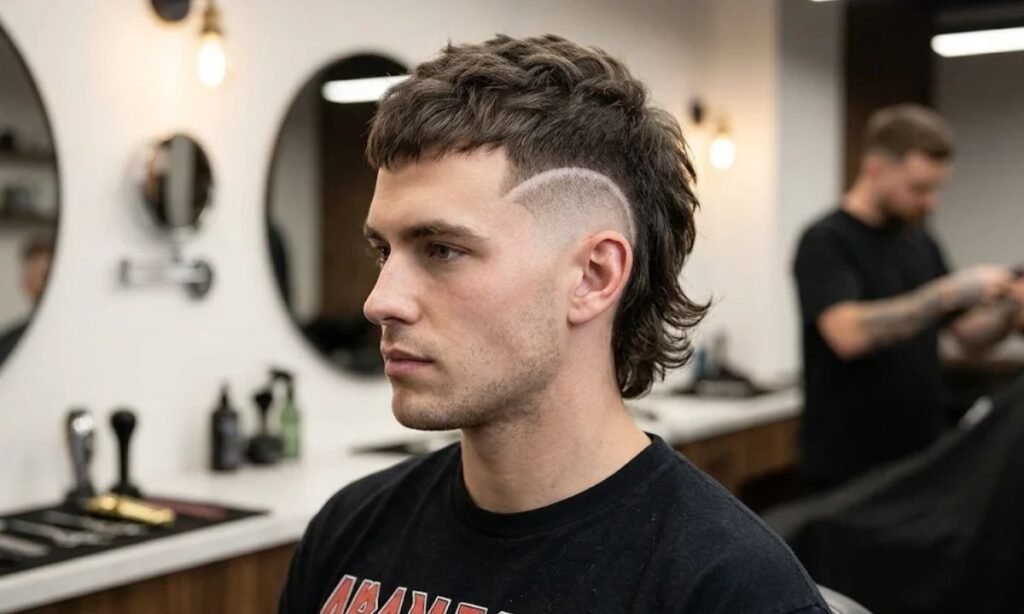
The short mullet with burst fade keeps the back to around two or three inches. It’s easy to style and easy to hide at work.
The top stays short to medium, so you get a polished hairstyle with a subtle tail. It’s a good first step for mullet newbies.
A bit of matte clay is all you need. It keeps the shape without extra shine.
9. Medium Length Mullet with Burst Fade

The medium-length mullet with burst fade sits around four to six inches in back. You can tuck it behind your ears or let it fall.
This is the most popular length because it balances style and practicality. It also gives your barber room to add layered back detail.
It works with wavy hair and straight hair equally well. Use a texture paste for definition.
10. Long Mullet with Burst Fade
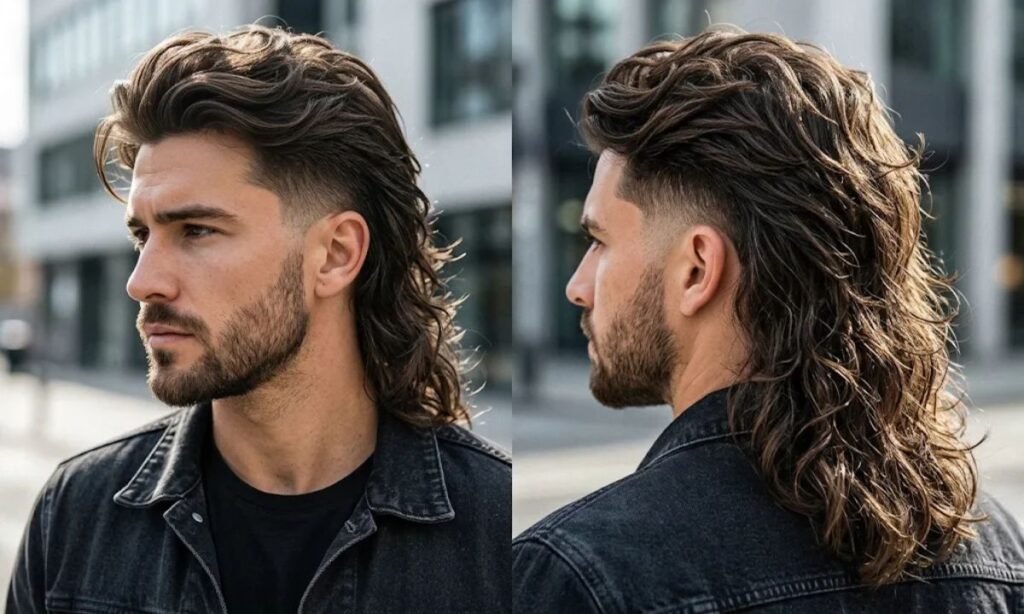
The long mullet with burst fade goes past the collar. It’s wild, free, and very noticeable.
The tight fade keeps the long hair from looking sloppy. That contrast is the whole appeal.
Plan for more hair trimming schedule time. Long backs need regular trims to prevent split ends.
Textured & Layered Looks

Texture gives a mullet movement. Layers give it shape. Together, they stop the cut from looking like a flat curtain.
Barbers use point cutting, razor cutting, and thinning techniques to build these looks. The goal is hair movement you can actually see.
Here are seven versions to know.
11. Textured Mullet with Burst Fade
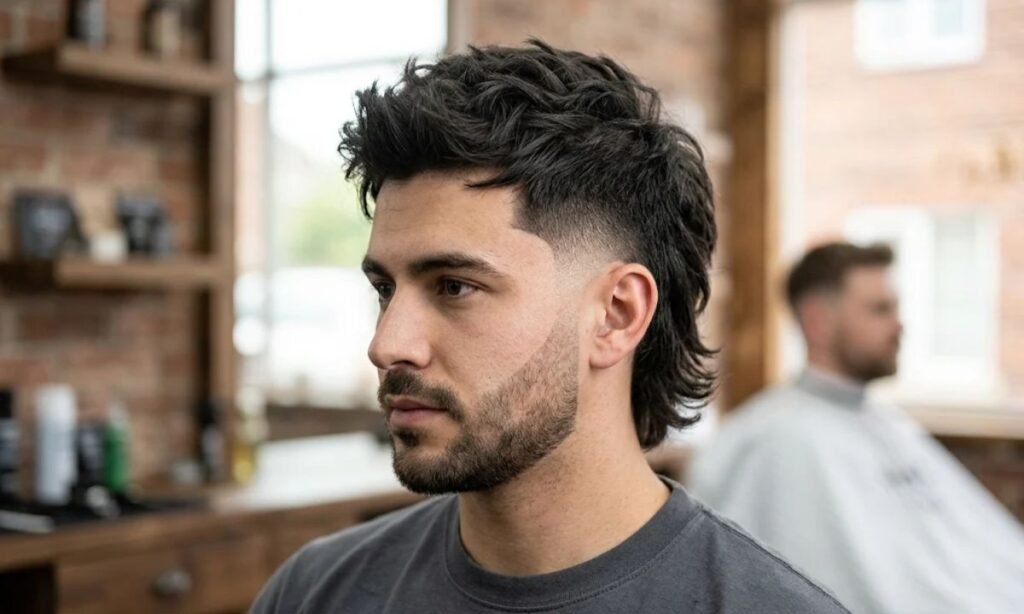
The textured mullet with burst fade uses choppy cuts on top and in the back. It looks lived-in, even on day one.
It’s ideal for thick hair since texturizing removes bulk. It also hides fade lines that haven’t grown out yet.
Style it with sea salt spray and a bit of matte clay. Scrunch, don’t comb.
12. Messy Mullet with Burst Fade
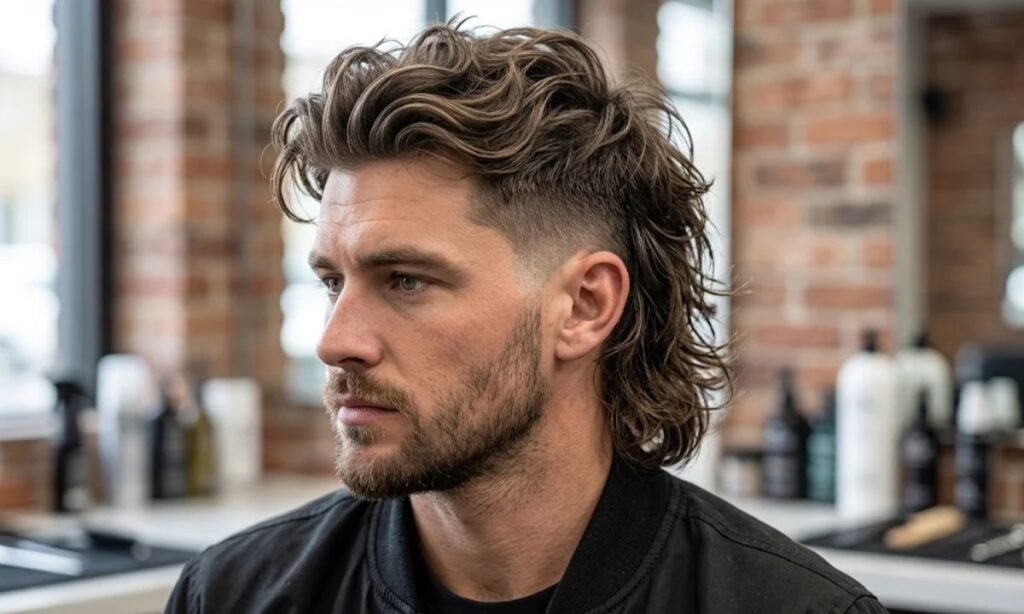
The messy mullet with burst fade looks like you rolled out of bed, but with a plan. The fade does the cleaning so the top can be wild.
It’s perfect for messy styling fans who want the cut to look effortless. A flexible hold product keeps it moving.
Don’t overdo the product. Overusing styling products turns messy into greasy.
13. Shaggy Mullet with Burst Fade

The shaggy mullet with burst fade has long, uneven layers all over. It has a vintage rock feel with a modern edge.
The fade at the sides keeps the shag from swallowing your face. That balance makes it wearable.
It looks best on wavy hair and medium waves. Straight hair needs more texture work.
14. Layered Mullet with Burst Fade
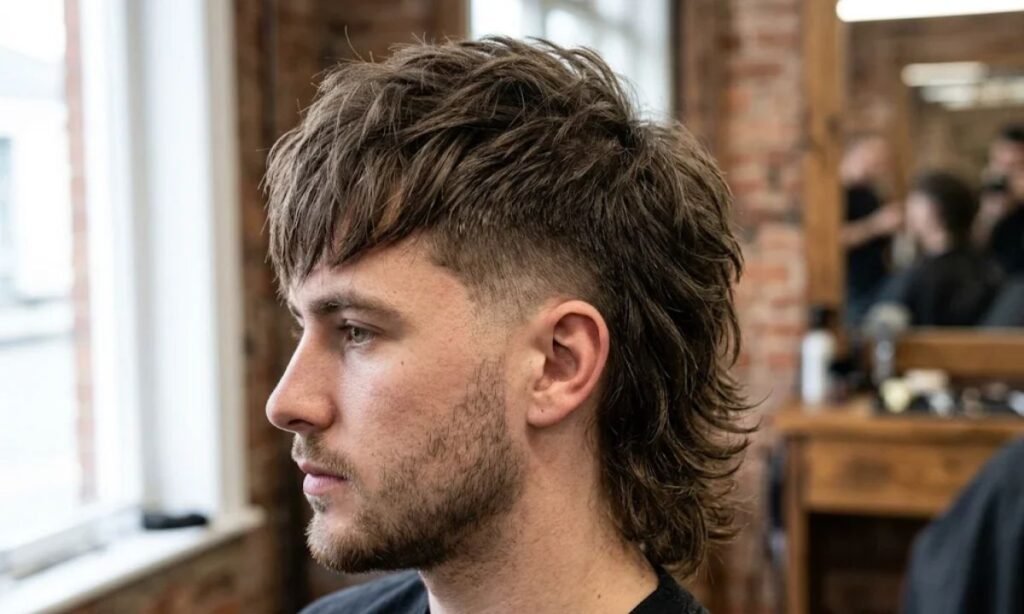
The layered mullet with burst fade stacks layers from the crown down. Each layer adds volume at the crown and a softer fall at the back.
Barbers use hair layering techniques like point cutting to blend them. The result is a smooth, full tail.
This one works well for low hair density because layers fake fullness.
15. Choppy Mullet with Burst Fade

The choppy mullet with burst fade has short, jagged layers. They add grit and edge.
It pairs well with a hard-part or a textured fringe. Choppy layers also hide thin ends.
Use texture paste and rough-dry your hair. You’ll get that lived-in finish.
16. Fluffy Mullet with Burst Fade

The fluffy mullet with burst fade is soft, airy, and full of hair volume. Think of a 90s boy band after a long weekend.
Blow-dry it with a round brush and finish with volumizing mousse. Keep the sides tight so the fluff stays on top.
It’s great for fine hair and for guys who like a bit of drama.
17. Natural-Texture Mullet with Burst Fade
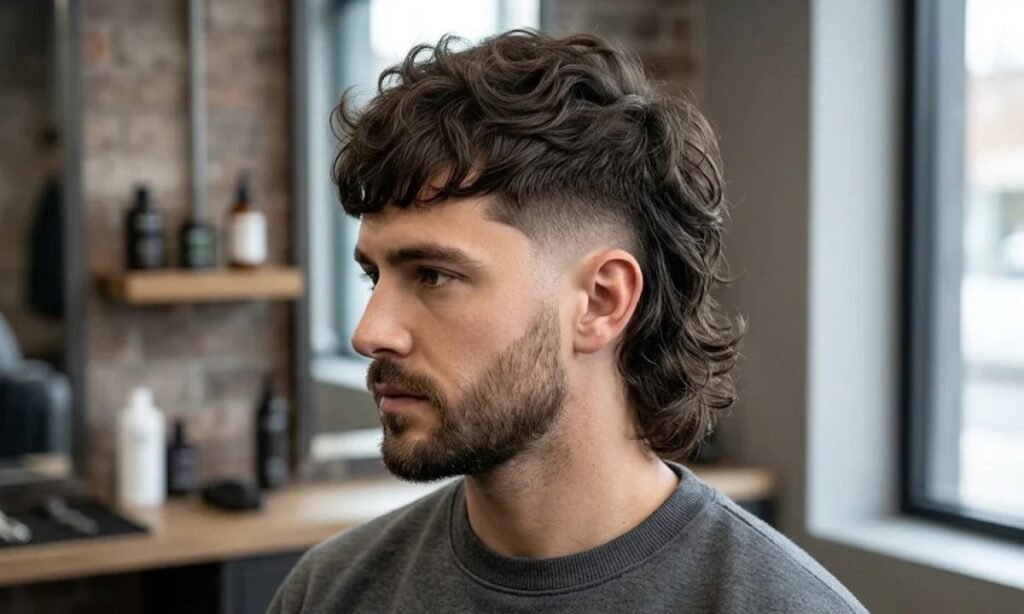
The natural-texture mullet lets your natural hair pattern do the talking. No heat, no fuss.
Your barber cuts with your hair growth pattern, not against it. That gives a more honest, easy-care shape.
A leave-in conditioner and a light curl cream are enough. Skip the heavy stuff.
Styles for Different Hair Types
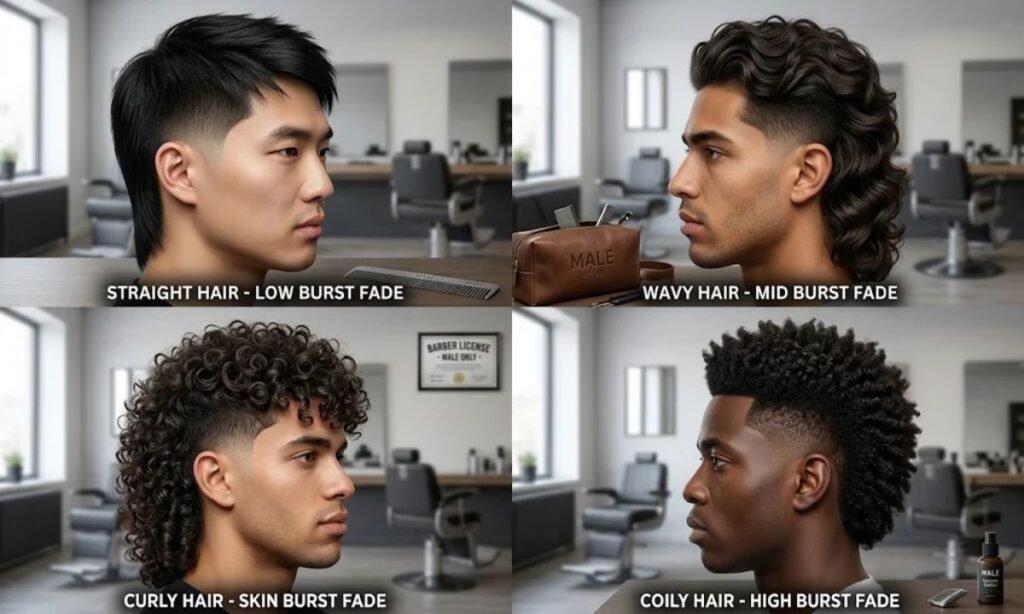
Your hair type decides which version works. Curly hair behaves differently than straight hair, and fine hair needs a different plan than dense hair.
Ignoring this is one of the biggest mistakes. Ignoring hair type leads to cuts that fight you every morning.
Here’s how to match the cut to your hair.
18. Curly Mullet with Burst Fade

The curly mullet with burst fade is a showstopper. The tight fade frames the curls, and the long back bounces.
Your barber should cut curls dry so they can see the real shape. Natural curls shrink when they dry, so leave extra length.
Use curl cream and let it air dry or use a hair diffuser.
19. Coily Mullet with Burst Fade

The coily mullet with burst fade shows off coily hair texture with sharp lines. The fade and the tail make a strong contrast.
Finger coils or twist-outs define the back. Keep it hydrated to avoid breakage.
A skin burst fade looks especially clean here. Book regular fade touch-up visits.
20. Wavy Mullet with Burst Fade
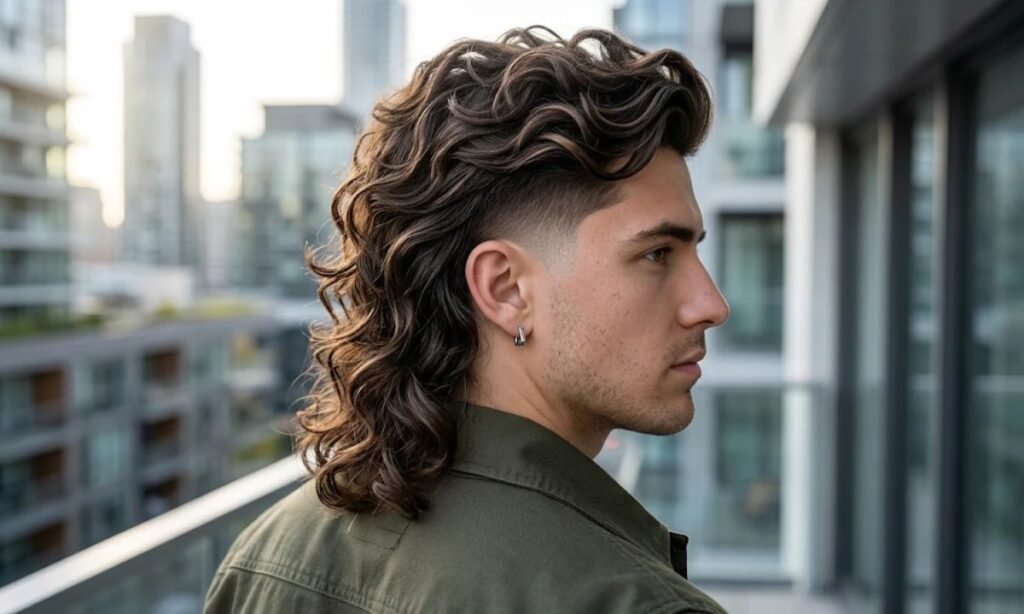
The wavy mullet with burst fade is the easiest to wear. Loose waves give the tail natural flow.
A bit of sea salt spray boosts the wave pattern. You’ll get a beachy, relaxed look.
It’s forgiving, which makes it perfect for first-timers.
21. Straight Hair Mullet with Burst Fade
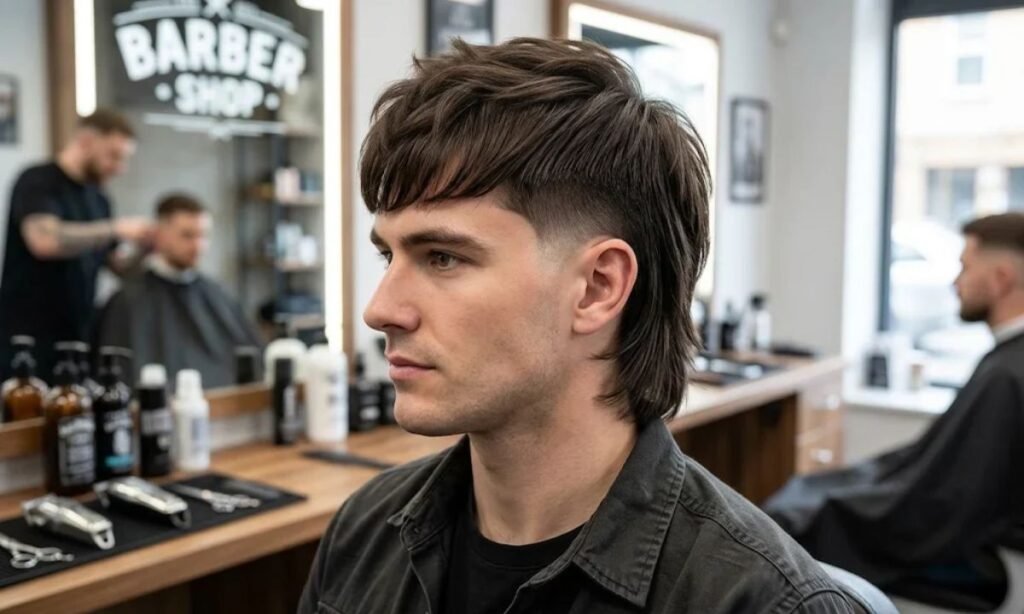
The straight hair mullet with burst fade needs layering. Without it, the back lies flat like a curtain.
Ask for feathered layers and textured back work. Add texture paste to build separation.
Straight hair holds a fade beautifully, so the sides will look sharp.
22. Burst Fade Mullet for Thick Hair

The burst fade mullet for thick hair removes weight where it counts. The fade clears the sides, and thinning shears tame the back.
This fights excessive hair bulk and keeps the shape clean. It also dries faster.
Use a light pomade or matte clay so the volume doesn’t balloon.
23. Burst Fade Mullet for Fine Hair

The burst fade mullet for fine hair relies on volume at the crown and shorter layers. Cutting it too long makes it look stringy.
A blow drying routine with volumizing mousse adds lift. Keep the back at medium length.
Choose a low burst fade mullet to keep weight on the sides where fine hair needs it.
Asian & Korean-Inspired Mullets
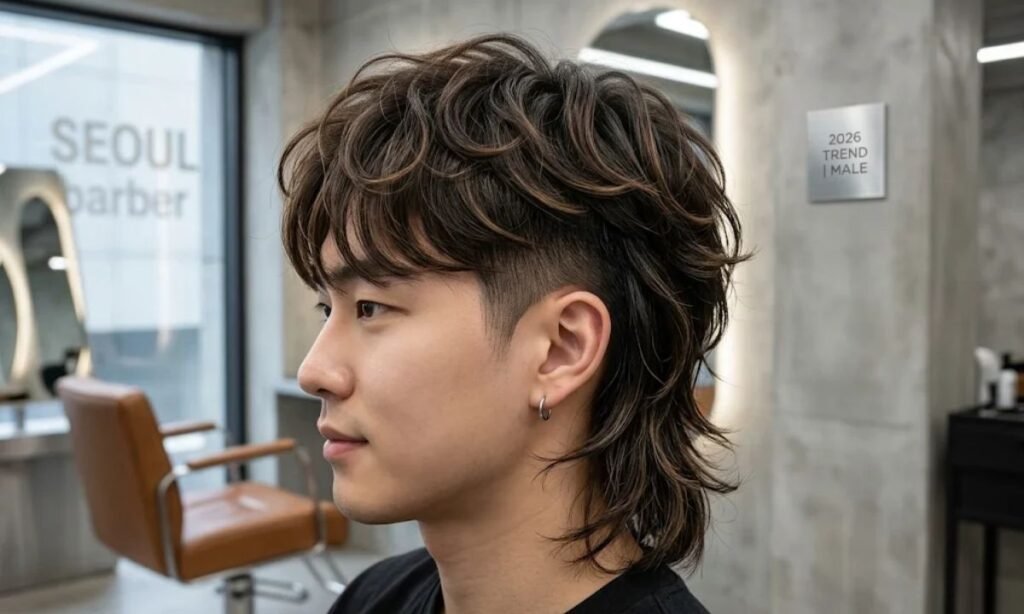
Asian hair is often thick and straight, which suits a clean fade and soft layers. Korean styling adds a polished, airy feel that has taken over social feeds.
These cuts focus on hair movement and natural finish. The fade is precise, and the top is usually softer.
Here are the two main versions.
24. Asian Modern Mullet with Burst Fade

The Asian modern mullet uses a precise burst fade and a layered back. It handles dense hair by thinning and layering.
The top gets a light textured top with a short fringe length. It looks neat but relaxed.
Use a matte finish product and blow-dry for hair separation.
25. Korean Mullet with Burst Fade

The Korean mullet with burst fade is soft, airy, and often parted. The fringe falls gently across the forehead.
The sides stay short with a smooth fade, while the back is feathered. It’s a sleek, youthful look.
Style it with a round brush, then finish with hairspray for a flexible hold.
Modern & Trendy Variations
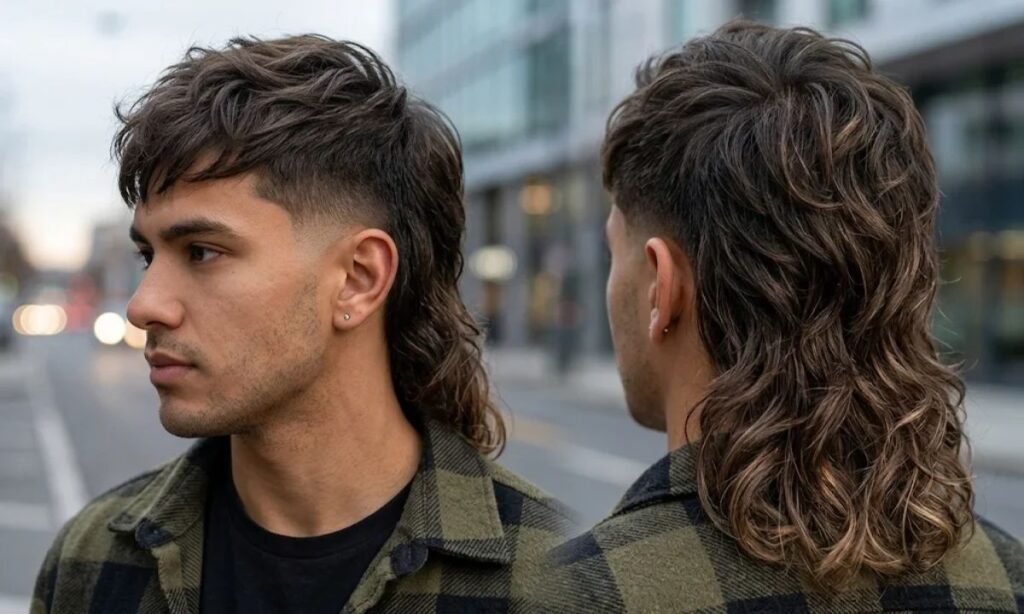
Some mullets chase trends harder than others. These versions borrow from streetwear, rock, and social media. They still use the same burst fade base, so the haircut structure stays solid.
If you like standing out, this is your corner of the guide. Just match the style to your face shape suitability, or the trend will wear you.
Here are five versions that keep showing up in 2026.
26. Wolf Mullet with Burst Fade

The wolf mullet with burst fade mixes a shaggy top with a chunky tail. It looks wild, like you just walked off a stage.
The fade keeps the sides tight so the shag doesn’t swallow your ears. That contrast gives it a sharp mullet silhouette.
Use sea salt spray and a bit of matte clay. Rough it up and leave it alone.
27. Edgar Mullet with Burst Fade
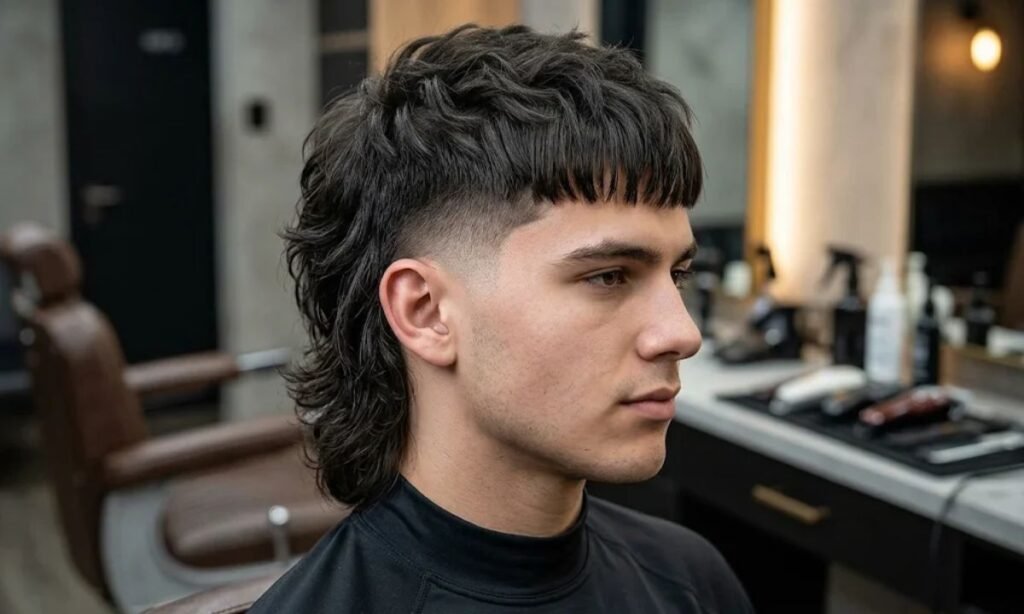
The Edgar mullet with burst fade pairs a blunt, forward fringe with a sharp fade and a short tail. It’s clean, bold, and very geometric.
The fringe sits straight across the forehead, so the hairline must be even. Ask for a crisp line up to finish.
Talk through the fringe length with your barber first. A fringe that’s too short looks like a mistake.
28. Mullet Mohawk with Burst Fade

The mullet mohawk with burst fade keeps the top long through the center and fades hard on both sides. The tail runs into the back as one continuous line.
It’s loud, and that’s the point. The fade makes the strip stand out like a ridge.
Use strong hold product if you want it standing up. Leave it soft for a looser, flowing look.
29. Mullet Faux Hawk with Burst Fade
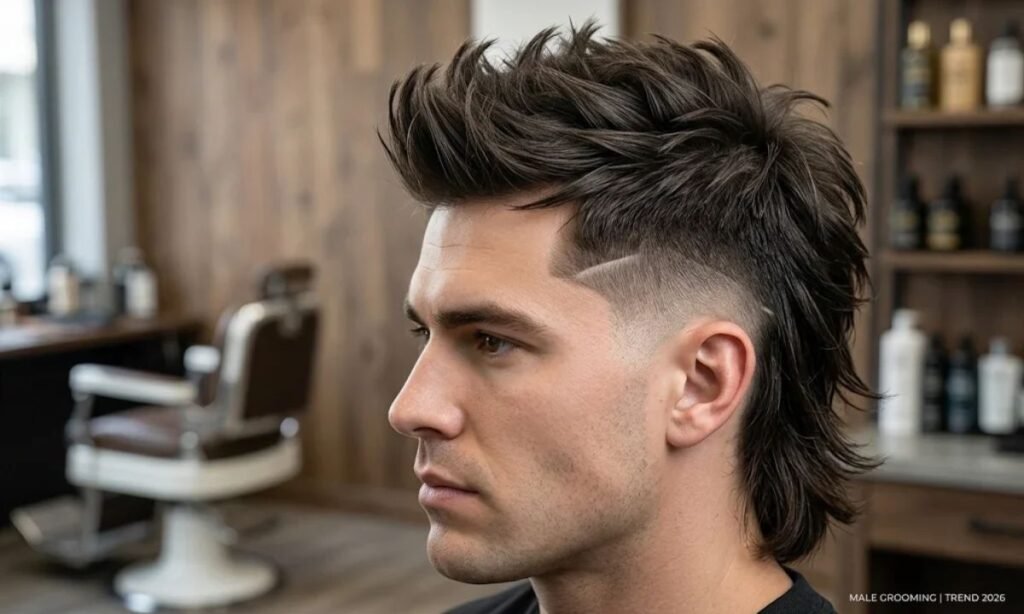
The mullet faux hawk with burst fade is the toned-down cousin of the mohawk. The top is pinched toward the center, but the sides keep some length.
This suits guys who want edge without scaring their grandmother. It also works in a casual office.
A light pomade and a quick finger-style do the job. No fuss needed.
30. Undercut Mullet with Burst Fade

The undercut mullet with burst fade disconnects the top from the sides. The burst fade cleans up the lower section, and the top stays long.
That disconnected layers look is dramatic, especially in the side profile. It’s a strong choice for dense hair.
Ask for a clear gap between the top and the fade. Your barber will keep it clean.
Fringe, Part & Styling Options
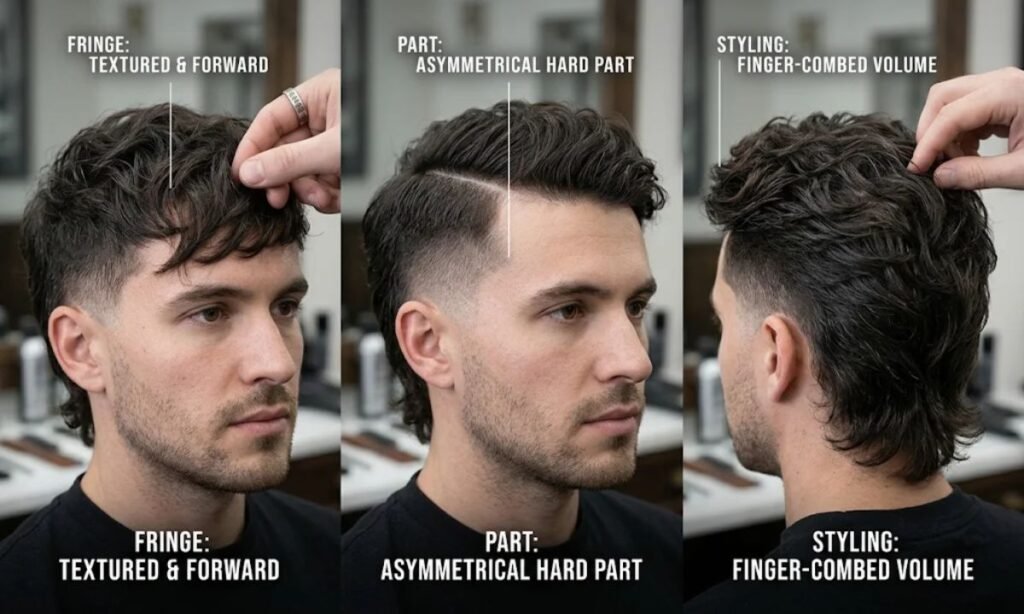
The front of a mullet changes everything. A fringe softens the face. A hard part sharpens it. A quiff adds height.
Pick a front that fits your forehead and your hair growth pattern. A cowlick at the front will fight a heavy fringe, so plan ahead.
Here are six ways to style the front.
31. Mullet with Burst Fade and Fringe

The mullet with burst fade and fringe is the all-rounder. A soft fringe falls across the forehead, and the fade stays crisp.
It gives you forehead coverage if that matters to you. It also makes the cut feel younger.
Trim the fringe every four to six weeks so it doesn’t poke your eyes.
32. Textured Fringe Burst Fade Mullet
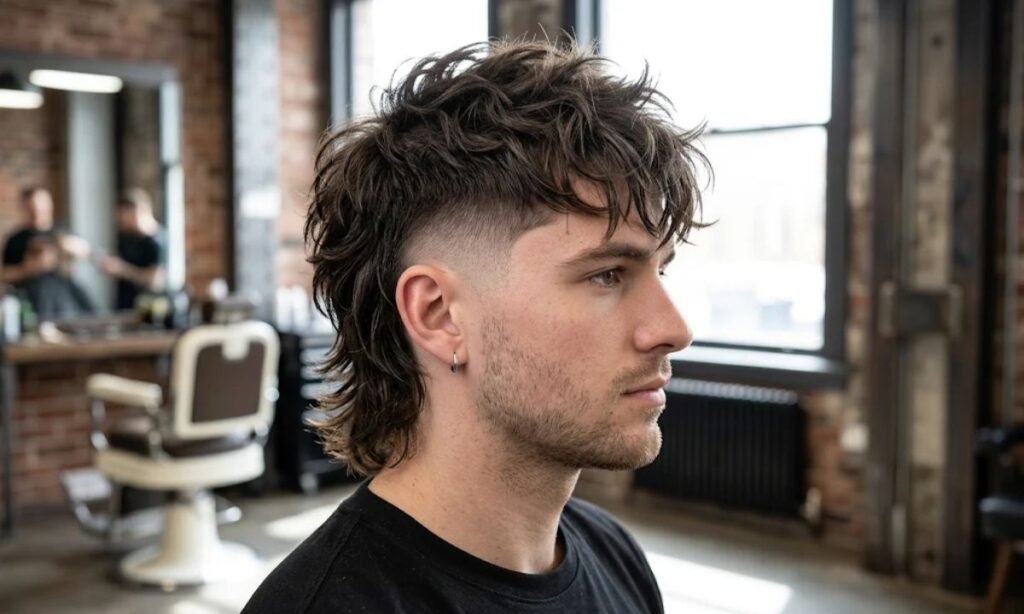
The textured fringe burst fade mullet has a broken, uneven front. Think messy bangs with a purpose.
Barbers use point cutting to make that effect. The texture paste you use at home completes it.
It works well on wavy hair and fine hair, since the texture hides thin spots.
33. Side-Parted Mullet with Burst Fade
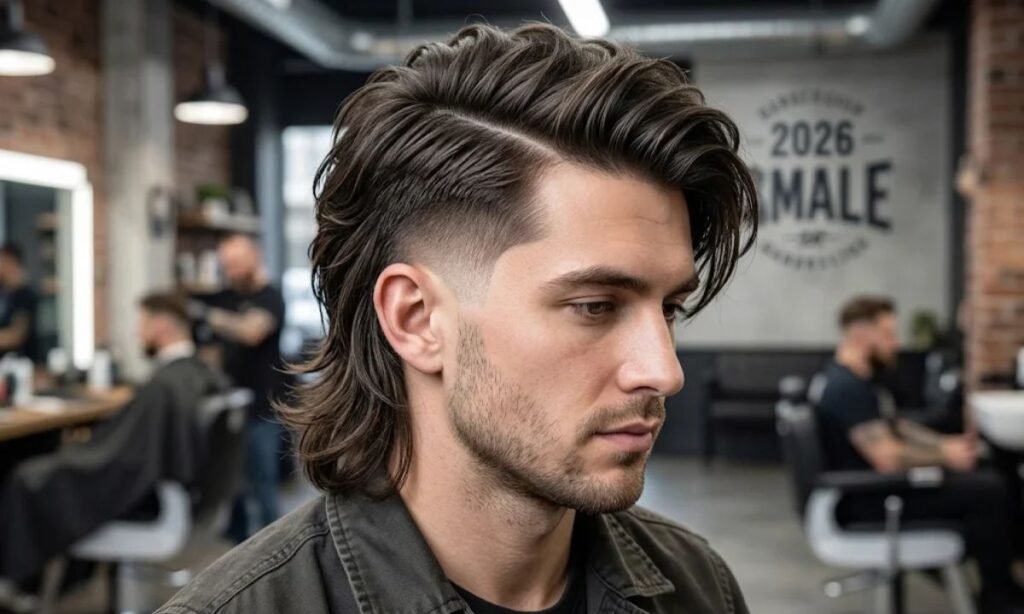
The side-parted mullet gives a classic, tidy front with a rebel back. It’s the business-friendly mullet.
Comb it over with a bit of pomade and the fade does the rest. People will see a neat guy with a surprise.
It’s one of the best answers to is a burst fade mullet suitable for work.
34. Slicked-Back Burst Fade Mullet

The slicked-back burst fade mullet pulls everything back, so the top flows into the tail. It looks polished and a bit retro.
You need enough top length, usually three to four inches. A strong hold gel or pomade keeps it in place.
Blend the tail into the slick-back so the transition looks smooth. This one looks great on straight hair.
35. Quiff Mullet with Burst Fade
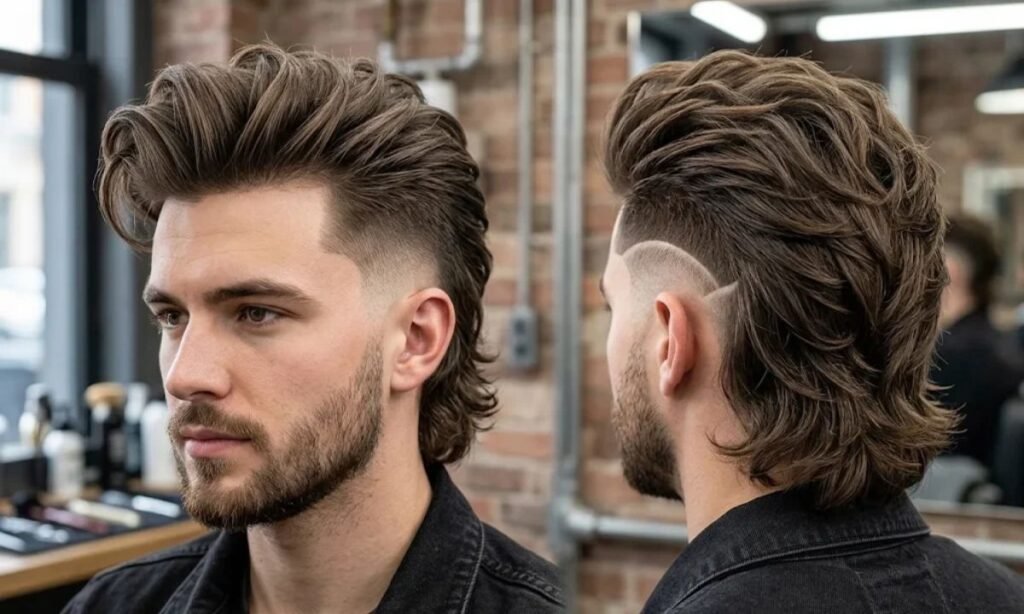
The quiff mullet with burst fade lifts the front into a soft wave. The fade at the side makes the quiff look taller.
Blow-dry the front with a round brush and finish with volumizing mousse. Add a touch of hairspray for flexible hold.
This suits guys who want top volume and a clean finish. It also stretches a round face.
36. Hard-Part Mullet with Burst Fade
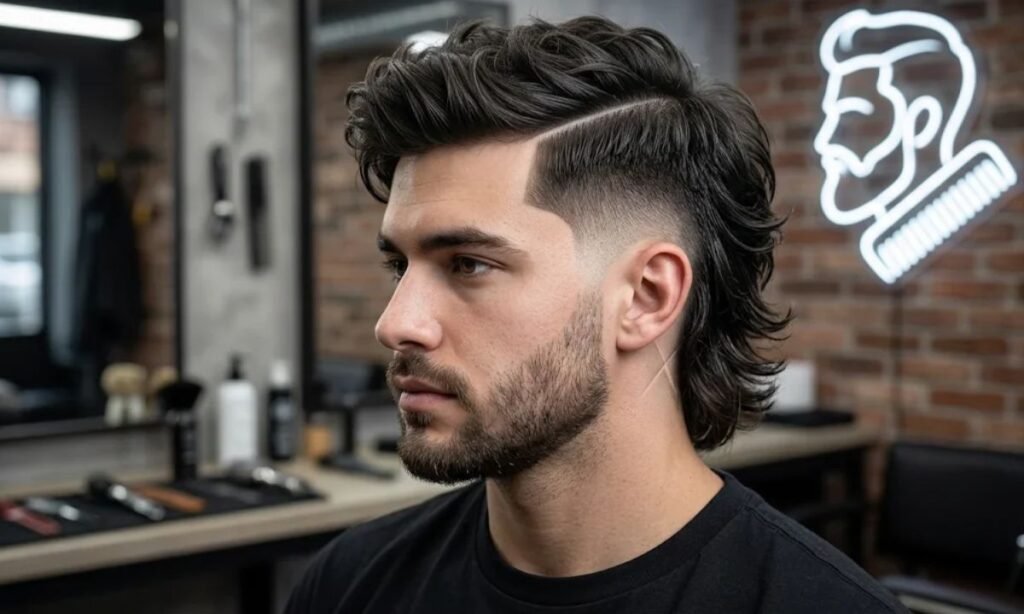
The hard-part mullet carves a shaved line into the side. The burst fade complements it by cleaning the sides.
The part gives a sharp, defined haircut outline. It looks great on thick hair or coily hair texture.
Ask your barber to cut the part first, then blend the fade. That keeps the lines clean.
Sharp & Detailed Finishes

Detail work turns a good cut into a great one. Lines, designs, and a clean neckline make the cut look expensive.
These finishes need a steady hand. Choose a barber with a portfolio that shows sharp scissor work and clean edges.
Here are five finishes to ask about.
37. V-Cut Mullet with Burst Fade

The V-cut mullet with burst fade shapes the back into a point. It draws the eye down the spine.
The point is cut with scissor cutting or razor cutting for a soft edge. Expect to trim it often to keep the V sharp.
It works best on medium-length backs and straight hair.
38. Burst Fade Mullet with a Hair Design

A burst fade mullet with hair design adds a shaved pattern into the fade. It might be a line, a symbol, or a small shape.
The design stands out most on a skin burst fade. Keep it simple at first, because bold designs need frequent touch-ups.
Bring reference photos so your barber knows what you want.
39. Burst Fade Mullet with a Line Up

A burst fade mullet with line up gives you a crisp edge along the forehead and temples. It frames the face.
The line up also cleans the temple area and the sideburn area. It’s a quick upgrade that makes any mullet look sharper.
Expect to refresh it every two to three weeks.
40. Spiky Mullet with Burst Fade

The spiky mullet with burst fade has punky points on top and a short, tidy fade on the sides. It’s playful and loud.
Use strong hold wax or clay. Work it in with your fingertips and pinch the ends.
The spikes look best with a textured back that matches the energy.
41. Burst Fade Mullet with a Tapered Neckline
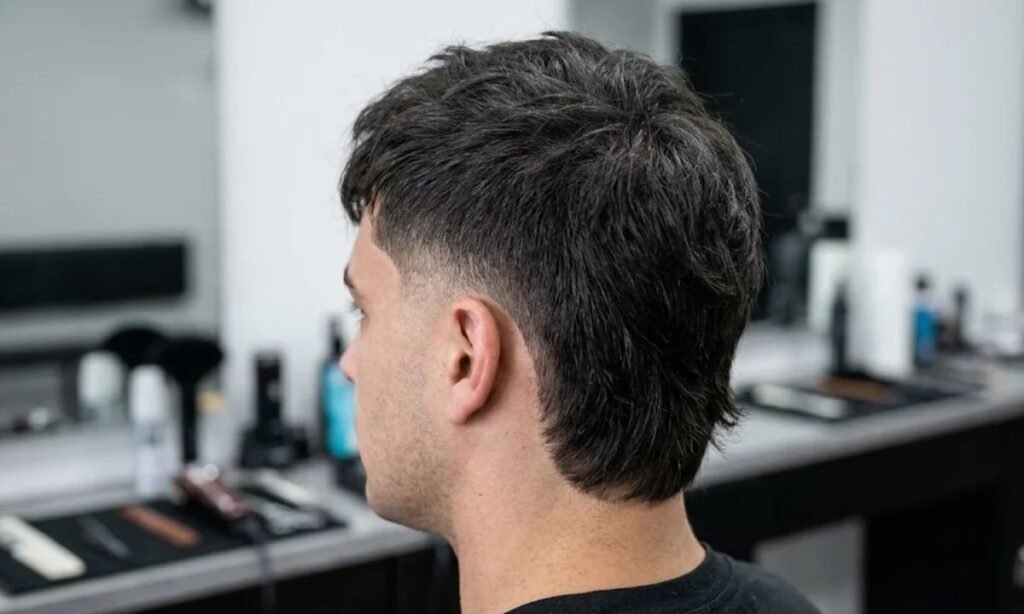
A burst fade mullet with tapered neckline fades the nape into a soft point. It looks neat when the tail is short.
A tapered nape also grows out gently, with no hard edge. That’s helpful if you skip a visit.
Ask for a clean fade finish and a natural taper. A blocked neckline would clash with the curve.
Beard, Blonde & Highlighted Looks

Beards and color change how a mullet reads. A beard adds weight to the face. Color adds attention to the hair.
The burst fade works well here because it can blend with facial hair. The curve flows right into the sideburns and then the beard.
Here are three ways to pair it.
42. Mullet with Burst Fade and Beard
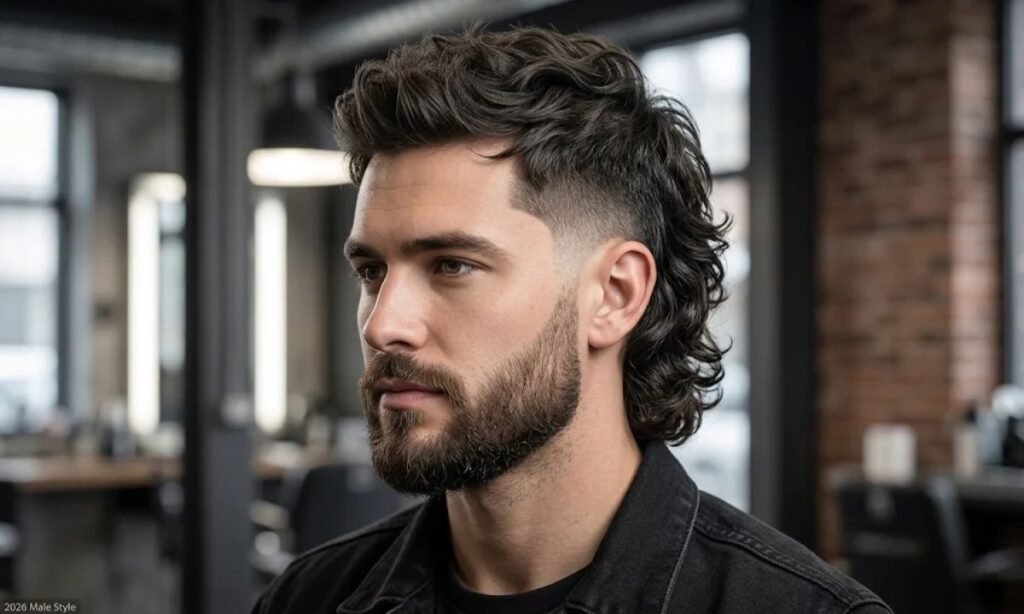
A mullet with burst fade and beard looks rugged and balanced. The fade blends into the beard so there’s no hard gap.
Tell your barber to match the fade base length with the beard’s length. That keeps the face looking connected.
Keep the beard neat along the neckline. A messy beard plus a messy mullet is too much.
43. Blonde Mullet with Burst Fade
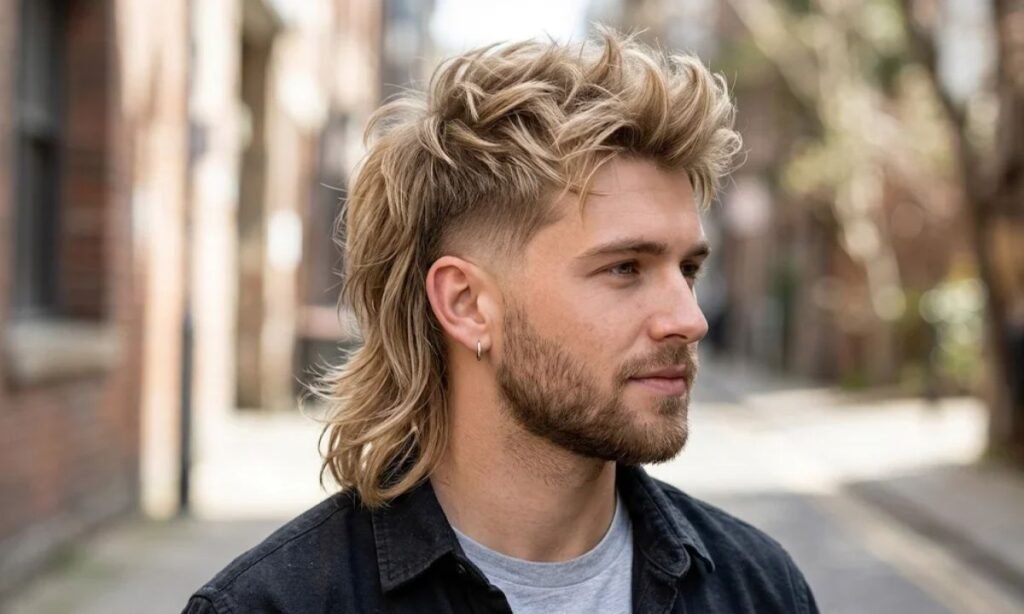
A blonde mullet with burst fade is bright and bold. The fade keeps the cut looking sharp so the color doesn’t look chaotic.
Bleach dries hair, so use a leave-in conditioner weekly. Purple shampoo keeps brassy tones away.
This suits straight hair and wavy hair especially well.
44. Highlighted Mullet with Burst Fade

A highlighted mullet with burst fade adds depth to the layers. Highlights show off textured top and layered back detail.
Pick shades close to your base color for a subtle effect. Go brighter for a statement.
Ask your colorist and barber to coordinate, because color changes how hair cuts and sits.
Braided & Twisted Styles
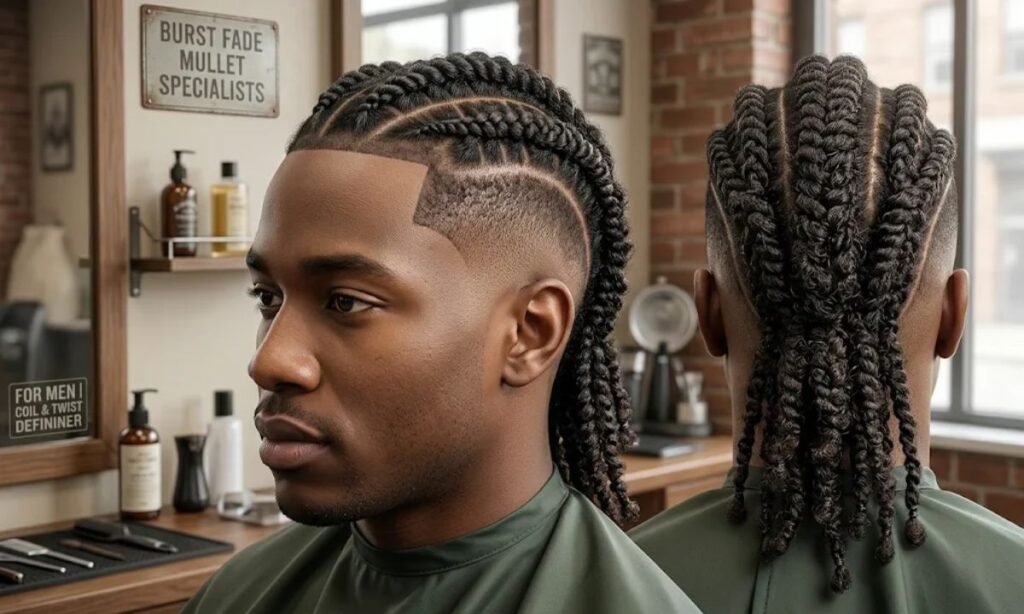
Braids and twists pair beautifully with a burst fade. The long back becomes a canvas, and the fade provides a clean frame.
These styles suit coily hair texture and natural curls, though any hair that’s long enough can be braided. Planning is key, since the hair needs enough length.
Here are two popular versions.
45. Mullet with Burst Fade and Braids

A mullet with burst fade and braids uses small braids in the back and a crisp fade at the sides. It’s a strong, intentional look.
The braids add movement and make the mullet tail the focus. The fade keeps the front tidy.
Don’t braid too tightly. Tension can damage the hairline over time.
46. Mullet with Burst Fade and Twists

A mullet with burst fade and twists gives you defined spirals in the back. It’s lightweight and easy to maintain.
Twists work with finger coils and curl cream for a defined pattern. A skin burst fade makes the contrast pop.
Retwist every few weeks to keep the pattern fresh and your scalp healthy.
Burst Fade Mullet Variations by Top Shape and Back Profile
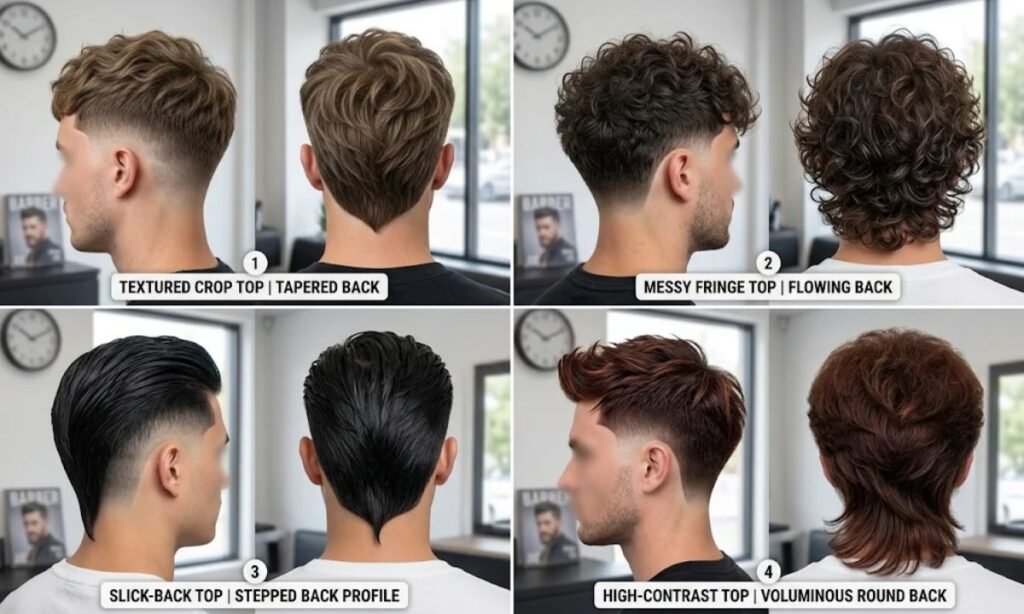
The top and the back define the shape of your cut. A flat top reads very different from a rounded crown. A curved back looks softer than a blunt one.
Think of this as sculpting. You’re shaping the overall haircut silhouette from the front, side, and back.
Here are four shapes to consider.
47. Burst Fade Mullet with a Disconnected Top

A burst fade mullet with a disconnected top uses a clear step between the top and the sides. The top keeps its length, and the sides stay short.
This creates a high-contrast look that suits thick hair. It also gives the cut a bold, graphic feel.
Ask your barber to keep the top heavy and the fade clean.
48. Burst Fade Mullet with a Curved Back Profile

A burst fade mullet with a curved back profile rounds the tail like a soft U. It looks gentle and natural.
The curve flatters narrow necks and gives the cut a flowing finish. It’s easy to maintain since there are no sharp corners.
Ask for a gentle curve from ear to ear along the nape.
49. Burst Fade Mullet with a Rounded Crown

A burst fade mullet with a rounded crown builds crown volume so the head looks full and even. The top curves like a soft dome.
It’s perfect for fine hair or flat backs of the head. The extra lift adds balance.
Use volumizing mousse and blow-dry from the root for lasting height.
50. Burst Fade Mullet with a Flat Top
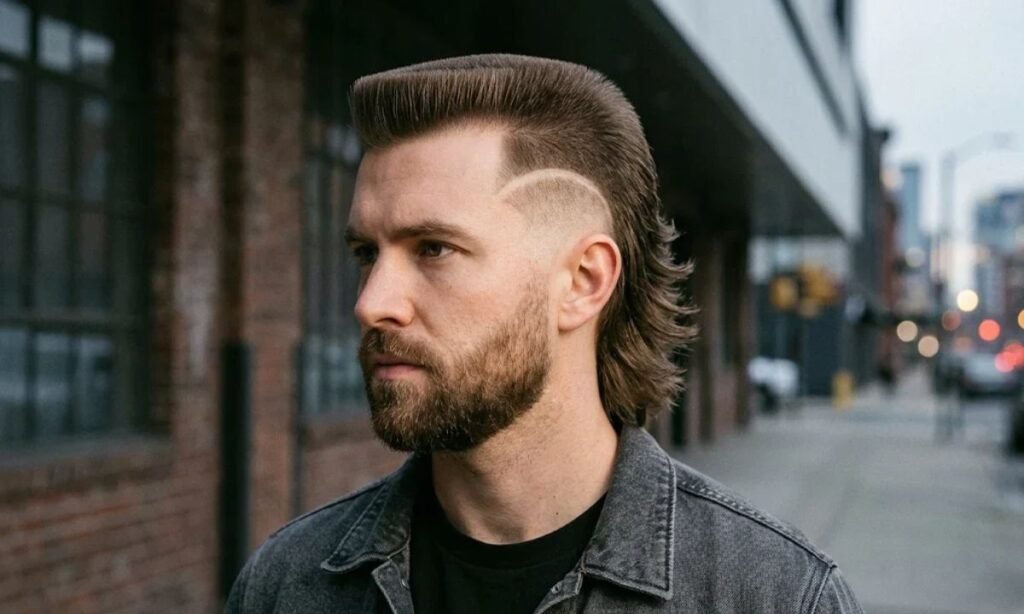
A burst fade mullet with a flat top squares off the top into a level plane. It’s rare, retro, and very sharp.
The fade helps the flat top look intentional. The long back gives it a rock-and-roll twist.
This one needs a skilled barber and regular touch-ups. Flat tops show every mistake.
Burst Fade Mullet Back and Crown Styles: Feathered, Blunt, Graduated, and Textured Finishes
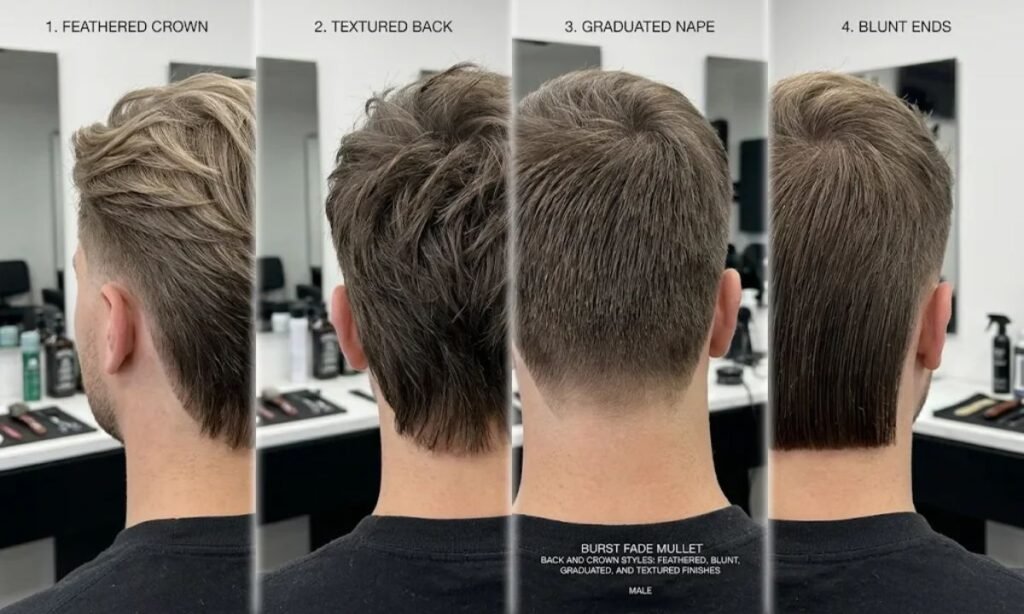
The back of your mullet deserves as much thought as the front. It’s what everyone sees when you walk away.
Here you choose how the ends finish. Soft and feathered, hard and blunt, or somewhere in between.
There are five finishes worth knowing.
51. Burst Fade Mullet with a Feathered Back
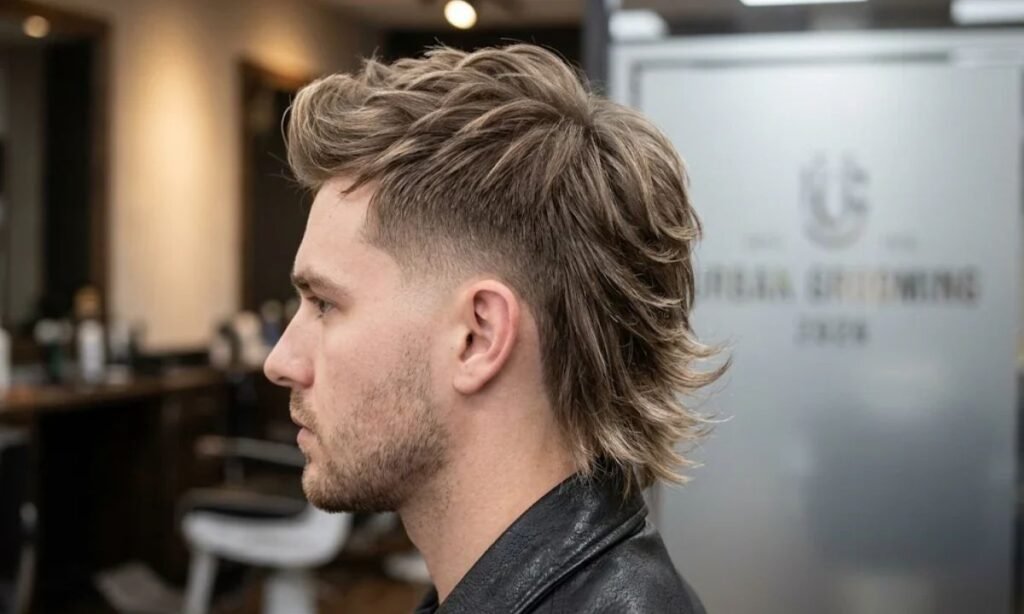
A burst fade mullet with a feathered back has soft, wispy ends. Feathered layers give it a light, airy fall.
It’s a good fit for straight hair and fine hair. The soft ends hide thinness.
Ask for point cutting at the ends and avoid blunt cuts.
52. Burst Fade Mullet with a Blunt Cut Finish
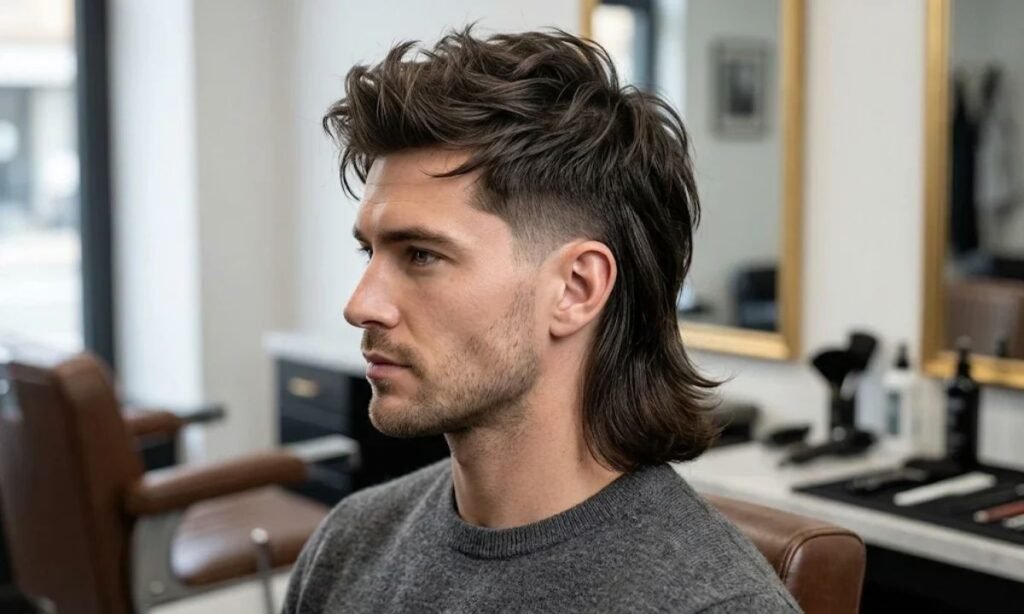
A burst fade mullet with a blunt cut finish ends in a clean, straight line. It looks strong and modern.
Blunt ends make thick hair look fuller. They also show off healthy hair.
Keep up with trims. A blunt cut shows split ends fast.
53. Burst Fade Mullet with a Graduated Back
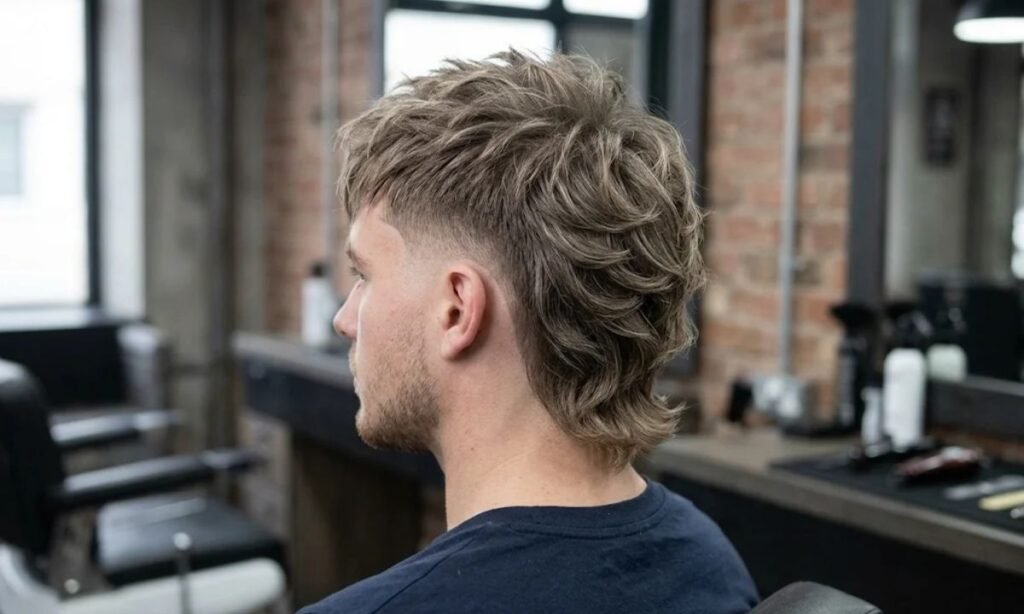
A burst fade mullet with a graduated back stacks the hair from short to long. The layers build up toward the tail.
That creates a smooth mullet silhouette with weight at the bottom. It’s neat and easy to style.
Ask your barber for a gradual fade transition into the back.
54. Burst Fade Mullet with Asymmetrical Layers

A burst fade mullet with asymmetrical layers has one side longer than the other. It feels edgy and artistic.
The fade helps the uneven layers look deliberate. Without it, the cut might look lopsided.
Style it with texture paste and let the hair movement do the talking.
55. Burst Fade Mullet with a Textured Crown

A burst fade mullet with a textured crown uses choppy cuts at the top back of the head. It adds volume at the crown and a messy charm.
This style hides cowlicks well. It also works for hair volume control in dense hair.
A bit of matte clay pulls it all together.
Burst Fade Mullet Variations with Unique Finishes, Hairlines, and Styling Details

The last five styles focus on small details. They’re the touches that make your cut look custom.
Your hairline, neck flow, and cutting tool all change the final look. Don’t skip these when you talk to your barber.
Here are five finishing touches.
56. Burst Fade Mullet with a Natural Neck Flow

A burst fade mullet with a natural neck flow lets the hair fall along your neckline with no sharp edge. It looks easy and relaxed.
Your barber leaves the longer neckline untouched and just removes strays. It grows out beautifully.
This is great for guys who dislike frequent visits.
57. Burst Fade Mullet with a Rounded Hairline
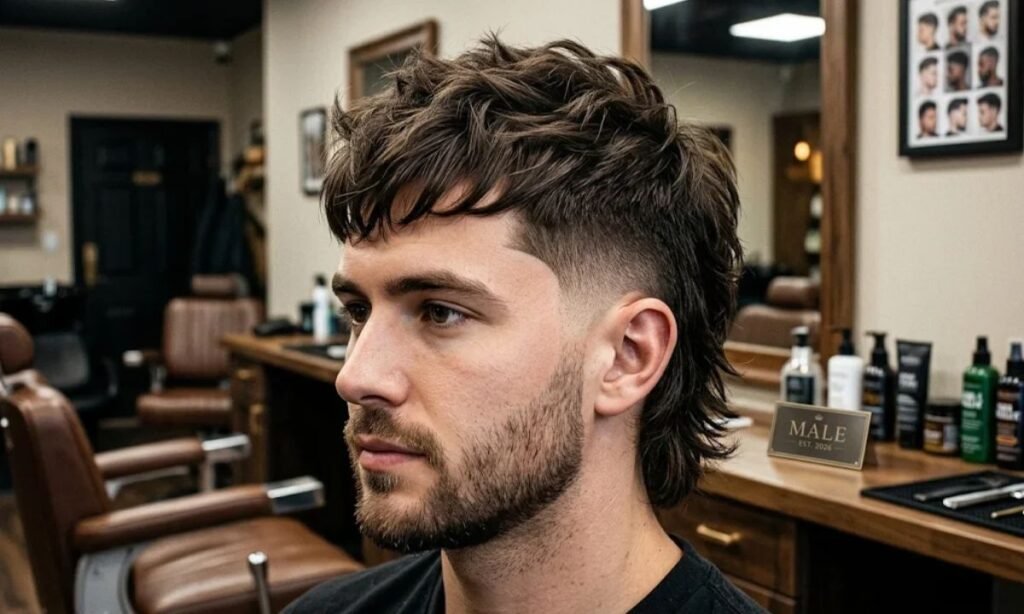
A burst fade mullet with a rounded hairline softens the edges around the forehead and temples. It looks natural and youthful.
It’s less sharp than a line up, so it’s more forgiving. Good for guys who want a natural finish.
Ask your barber to skip the razor at the front.
58. Burst Fade Mullet with a Scissor-Cut Top

A burst fade mullet with a scissor-cut top uses shears for a soft, flowing finish. It avoids the harsh look of clippers.
Scissor cutting gives more control over hair texture and density. It’s perfect for wavy hair and curly hair.
Expect a longer appointment, but the result is worth it.
59. Burst Fade Mullet with a Two-Tone Color Blend
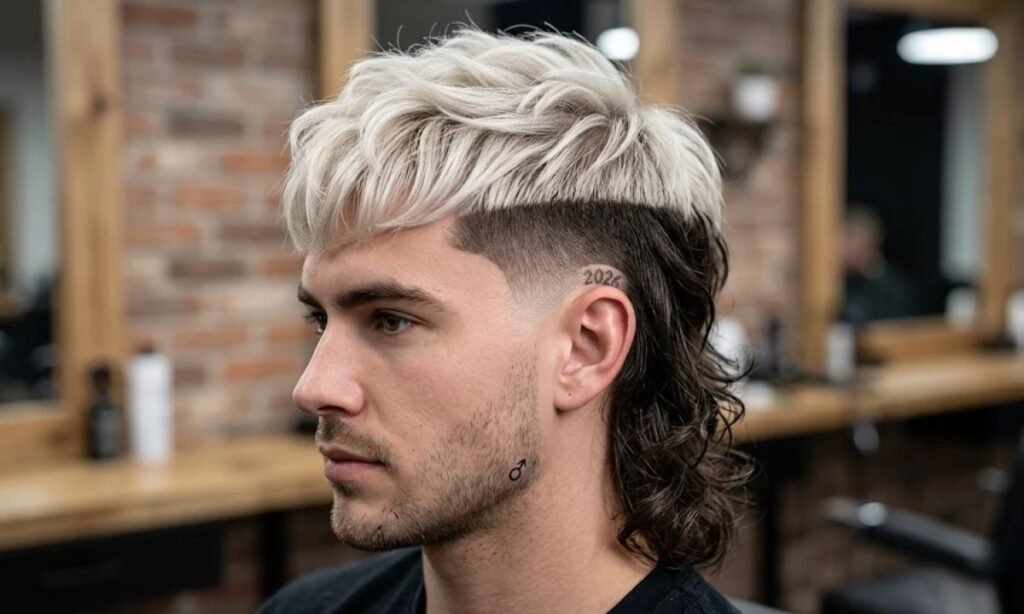
A burst fade mullet with a two-tone color blend fades one color into another. The top might be dark, the tail bright.
The burst fade keeps the edges neat so the color is the star. It’s a fun summer look.
Plan on extra care and a color-safe shampoo.
60. Burst Fade Mullet with a Razor-Cut Finish

A burst fade mullet with a razor-cut finish uses a razor to soften and shred the ends. It makes the hair look light and airy.
Razor cutting adds texture without bulk. It suits thick hair and straight hair.
Don’t use it on very dry or frizzy hair, since it can rough up the cuticle.
Burst Fade Mullet vs Other Popular Mullet Haircuts

With so many mullets floating around, it’s easy to mix them up. Barbers use different names for similar cuts.
Knowing the differences helps you ask for exactly what you want. It also keeps you from walking out with the wrong haircut.
Here’s a quick tour of five comparisons.
Burst Fade Mullet vs Modern Mullet

A modern mullet is a broad term for any updated mullet. A burst fade mullet is a specific kind, with a curved fade around the ears.
So every burst fade mullet is modern, but not every modern mullet has a burst fade. Think of it as a square and a rectangle.
Choose the burst fade if you want sharp, clean sides.
Burst Fade Mullet vs Taper Mullet

A taper mullet shortens the hair gradually down the sides and neck. It’s subtle and soft.
The burst fade is more dramatic because the curve shows around the ear. The taper is easier to wear with a suit.
Pick the taper if you want low drama. Pick the burst for more shape.
Burst Fade Mullet vs Burst Fade Mohawk
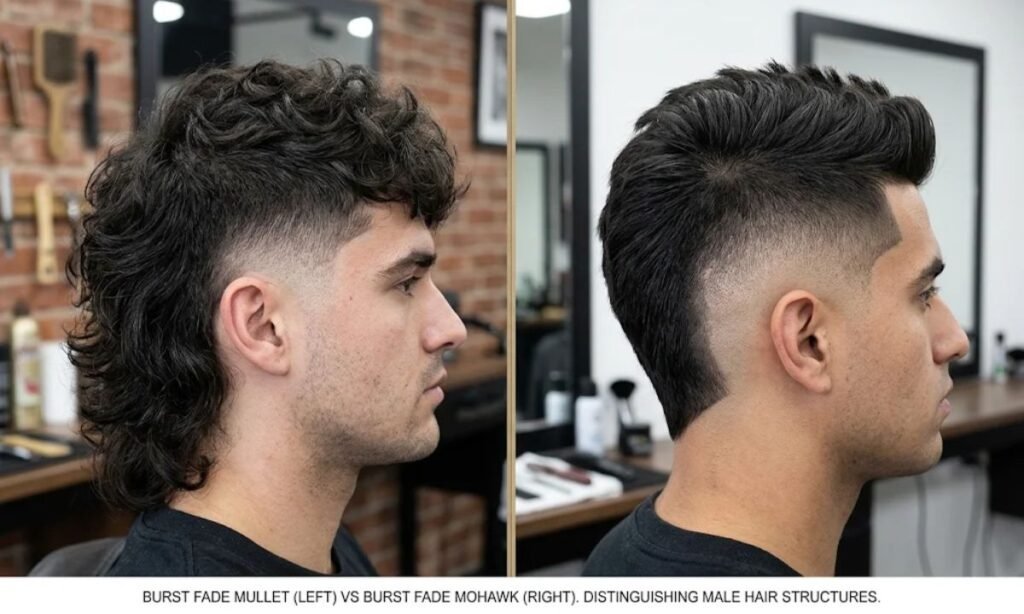
A burst fade mohawk keeps a long strip on top and fades the sides, but the back is usually short. The mullet keeps length in the back.
That back length is the dividing line. The mohawk looks forward. The mullet looks balanced.
If you want a tail, go mullet. If you want a crest, go mohawk.
Burst Fade Mullet vs Drop Fade Mullet
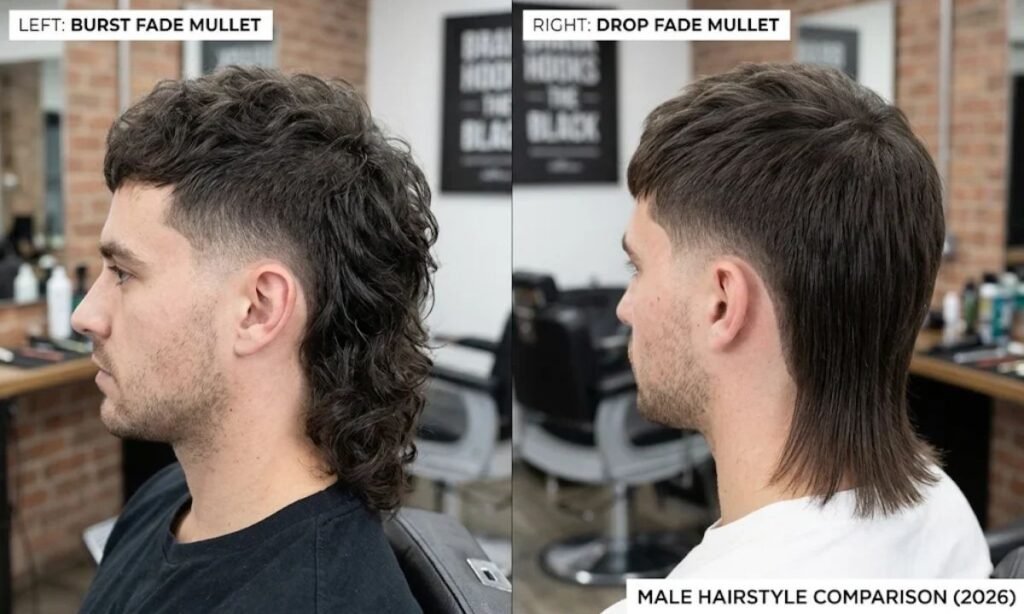
A drop fade mullet curves down behind the ear and dips toward the neck. The line drops lower in the back.
A burst fade circles the ear and stays more rounded. That’s the main difference.
A drop fade suits guys with longer tails and a lower neckline.
Burst Fade Mullet vs Skin Fade Mullet

A skin fade mullet describes how low the fade goes, down to bare skin. A burst fade describes its shape.
You can actually have both, a skin burst fade. They’re not rivals, just different labels.
Tell your barber the shape and the finish, so they can nail both.
How to Style a Burst Fade Mullet
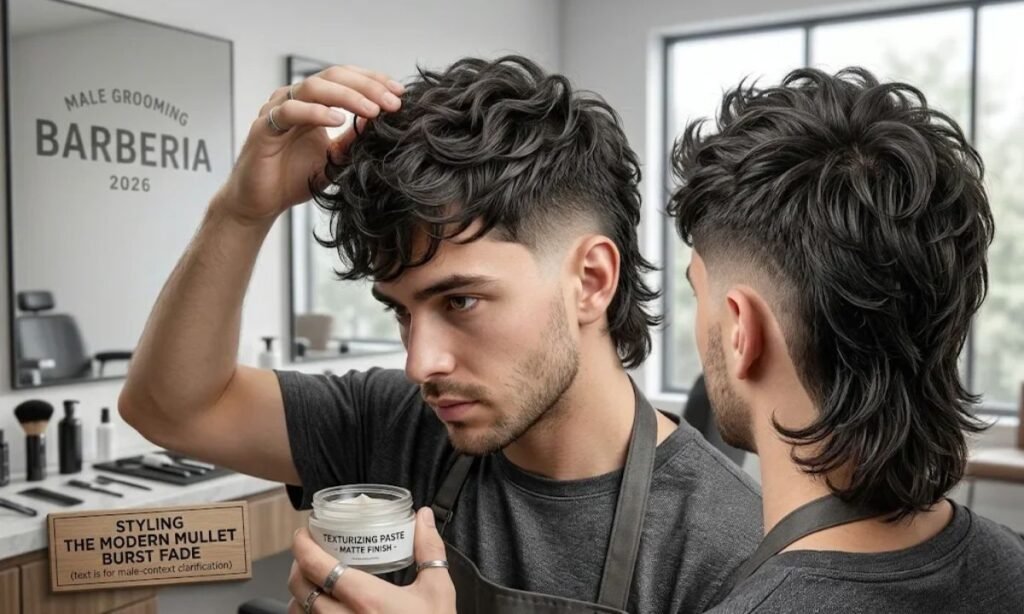
Here’s the good news. A burst fade mullet takes about five minutes to style. Most of the work is done by the cut.
Start with damp hair. Apply a small amount of product and shape it with your fingers or a comb.
Want a step-by-step? Here’s the routine I’d give a friend.
- Towel-dry your hair so it’s damp, not dripping.
- Add sea salt spray or volumizing mousse at the roots.
- Blow dry the top with a round brush for lift.
- Rub a pea-sized amount of matte clay or texture paste between your palms.
- Work it through the top and tail, then finish with hairspray if needed.
For curly hair, use a hair diffuser and curl cream instead. For straight hair, add texture with paste. Your styling routine should match your hair texture and density.
How to style a burst fade mullet also depends on the vibe. Messy for the weekend, polished hairstyle for the office. Same cut, different finish.
Products That Work Best for a Burst Fade Mullet
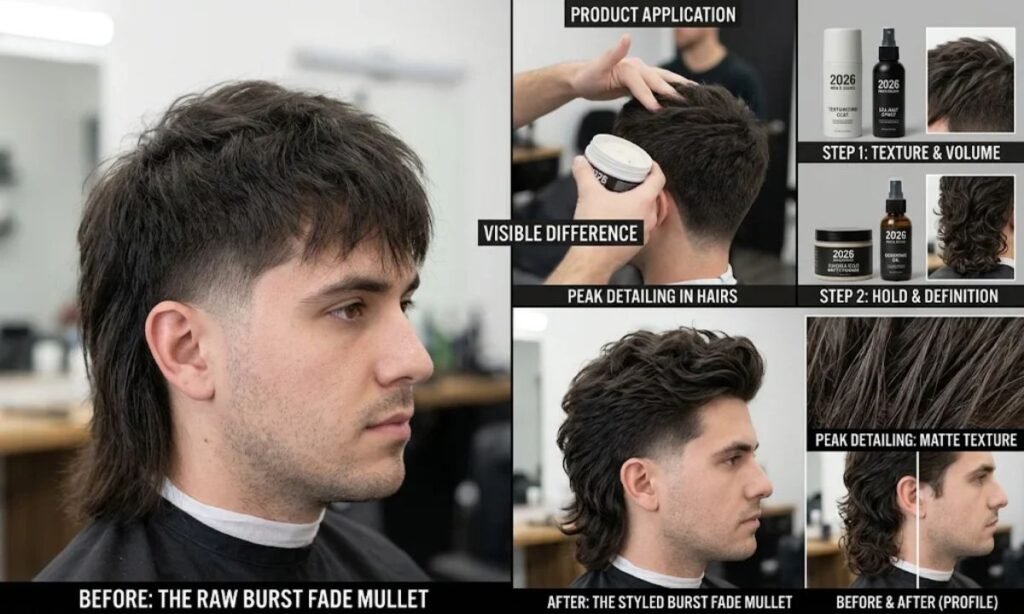
Products can make or break a mullet. The right one gives hold and texture. The wrong one weighs everything down.
Pick by hair type and finish. Don’t buy five jars. Two or three are enough.
- Matte clay: a matte finish with flexible hold, great for thick hair.
- Texture paste: adds separation, good for choppy layers.
- Pomade: adds shine and strong hold, great for slicked-back looks.
- Sea salt spray: gives grit for beach texture.
- Curl cream: supports natural curls and helps with frizz control.
- Volumizing mousse: lifts fine hair and boosts hair volume.
- Leave-in conditioner: keeps the long back healthy.
Use less than you think. Overusing styling products is one of the easiest ways to ruin the look. A dime-sized amount often does the job.
If your hair feels crunchy, switch to a lighter product. If it feels flat, add mousse at the roots.
How to Ask Your Barber for a Burst Fade Mullet
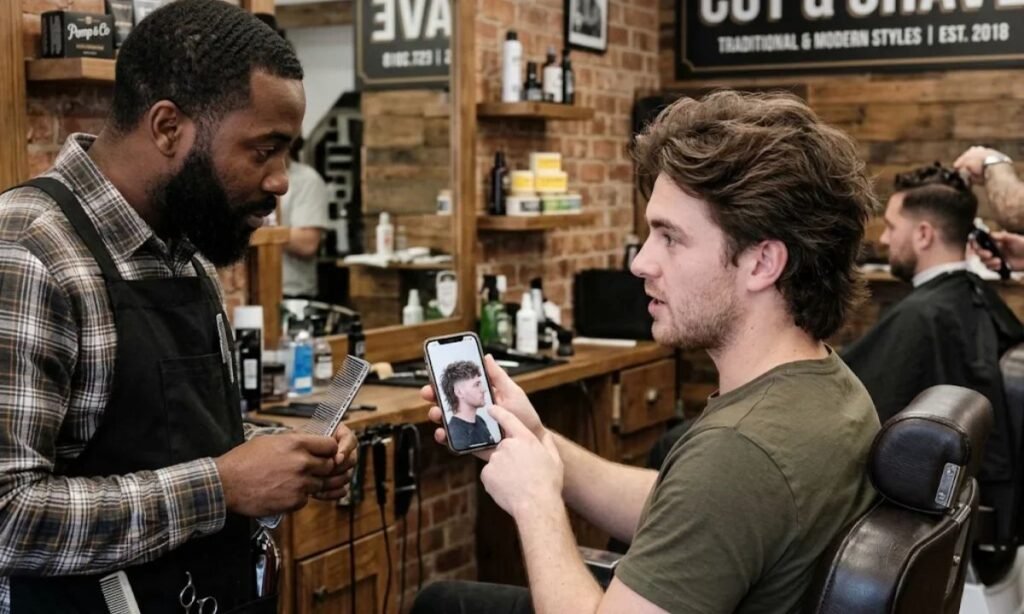
The haircut consultation is the most important five minutes of your visit. Talk clearly, and bring photos.
A good barber listens and asks questions. A great one tells you what won’t work for your hair type.
Here’s a simple script you can use.
- Say, “I want a burst fade mullet with a medium curve around the ear.”
- Tell them the fade height: low, mid, or high.
- Mention the guard sizes you prefer, like guard number 1 at the base.
- Describe the back length in inches, such as three to four inches.
- Ask for layers or texture based on your hair.
- Show your reference photos, from the front, side, and rear view.
Skipping reference photos is a classic mistake. Words can mean different things to different barbers. A picture removes the guesswork.
And ask questions. How often should I come back? What products do you recommend? That’s how you build a real relationship with your barber.
Growing Out and Transitioning to a Burst Fade Mullet
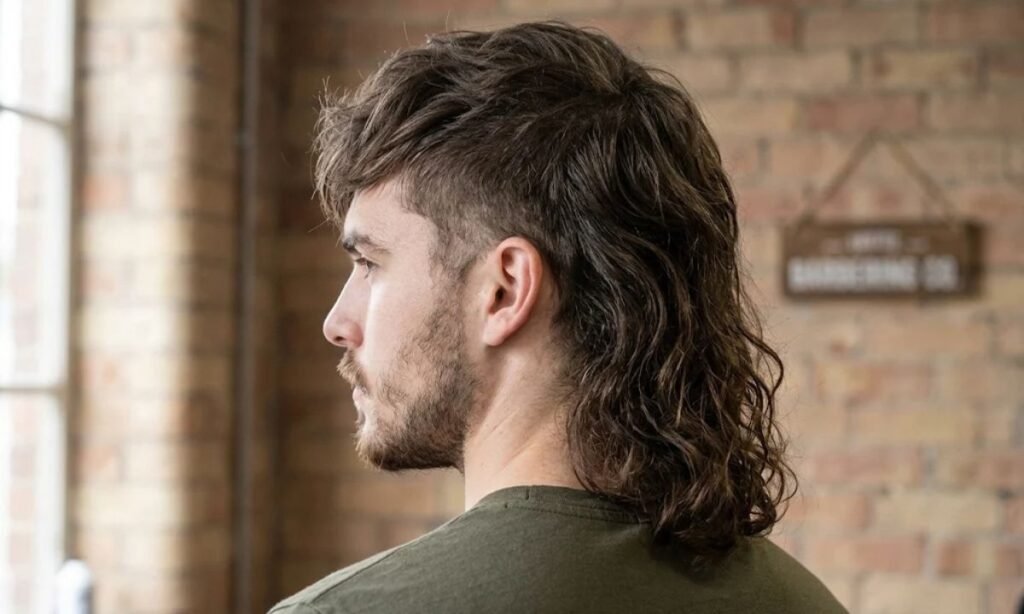
Can’t just walk in and get a mullet from short hair? Not quite. You’ll need patience.
The mullet grow-out period depends on your hair growth rate. Most hair grows about half an inch a month, so a four-inch tail takes around eight months.
The good news is you can wear a burst fade the whole time. It keeps the sides tidy while the back catches up.
Which Hair Areas Should You Grow Before Booking Your First Appointment?
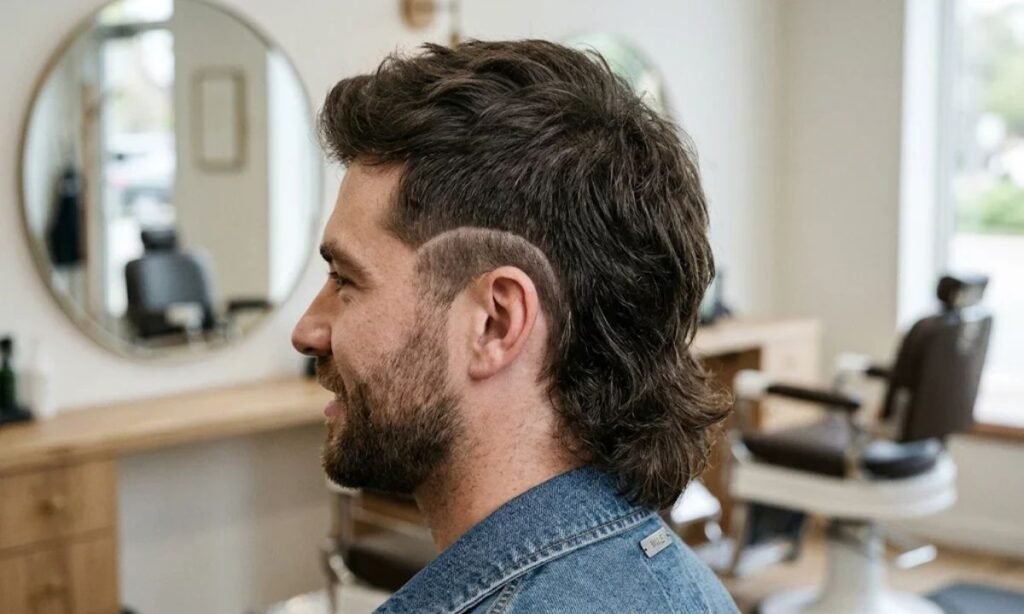
Focus on the back and the top. Those two zones decide how the cut looks. The sides will be faded anyway, so you can skip those.
Aim for at least three inches on top and two to three inches at the nape. That gives your barber enough to shape.
If you’re wondering can you get a burst fade mullet with short hair, the answer is yes, but it’ll look like a short mullet at first.
How Do You Transition From a Traditional Haircut to a Mullet Shape?

Start by stopping the back trims. Keep the sides and top trimmed so the cut doesn’t look wild.
Ask your barber for a light burst fade early. That gives the mullet shape a framework while you grow.
Trim the fade grow-out areas every four weeks and shape the neckline. By month four, you’ll see the tail forming.
Modern Burst Fade Mullet Guard Sizes

Guard numbers confuse a lot of guys. Here’s a plain-English look. Guard sizes can vary slightly between brands, so confirm with your barber.
The fade guard sequence usually starts at the lowest guard and builds up. A burst fade blends two to three guards in a curve.
Here’s the cheat sheet.
| Guard | Length | Typical Use |
|---|---|---|
| 1 | 1/8 inch (3 mm) | Base of a skin or shadow fade |
| 2 | 1/4 inch (6 mm) | Lower to mid blend |
| 3 | 3/8 inch (10 mm) | Mid blend into the curve |
| 4 | 1/2 inch (13 mm) | Top of the fade or soft low fade |
Guard 1
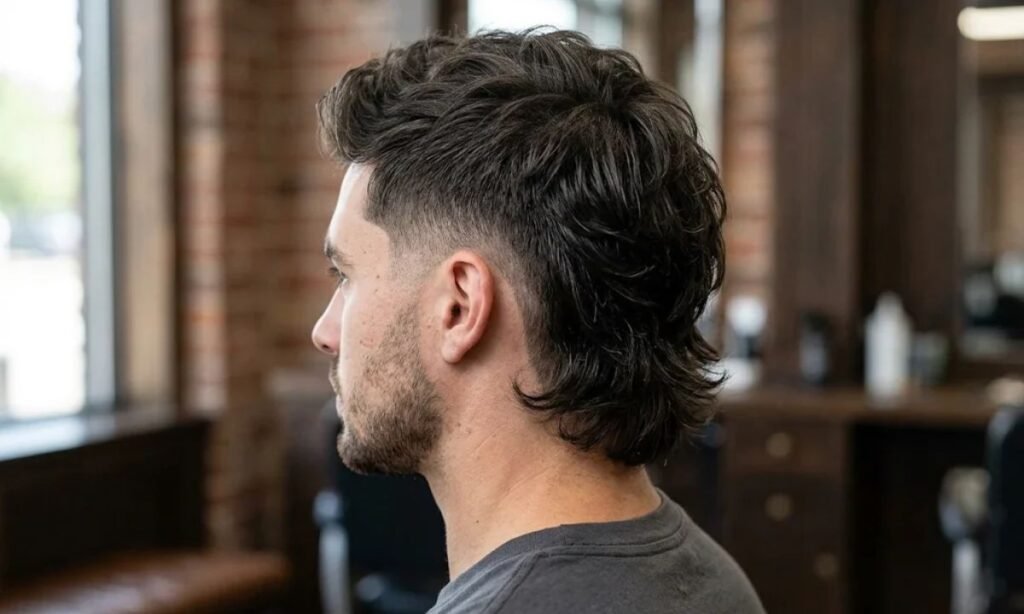
Guard number 1 leaves hair at about an eighth of an inch. It’s the go-to for a shadow burst fade base.
It shows a hint of hair, not bare skin. That’s softer and easier to maintain.
It’s also a safe starting point if you’re nervous.
Guard 2

Guard number 2 leaves about a quarter inch. It works as a mid-tone in the fade.
It gives a visible blend between the base and the longer hair. Many barbers use it as the second step.
It’s great for a tapered burst fade.
Guard 3

Guard number 3 leaves about three-eighths of an inch. It works well in the top section of a low or mid fade.
This guard helps create smooth transitions into the longer hair. It also keeps density for fine hair.
Ask for it if you don’t want too much contrast.
Guard 4
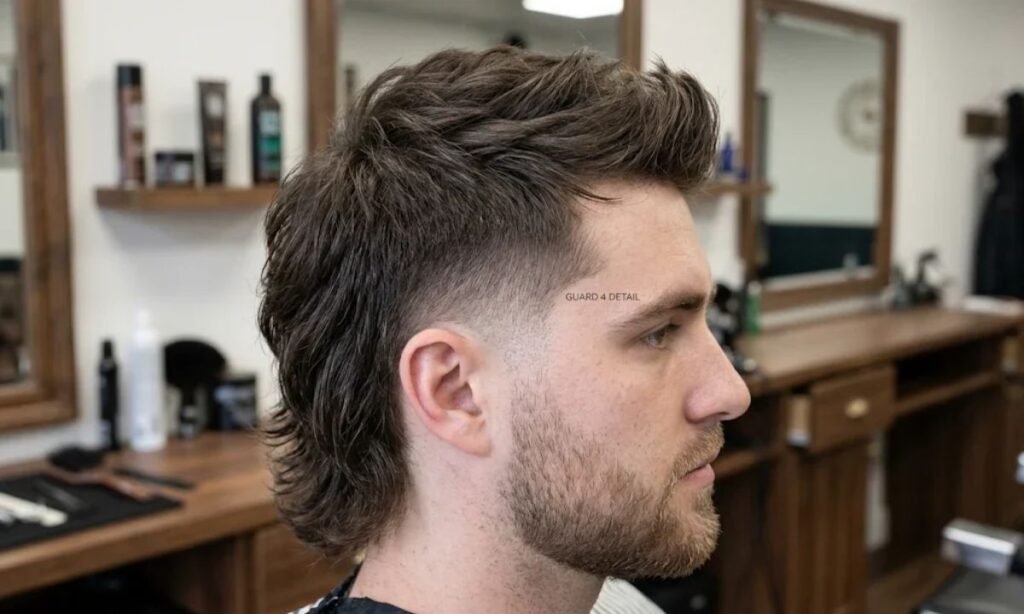
Guard number 4 leaves half an inch. It’s the longest of the four and usually marks the end of the fade.
Use it for a gentle, natural finish and a soft fade. It’s also good for thick hair.
Combine it with scissor work to blend into the top.
Common Mistakes When Getting a Burst Fade Mullet

A mullet is easy to get wrong. Most mistakes come from rushing or poor communication. Here are the big ones.
Avoid these, and you’ll save yourself weeks of regret.
- Taking the fade too high: it shrinks the top and makes the head look small.
- Cutting the back too short: you lose the whole point of a mullet.
- Ignoring hair type: curls, waves, and fine hair all need different cuts.
- Choosing the wrong fade height: a high fade on a round face adds width.
- Uneven fade blending: visible lines look careless.
- Poor haircut proportions: if the top and back don’t match, the cut looks off.
- Overusing styling products: it makes hair greasy and flat.
- Incorrect clipper guard: the wrong guard changes the entire fade.
- Choosing an inexperienced barber: fades take skill.
- Skipping reference photos: guesswork leads to surprises.
- Unbalanced neckline: a crooked neck shows from behind.
- Poor fade maintenance: the cut loses shape within weeks.
Here’s a short story. A guy once asked for a mullet, but he didn’t bring photos or mention length. He left with a short, spiky cut and a sad face. A single photo would have fixed it.
Take your time and choose your barber carefully.
How Often Should You Book a Fade Touch-Up?

Most people need a fade touch-up every two to four weeks. Skin fades fade fastest, and low fades last longer. The goal is maintaining fade definition.
The back can wait longer. You only need to trim the tail every six to eight weeks. That helps with maintaining mullet shape and back length maintenance.
Create a simple hair trimming schedule. Book your next visit before you leave the chair. It keeps your haircut upkeep easy and stress-free.
You can also checkout this article as well: 40+ Best Round Face Shape Haircuts For Men In 2026
Frequently Asked Questions about Burst Fade Mullet Styles
Here are the questions guys ask most. Short, honest answers, no fluff.
If yours isn’t here, drop it in the comments. We’ll add it.
Is a burst fade mullet hard to maintain?
Not really. The fade needs a trim every two to four weeks, and the back needs one every six to eight. Daily styling takes about five minutes.
If you want less work, choose a low or shadow fade. They grow out gracefully.
Does a burst fade mullet work for office jobs?
Yes, if you keep it subtle. A low burst fade with a short back and a side part looks tidy and professional.
Save the wild versions for weekends. You can still show personality without causing a stir.
How long does hair need to be for a mullet?
You need about three inches on top and two to three inches at the back. That’s enough for a short mullet.
For a longer tail, aim for five to six inches. Your barber can tell you what’s possible.
Is a modern mullet with burst fade the same as a regular mullet?
Not quite. A regular mullet has uniformly short sides. The modern version adds a curved fade around the ears for a cleaner finish.
The long back stays, but the transition looks smoother. It’s the upgraded version.
How long should the back of a burst fade mullet be?
Most guys do best with three to six inches. Shorter works for work, longer for style.
Consider your hair growth rate and hair texture and density before choosing.
Can I grow a burst fade mullet from short hair?
Yes. Grow the top and back while keeping the sides faded. Expect about six to eight months for a solid mullet.
A burst fade at the sides helps you look put together during the process.
Can a burst fade mullet be subtle?
Absolutely. Choose a low burst, a short back, and a natural finish. It’ll look like a stylish cut, not a statement.
Most people won’t spot the mullet unless they look from behind.
What happens if the burst fade is taken too high?
The top looks small, and the head looks narrow. It also makes the cut harder to grow out.
If it happens, let the top grow and ask for a lower fade next time.
Is a burst fade mullet good for all face shapes?
Most face shapes can wear it with the right tweaks. Round faces need more height. Long faces need less top and more width.
Talk to your barber about face shape balance and facial proportions. They’ll adjust the cut.
How often does a burst fade mullet need a haircut?
Plan on every two to four weeks for the fade and six to eight weeks for the tail. Skin fades need more frequent visits.
Booking early saves you from the awkward in-between stage.
Final takeaway on Burst Fade Mullet
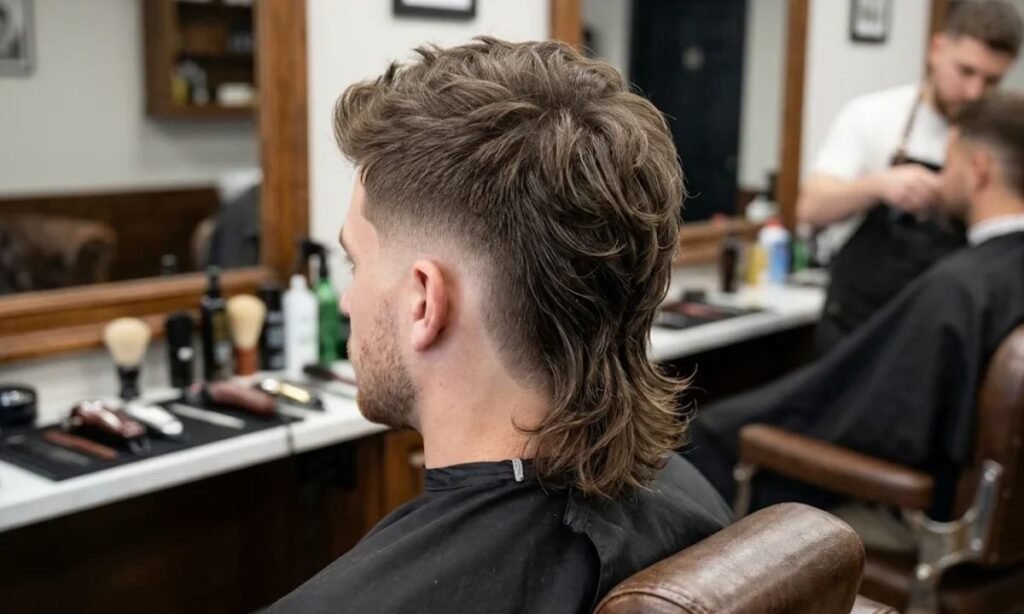
A burst fade mullet gives you the best of two worlds. The sides stay clean, and the back stays wild. You choose how loud it gets.
Start with your hair type, your face shape, and your lifestyle. Then pick a style from the list, save a few reference photos, and book a barber you trust.
Have a favorite style? Tell us in the comments which one you’re trying. Share this guide with a friend who keeps asking if they could pull off a mullet. And check back, because we update this list as new trends pop up in 2026.

I’m Michael Charles, the creator of MegaCrazes—your source for fresh hairstyles, sharp haircuts, and simple hair-care inspiration. Find your style. Own your look.
1 thought on “55+ Best Burst Fade Mullet Styles for Men in 2026”