

You saved a photo, but you can’t name the cut. Or you named it, and the barber gave you something else.
That happens a lot with fades. Two people can say the same words and mean different haircuts.
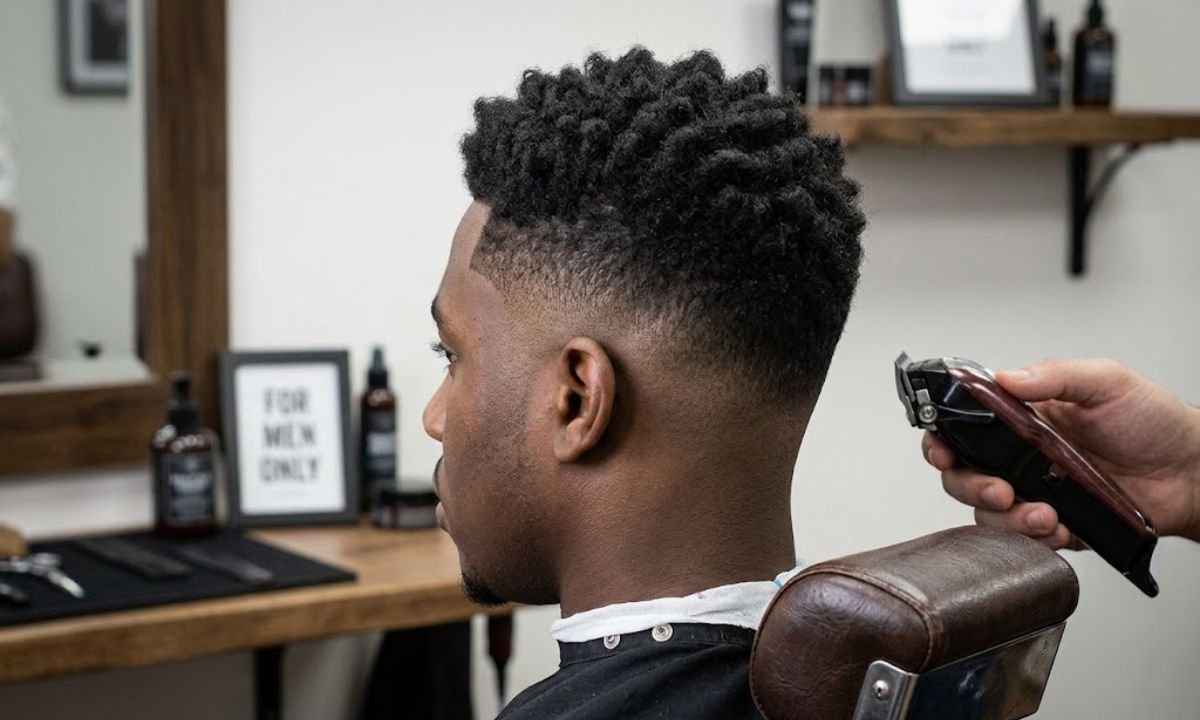
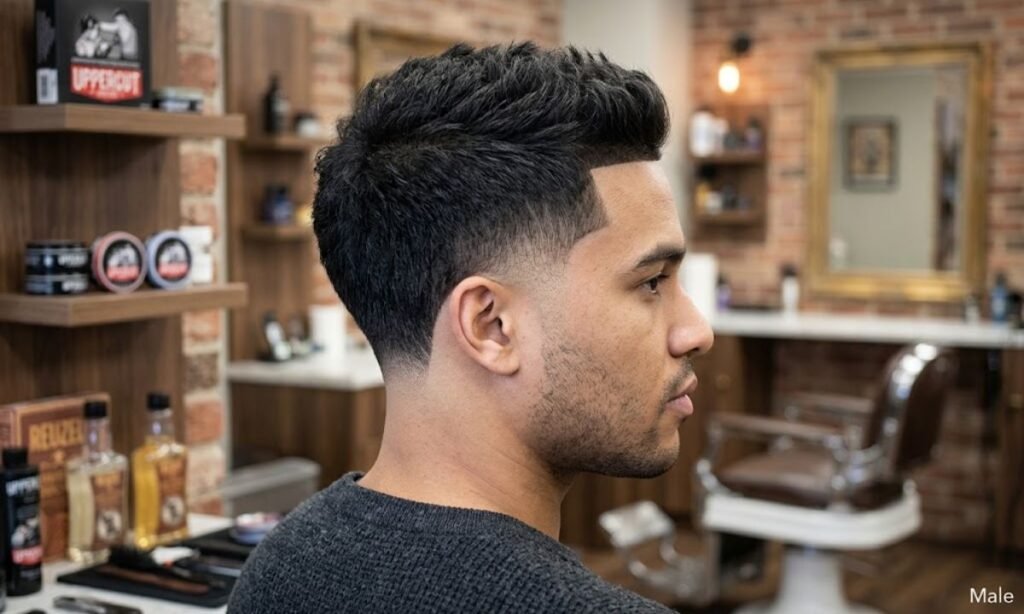
Here’s the short fix. A low taper drop fade starts short near the temples and sideburns, then curves down behind the ear toward the nape.
It looks soft in front and sharp at the back.
This guide covers what it is, who it suits, the best styles, and the exact words to use in the chair. You’ll also learn how to keep it fresh and fix common problems.
Last updated October 2026.
Quick Answer
A low taper drop fade haircut is a short-sided cut with a low, curved fade line. The line starts near the temples and ears, then dips behind the ear and follows the occipital bone toward the neckline.
The top stays as long as you like. That’s why it works with a buzz cut, a quiff, or a full set of defined coils.
Here’s what to tell your barber:
- Start low: the fade begins just above the ear, not high on the head.
- Drop behind the ear: the curved fade line behind the ear arcs down toward the nape.
- Pick a finish: skin finish, near-skin finish, or shadow finish.
- Choose a neckline: natural neckline, blocked neckline, or tapered neckline.
- Name your top: give the length and the style, so the blend makes sense.
What Is a Low Taper Drop Fade?
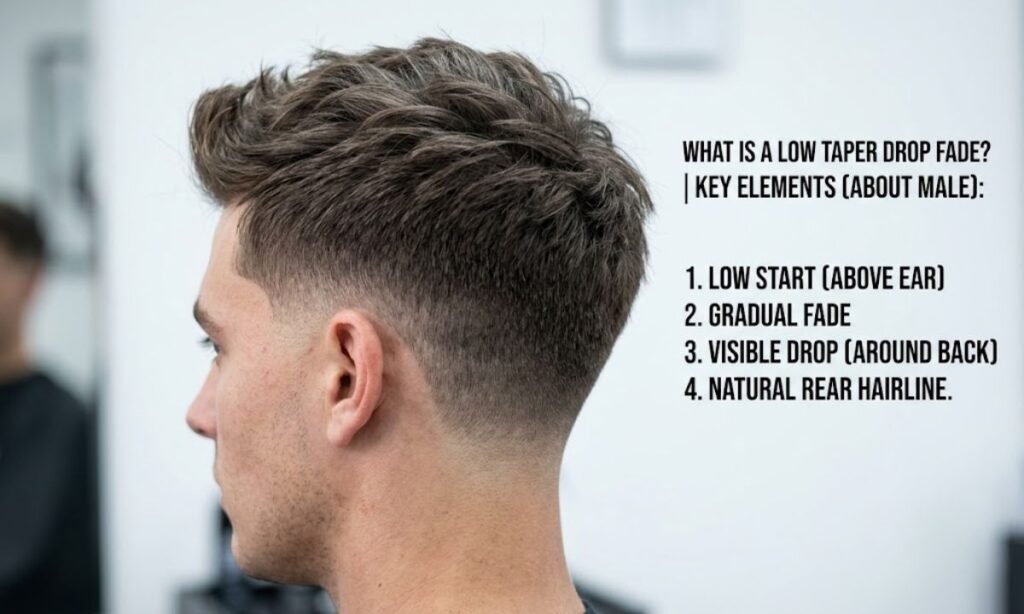
Let’s break the name into three parts. Low means the fade starts close to the ear and temple, so most of your hair stays put.
Taper means the hair shortens gradually instead of jumping from long to short.
Drop is the fun part. Instead of running flat around the head, the fade path curves down behind the ear.
That arc follows your skull, so the cut looks built for your head, not stamped onto it.
So, what is a low taper drop fade in plain words? It’s a gentle, clean, low-contrast cut with a curved back line.
It suits people who want a sharp look without a dramatic, high-contrast fade on the sides.
Is It the Same as a Low Drop Fade?
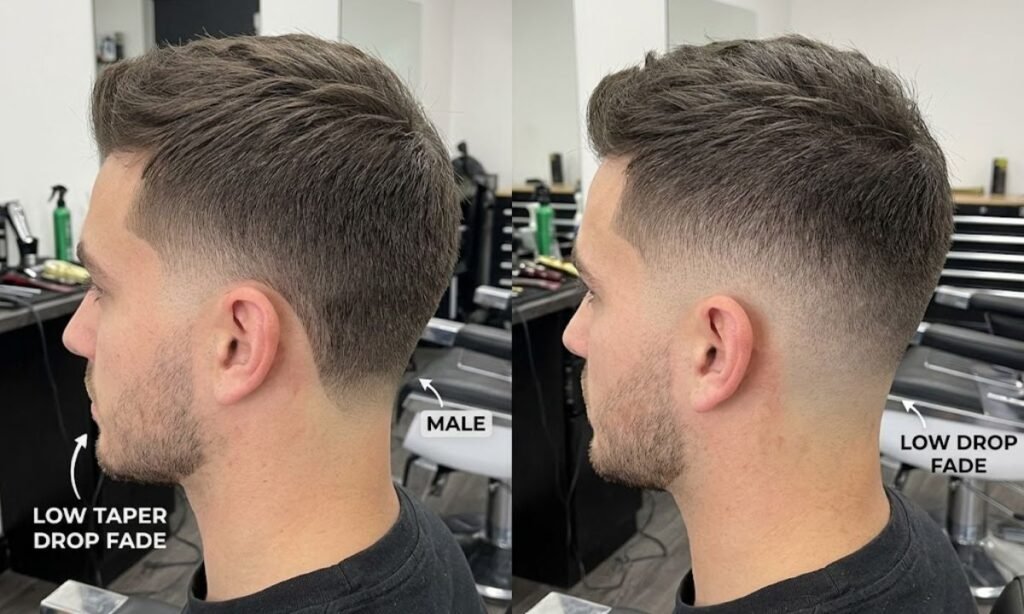
Not quite, though the two overlap. A low drop fade can start lower and go closer to the skin, and the blend is usually faster.
A low taper drop fade keeps more length at the sideburns and neckline, so the shift looks softer.
Think of it like dimming a lamp. A low drop fade is a quick dial down, and the taper version is a slow glide.
That’s the heart of the difference between a low taper and a low fade: how fast the hair shortens and how much scalp shows.
Barbers don’t always agree on these labels. One shop’s low taper fade is another shop’s low fade.
That’s why a photo and a guard number beat any name.
Low Taper Drop Fade vs Similar Cuts
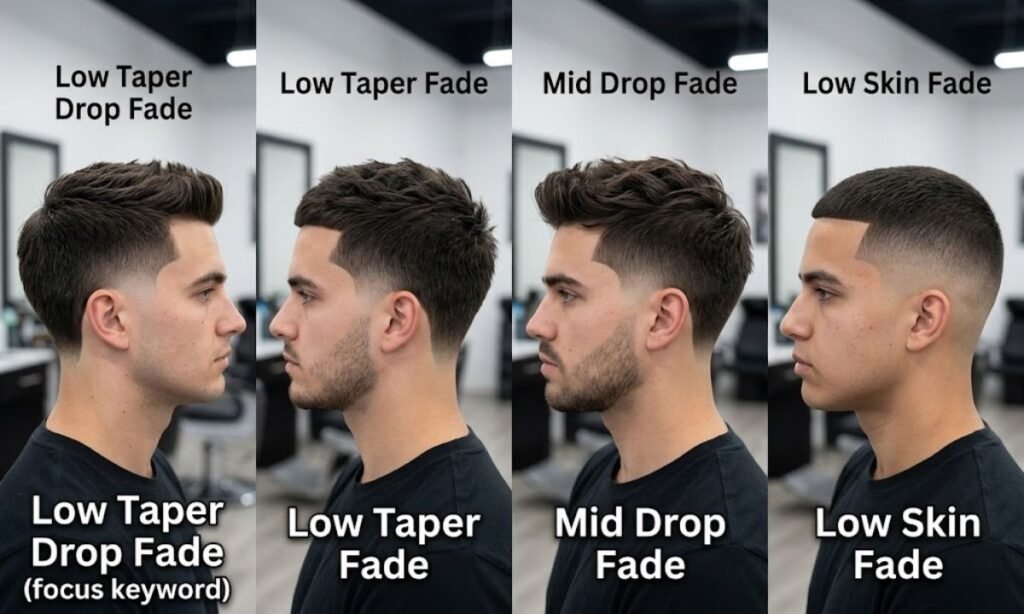
People mix these cuts up constantly, and it’s easy to see why. They all shorten the sides, and they all sit lower than a high fade.
The real differences come down to height, contrast, and how much the line curves.
Use this table as a quick map. Heights are typical, and every barber works a little differently.
| Cut | Where it starts | Contrast | Back line |
|---|---|---|---|
| Low taper drop fade | Low, near temple and ear | Soft to medium | Curves down behind the ear |
| Low drop fade | Low | Medium | Curves, often closer to skin |
| Mid drop fade | Around the middle of the head | Medium to high | Curves, more skin on show |
| High drop fade | High, near the parietal ridge | High | Dramatic arc |
| Burst fade | Around the ear only | High | Curves around the ear, hair stays long behind |
| Classic scissor taper | Low, no skin | Very low | Natural, tapered |
| Skin fade | Any height | Highest | Runs to bare skin |
A low taper vs high taper fade comparison is simple. The high version shows more skin and draws more attention.
The low version keeps things quiet, which many offices and schools prefer.
A drop fade vs burst fade matters if you wear longer hair at the back. The burst fade curves around the ear and leaves the nape long.
That pairs well with a mullet or longer curls. The drop version falls all the way to the nape.
Anatomy of the Cut: Fade Path, Blend, and Finish
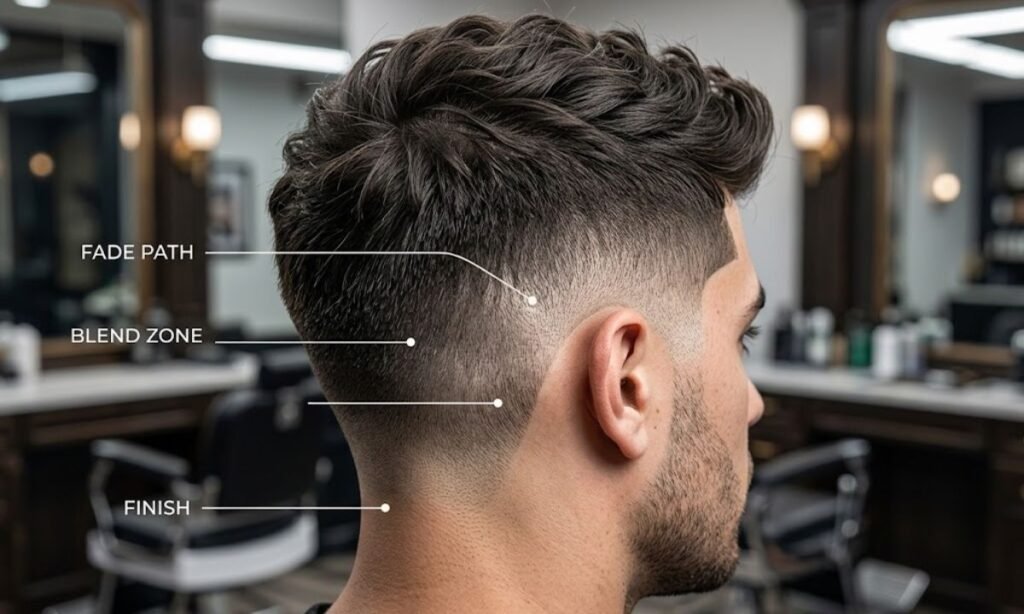
A good fade looks easy, but it’s a lot of small decisions. Understanding them helps you spot a great cut and explain a bad one.
It also helps you ask for exactly what you want.
Three things decide the result: where the line travels, how smooth the fade blend is, and how close the finish gets to skin.
Every one of those has a few options.
Fade Path and Weight Distribution

The fade path is the route the fade takes around your head. For this cut, it starts at the temple, passes just above the ear, and drops behind it.
The drop depth is how steeply that line falls toward the nape.
Weight distribution is how much hair sits where. A low path leaves weight above the ear and at the crown.
That’s why this cut looks fuller than a high fade, even when the top is short.
Your barber follows the parietal ridge (the point where the head curves from the top to the side) and the occipital bone (the bump at the back of the skull).
A fade that ignores those points looks flat or lopsided.
Skin, Shadow, and Natural Finishes
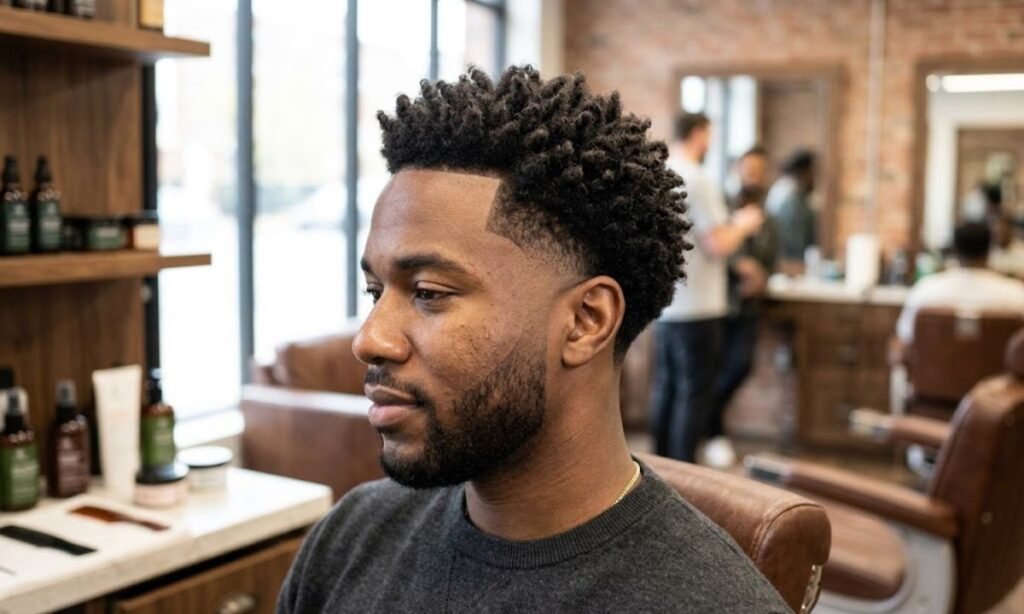
The fade height gets the attention, but the finish shapes the mood. A skin finish goes all the way to bare skin with a foil shaver or a zero-gap clipper.
It’s the sharpest option and the highest maintenance.
A near-skin finish stops just shy of skin. It gives you a clean look with less irritation, which matters if you get bumps.
A shadow finish goes even lighter, so you see a soft darkness instead of scalp.
Then there’s the neckline. A natural neckline follows your real hairline and grows out gracefully.
A blocked neckline is squared and crisp, and a tapered neckline fades into the skin and stays the most forgiving.
Who It Suits: Hair Type, Density, and Head Shape
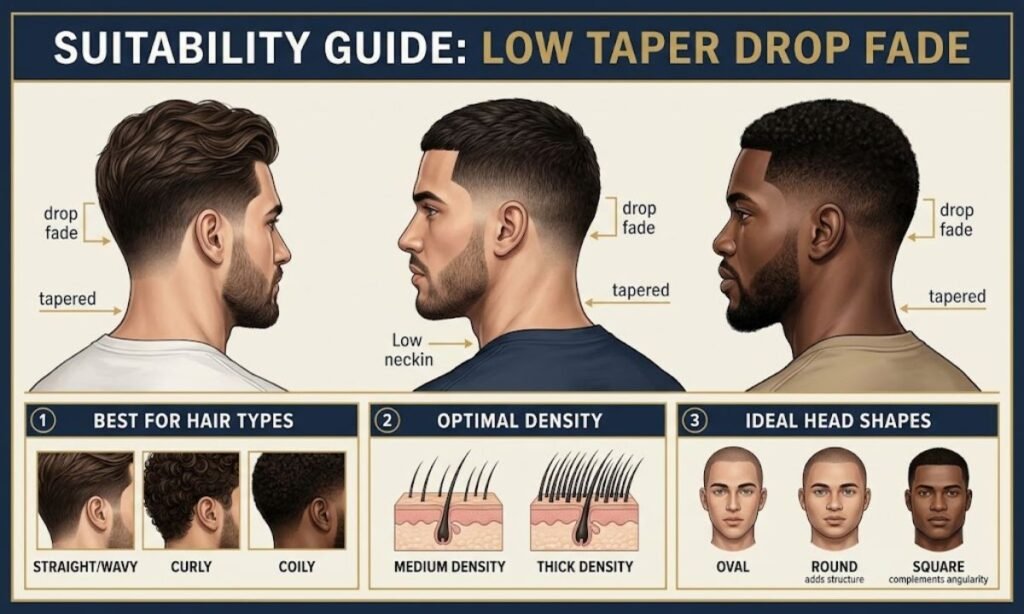
This cut works for most people, but it works better for some. Hair type, density, and head shape all change how it looks.
A quick check saves you from walking out with a cut that fights your hair.
Picture two friends with the same photo. One has fine, straight hair, and the other has thick curls.
They’ll need different guards, different lengths on top, and different expectations.
Hair Texture and Density

Hair texture decides how the blend looks. On straight hair, a low taper drop fade shows every line, so the fade blend needs to be clean.
On wavy hair, the blend hides small flaws and the top gets a natural lift.
For curly hair and coily hair, the cut is a favorite. A curly low taper fade keeps the sides tidy and lets the curls take center stage.
The fade also gives defined coils a frame that looks deliberate.
Hair density matters too. With thick hair, the sides can puff out, so a taper keeps weight under control.
With fine hair, a lighter shadow finish avoids a patchy look.
If you have thinning hair, keep the top slightly longer and textured. A very short skin fade can make thin areas stand out.
Ask your barber how much scalp coverage the cut will leave before you commit.
Head Shape, Hairline, and Face Shape
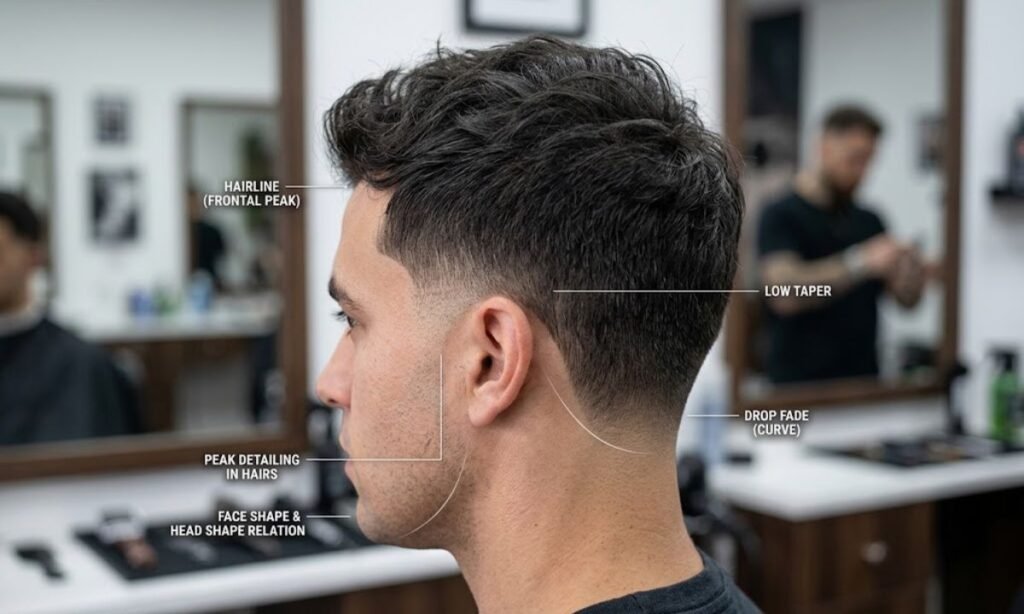
Nobody has a perfect head, and the drop fade is forgiving because it curves. A rounder head often looks better with a bit of height on top.
A longer face can handle more length at the sides, so a low start works well.
So how does low taper drop fade for different face shapes actually play out? Oval faces can wear almost anything.
Square faces look sharp with a crisp blocked neckline, and round faces gain from a quiff or textured fringe on top.
Your hairline shape counts as well. For a receding hairline, a low fade can look natural because it doesn’t highlight the temples.
Stay away from sharp temple lines if the hairline is moving back. A natural hairline with a gradual blend hides a lot.
Your hair growth pattern, like a crown swirl or a cowlick, also changes how the top sits.
Tell your barber about both. They’ll plan around them.
Best Low Taper Drop Fade Styles

The sides stay the same, so the top is where you get to play. Here are the best low taper drop fade styles, grouped by how much effort they need.
Pick one that fits your hair, your routine, and your week.
Short, Clean Styles

These are the easy ones. They need little styling, and they’re ideal if you want a low-maintenance haircut.
You can usually wake up and go.
Textured Crop

The textured crop is short, choppy hair with a slightly forward fringe. Paired with a low taper drop fade, it looks modern without trying hard.
A little hair clay or a low-shine styling product gives it that broken-up finish.
This one works for straight and wavy hair. It also hides cowlicks nicely.
Ask for 1 to 2 inches on top and leave the sides at a near-skin finish.
Crew Cut or Buzz Cut

A low taper drop fade with a crew cut keeps the top short and slightly longer toward the front. It’s neat, simple, and almost impossible to get wrong.
It’s a safe pick for school and for conservative workplaces.
A low taper fade buzz cut goes shorter all over, usually a #2 or #3 on top. The taper adds shape so the head doesn’t look like a flat ball.
It’s also handy for people with thinning hair who want one even look.
Caesar or French Crop

The Caesar cut has a short, horizontal fringe cut straight across the forehead. The French crop is similar, but the top is a bit longer and more textured.
Both look sharp with a low taper drop fade because the clean sides balance the fringe.
These cuts help if your hairline is receding at the temples. The fringe covers it, and the low fade doesn’t call attention to it.
Skip heavy product, since a matte finish looks best.
Volume and Movement on Top

These styles need more time and a little skill. They also give the most visible payoff.
If you like a styled look, start here.
Textured Fringe or Blowout

A textured fringe falls forward and looks relaxed. The blowout hairstyle pushes the top up and back with a dryer for volume.
Both look great against a low taper fade fringe because the sides stay slim.
Use a bit of sea salt spray or light cream, then blow-dry with your fingers. Don’t over-product it, or the volume collapses by lunch.
Fine hair benefits most from this method.
Quiff or Side Part

The quiff hairstyle lifts at the front and sweeps back. The side part is cleaner and more classic.
Each one pairs well with a low taper drop fade because the sides stay tidy.
For a quiff, you’ll want 3 to 4 inches on top. For a side part, a comb and a pomade or cream do the job.
Both suit offices, weddings, and anything where you want to look put together.
Slick Back
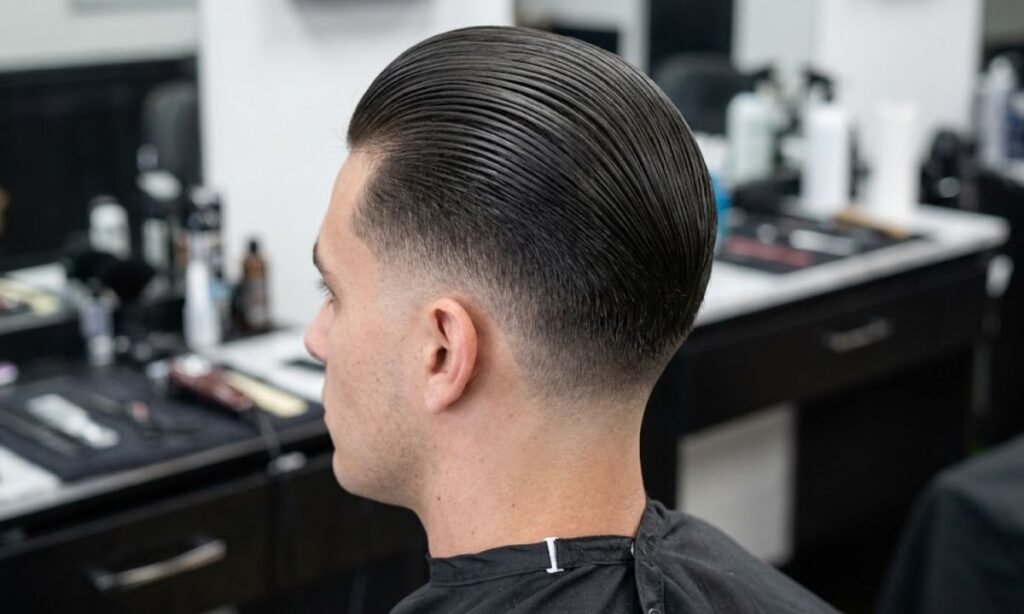
The slick back needs length, usually 3 inches or more, and a product with some hold. A low taper drop fade with a slick back looks polished and a bit retro.
It works best on straight or wavy hair that’s medium to thick.
Use a small amount of pomade and a comb. Too much shine makes the look feel heavy.
Pick a low-shine styling product if you want it subtle.
Curly, Coily, and Wave Styles
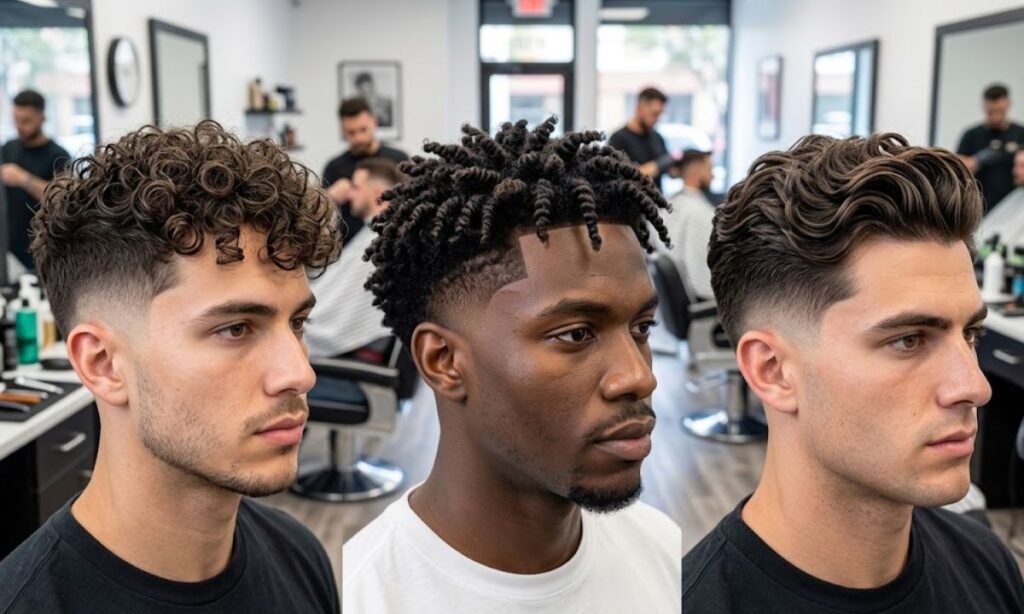
Textured hair and this fade make a great team. The taper keeps the sides clean, and the top gets room to show its pattern.
Here’s how to wear it.
Curly Top

A curly top sits on top of a low taper drop fade for curly hair. Leave 2 to 4 inches of length so curls can form and bounce.
A curl cream or leave-in conditioner keeps frizz down and definition up.
Ask your barber to cut the curls dry or slightly damp. Wet curls stretch, and you’ll lose length you didn’t expect.
That’s a mistake plenty of people only notice after it’s done.
Short Afro or Defined Coils
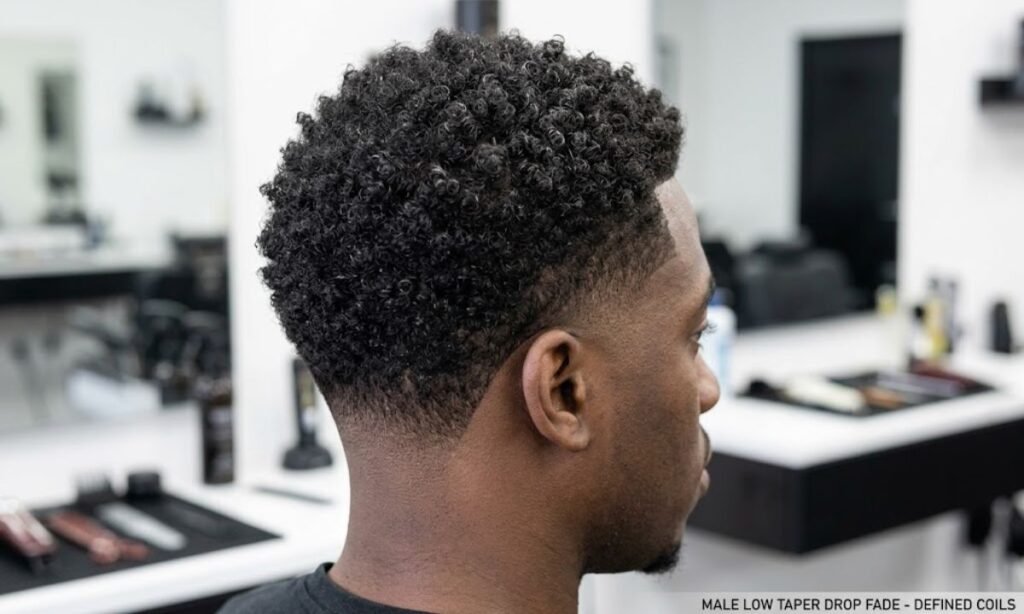
A short afro with a low taper drop fade is clean and confident. Because the sides taper into a natural neckline, the shape stays round and full.
This is a popular low taper fade afro look for good reason.
Defined coils work the same way. Twist sponge or finger coils on top, then fade the sides low.
The contrast shows off the coil pattern without needing a lot of height.
360 Waves
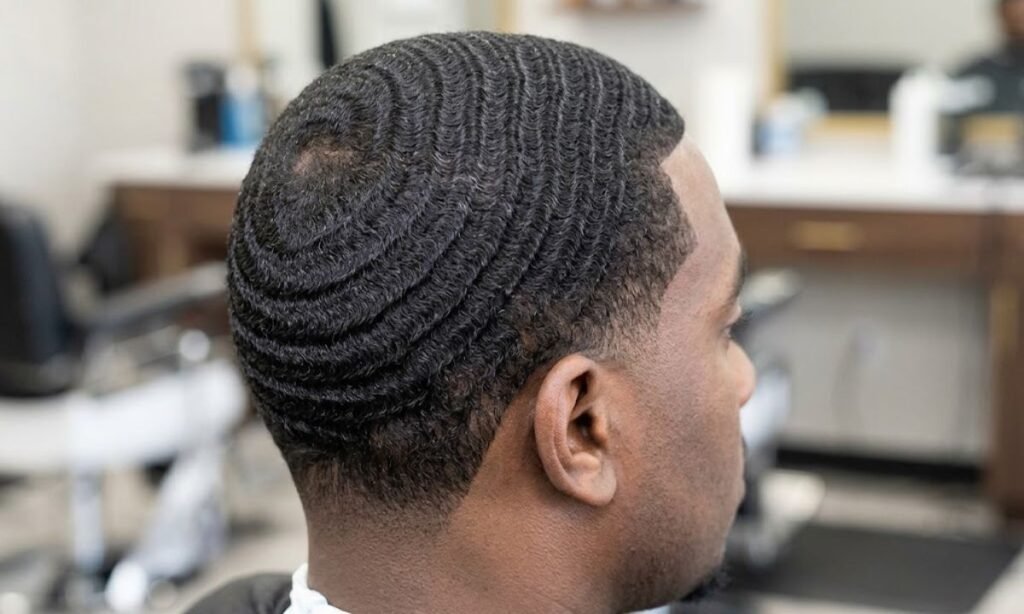
The 360 waves pattern needs short sides and consistent brushing. A low taper drop fade with 360 waves keeps the sideburns and the back neat while the crown shows the pattern.
It’s a more detailed cut, so choose a barber who knows waves.
Brush daily, wear a durag at night, and keep the neckline sharp. The fade shouldn’t cut into the wave pattern.
If it does, you’ll see breaks in the flow.
Statement Variants
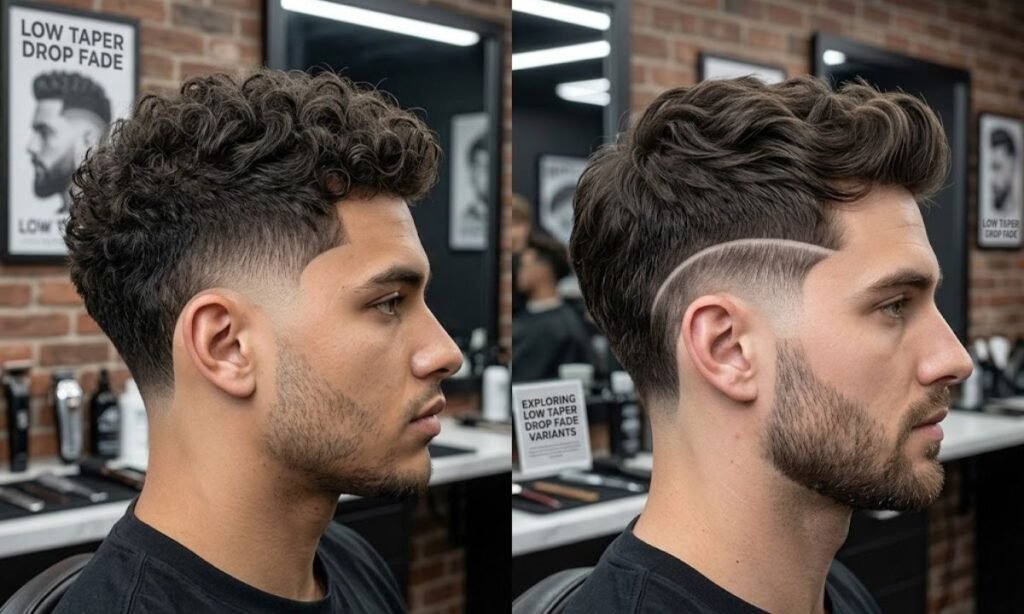
If you want more attitude, this section is for you. These versions turn heads, but they also need confident execution.
Bring references and be specific.
Hard Part or Shaved Design
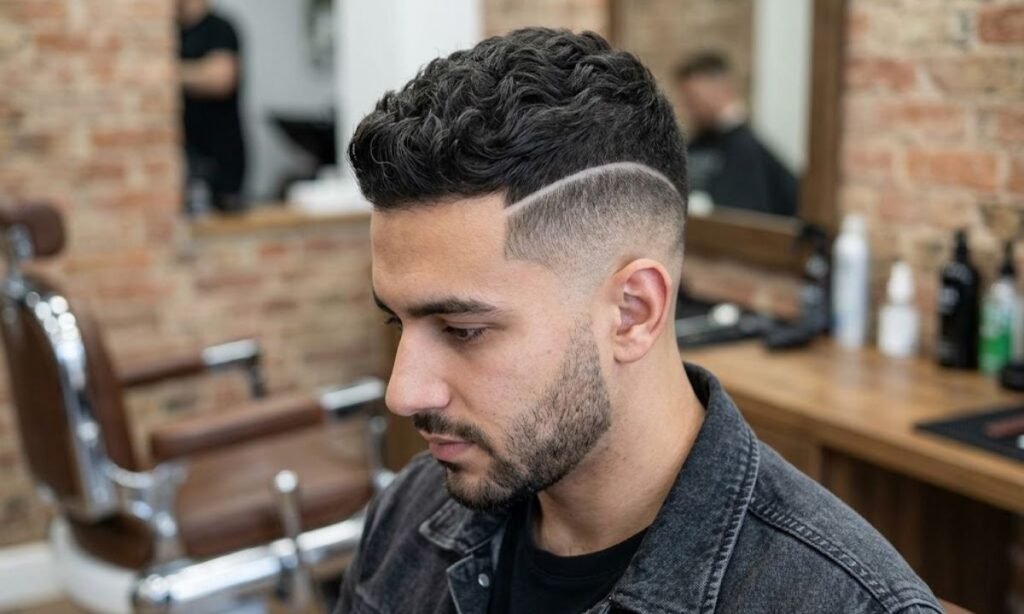
A hard part is a thin, shaved line that marks where you part your hair. A shaved hair design adds shapes or lines near the temple or back.
Both look striking with a low taper drop fade because the clean sides make the lines pop.
Keep the design simple at first. A sharp line grows out fast, and a messy one shows up right away.
Plan on touch-ups every two weeks to keep it crisp.
Mullet or Faux Hawk

A low taper fade mullet (or drop fade mullet) keeps the sides short and the back long. The drop gives the mullet a smooth bridge instead of a harsh step.
It’s a fun way to try a bold shape without losing polish.
A faux hawk, sometimes called a low taper fade mohawk, pushes the center up and keeps the sides slim. The low start means you don’t look too edgy for work.
Style it with clay and a little height.
How to Ask Your Barber for a Low Taper Drop Fade
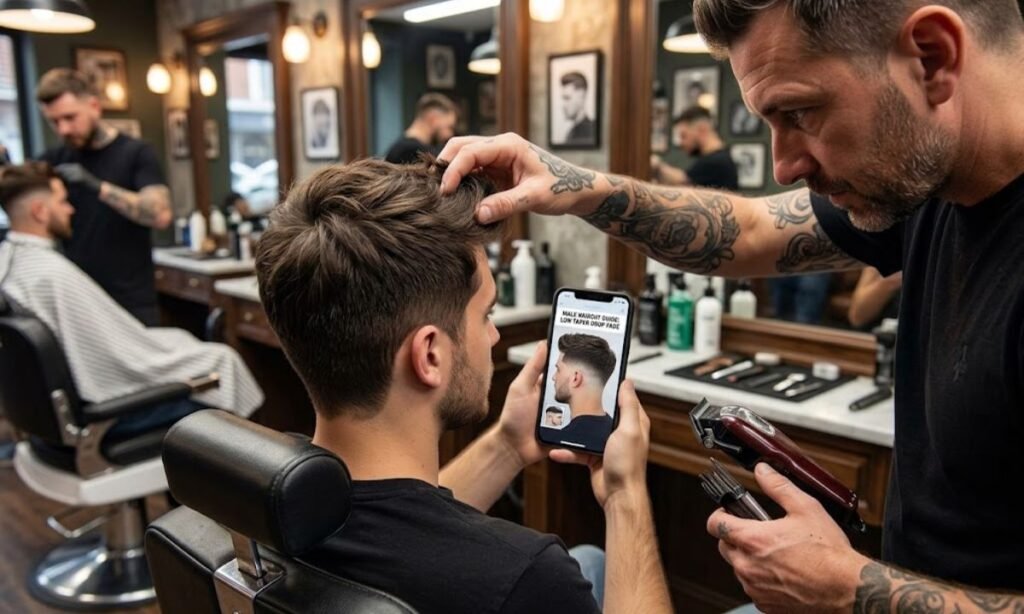
Most bad fades start with a vague request. ‘Low fade, please’ can mean five different haircuts.
A clear ask takes about thirty seconds, and it saves you three weeks of wearing a hat.
Think of the barber consultation as a short brief. You describe the shape, the finish, and the top, then the barber confirms.
If they ask questions back, that’s a good sign.
Five Details to Specify
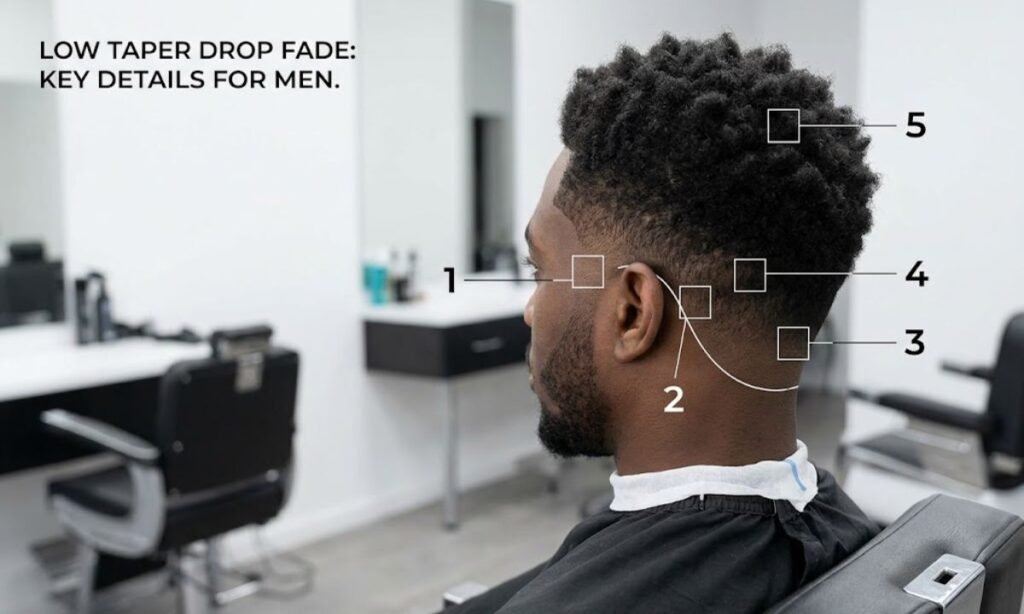
If you want to know how to ask your barber for a low taper drop fade, cover these five points. Each one removes a guess.
Together they give your barber a full picture.
- Starting height: say ‘low,’ and point to just above the ear. This sets the low taper drop fade starting height.
- Drop depth: ask how far the line curves behind the ear. Tell them if you want a shallow or a deeper arc.
- Finish: pick a skin finish, near-skin finish, or shadow finish.
- Neckline: choose natural, blocked, or tapered.
- Top length and style: for example, 2 inches with texture, or a quiff.
What about clipper guard lengths? Many barbers start a low fade at a #0.5 or #1, then step through #2 and #3 before reaching the length on top. A #1 leaves about an eighth of an inch, and a #2 leaves about a quarter.
If you’re unsure about what guard number to ask for, say ‘near skin at the bottom, blending up gradually.’ Most barbers translate that without trouble.
A Sample Script
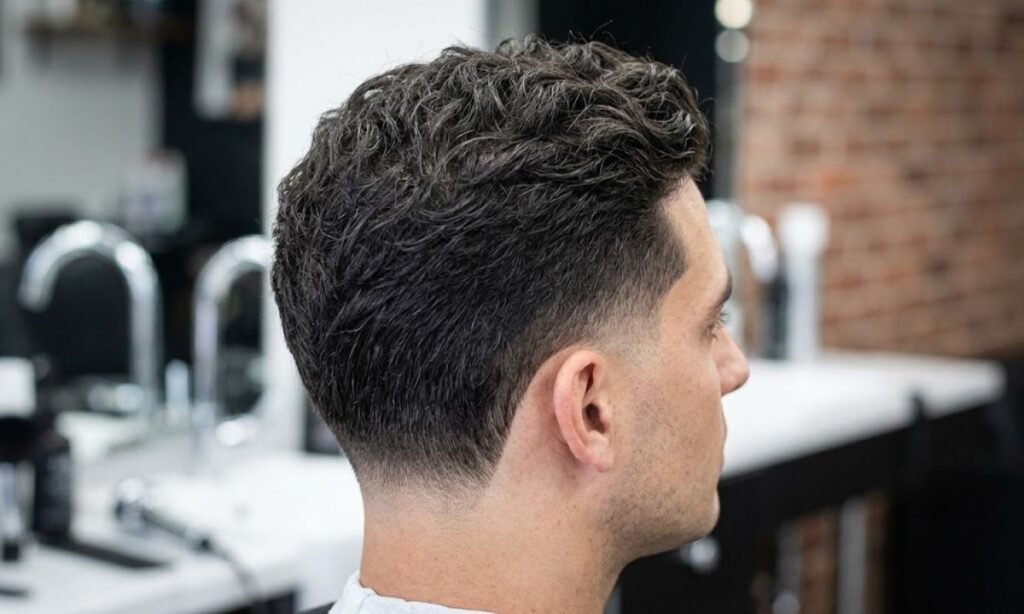
Here’s a script you can copy and tweak. Keep it casual, because barbers prefer plain talk to jargon.
Read it once before you sit down so it comes out smoothly.
‘Hi, I’d like a low taper drop fade. Start the fade low, just above my ear, and curve it down behind the ear toward the nape. I want a near-skin finish and a natural neckline. Leave about two inches on top, textured, and brush it forward. Can we keep a gradual blend so it doesn’t look too harsh?’
If you wear a beard, add one more line. ‘Blend the fade into my beard at the sideburns.’
That’s the key to a smooth low taper drop fade with a beard.
Check Where Your Reference Photo Came From
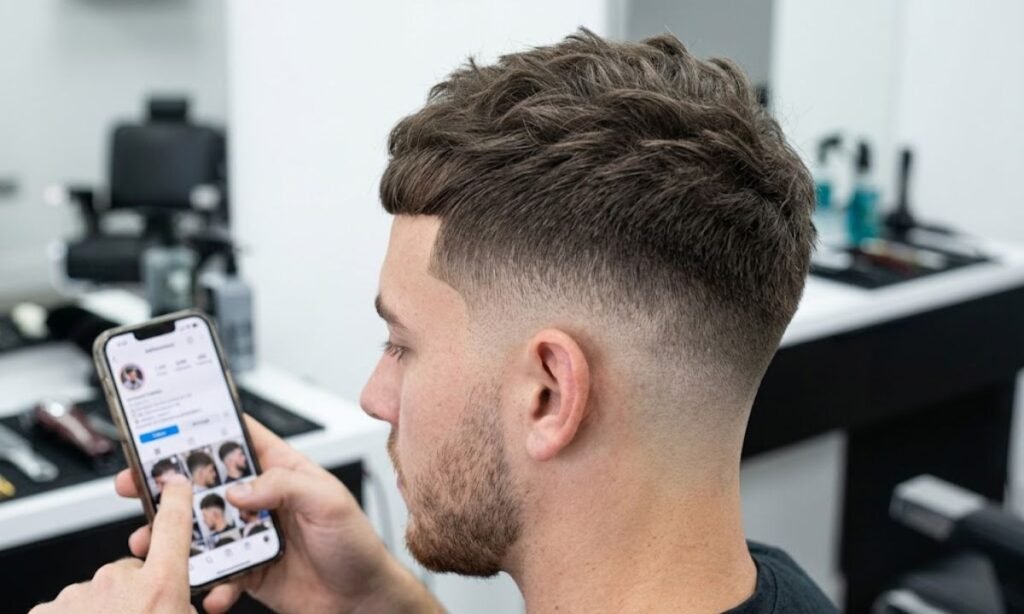
A photo helps, but not every photo tells the truth. Many low taper drop fade reference photos online come from edited images or hair with a different texture.
A photo of straight hair won’t help much if yours is tightly coiled.
Look for three things. Find a photo with a similar hair type, a similar hairline, and a view from the back or the side.
A front-only photo hides the curved fade line behind the ear, which is the whole point.
Also check the lighting. A bright flash can make a shadow finish look like a skin fade, and a dark background can make the opposite happen.
Show two photos if you can. One shows the shape, and the other shows the finish.
Styling, Maintenance, and Grow-Out

The cut looks best in the first two weeks, and then the edges soften. That’s normal.
A little routine keeps it looking fresh for longer.
Good news here. A low fade is easier to live with than a high skin fade, since less scalp shows as it grows.
Still, fade maintenance is part of the deal.
Styling by Hair Type

Here’s how to style a low taper drop fade based on what you’ve got. Start small with any product, because you can always add more.
Too much product makes the cut look heavy and hides the fade.
- Straight or fine hair: use light cream or sea salt spray, then blow-dry for body.
- Thick hair: try hair clay for control and a matte finish.
- Wavy hair: use a low-shine styling product and let the texture dry naturally.
- Curly hair: apply curl cream and a leave-in conditioner on damp hair.
- Coily or waves: keep the scalp moisturized and brush often.
The best products for a low taper drop fade are usually the simple ones. A clay, a cream, and a conditioner cover most needs.
You don’t need a shelf full of hair styling products.
Touch-Up Timing and Grow-Out Signals
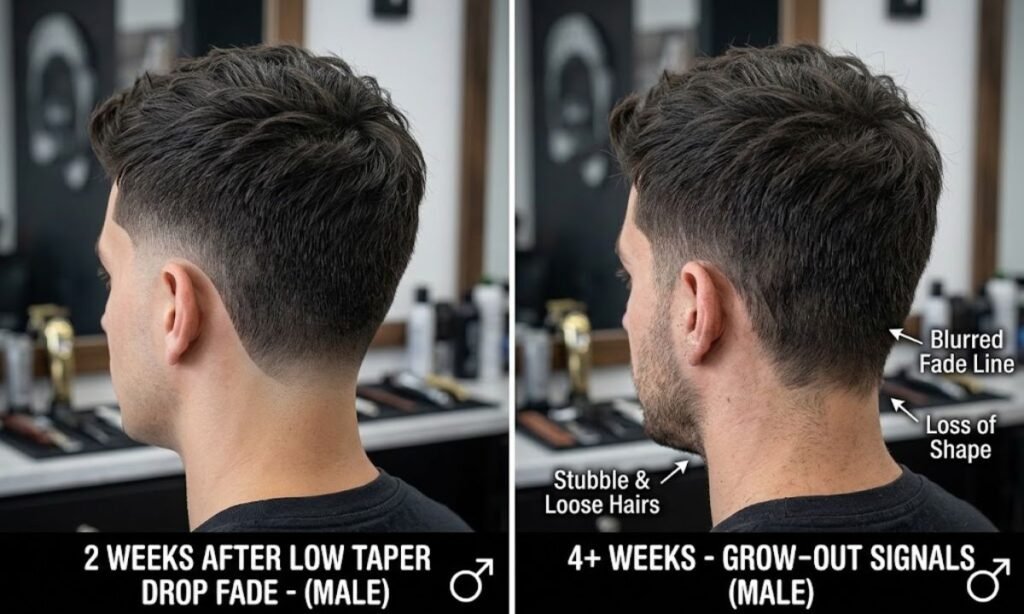
How often to get a low taper drop fade trimmed depends on your finish. For a skin finish, plan on every two to three weeks.
For a near-skin or shadow finish, three to four weeks usually works.
The low taper drop fade grow-out stages are easy to spot. In week one, it still looks crisp.
By week two or three, the neckline starts to fuzz, and the sides lose that clean contrast.
By week four to six, the fade looks more like a shaggy taper. You might spot the line behind the ear fading out.
That’s your cue to book, or to switch to a lower-maintenance finish.
Here’s a trick. Between visits, ask your barber for a quick neckline clean-up only.
It costs less and buys you another week or two.
Low Taper Drop Fade with a Beard

Beards and fades are best friends when the blend is right. The goal is a smooth change from hair to beard, without a visible gap.
That’s what the beard blend and sideburn blend are all about.
A low taper drop fade with a beard works because the fade starts low and meets the beard near the ear. The two lines connect, so the face looks framed.
So yes, you can connect a low taper drop fade into a beard.
If you want a softer look, ask for the fade to stop above skin. A low taper drop fade can stop above the skin, which leaves a fuzzy shadow instead of a bare line.
It’s easier to maintain, and it looks natural.
Is It Okay for School and Work?
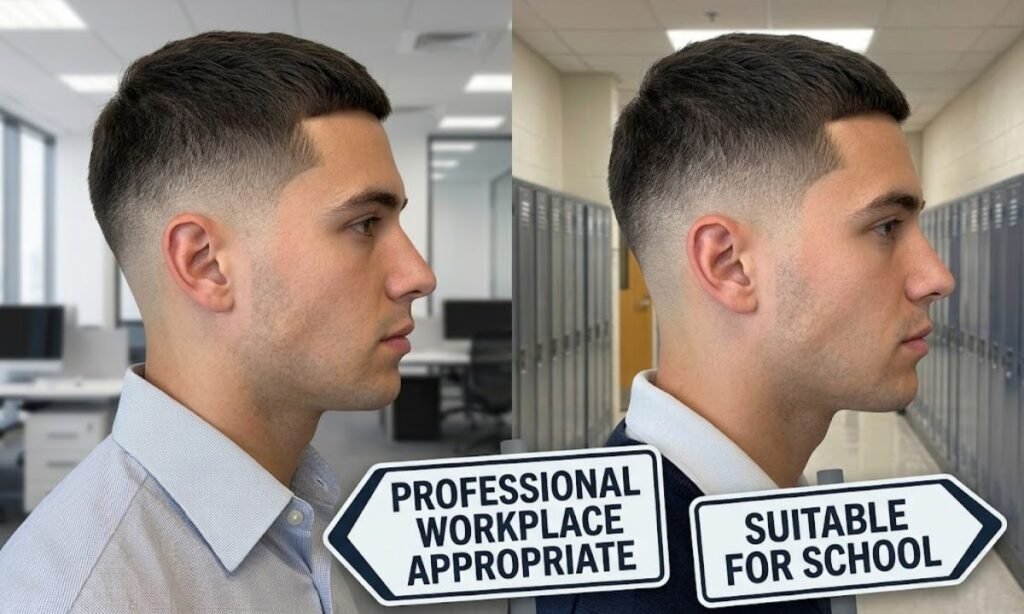
Short answer: usually yes. A low taper drop fade for school is one of the safest choices since it doesn’t scream for attention.
Most dress codes care more about length and extreme designs than about fades.
For conservative workplaces, choose a natural neckline, a shadow finish, and a neat side part or crew cut. That mix looks tidy in any meeting.
Skip the hard part, the shaved design, and bold color.
When in doubt, check the dress code first. Policies differ a lot, and nobody wants to get sent home mid-day.
A quick email to HR or a look at the handbook settles it.
Common Mistakes, Risks, and Edge Cases

Even a great barber has off days, and sometimes the miscommunication is on us. Let’s walk through what can go wrong and how to fix it.
None of this is hard to repair, but it helps to know the cause.
The usual culprits are fade blending mistakes, a line that’s too high, or an uneven back. All of them are fixable with a bit of patience.
The key is to speak up early, not three days later.
Result Problems and Their Fixes
A fade that sits too high. If the line rides above your temples, the cut looks more like a mid fade. How to fix a fade that sits too high: wait a week or two, then ask for a lower start and a softer blend.
You can’t add hair back, so patience is the only tool.
A dark line in the fade. That’s a spot where one guard step is too far from the next. How to fix a dark line in a fade: ask the barber to blend that area with a lighter guard or scissor-over-comb.
It takes a few minutes and usually fixes the problem.
Uneven drop fades. One side drops lower than the other, or the arc isn’t the same. How to prevent uneven drop fades: sit still, keep your head level, and look in the mirror before the barber starts the second side.
You can also ask them to check both sides together at the end.
Symmetry at the back. To check fade symmetry at the back, use a hand mirror and look at both ears. Both fade lines should start and finish at the same height.
Good haircut symmetry is about the pair, not either side alone.
Scalp, Hairline, and Skin Edge Cases

Close cuts can irritate skin, especially at the neckline. Skin fade and razor bump prevention starts with the finish you pick.
A near-skin finish or shadow finish lowers the risk.
Three issues come up most:
- Razor bumps: small, irritated bumps from curly hair growing back into the skin. A longer finish helps.
- Folliculitis: an inflamed hair follicle, which can show up as red or pus-filled spots. Folliculitis after a close shave is common, and a doctor can help if it keeps coming back.
- Acne keloidalis nuchae: firm bumps at the back of the neck, often tied to very close cuts. If you see them, talk to a dermatologist before getting another skin fade.
If you have a sensitive scalp, tell your barber at the start. Ask for a lower clipper setting, a clean blade, and no harsh aftershave.
This isn’t medical advice, and any lasting redness or pain deserves a professional check.
One more edge case: low taper drop fade for sensitive skin works best with a shadow finish. It gives you the clean shape without razor contact.
A gentle moisturizer after the cut also helps.
Can You Cut a Low Taper Drop Fade at Home?
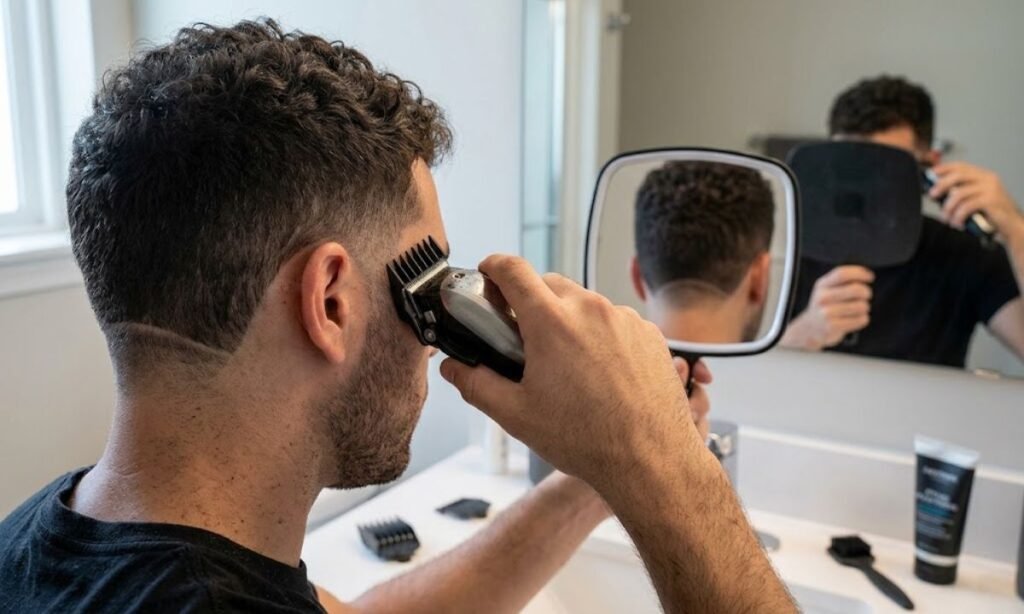
You can try, but don’t expect barbershop results on the first go. A low taper drop fade takes a steady hand, good light, and a mirror for the back of your head.
The curve behind the ear is the hardest part to do alone.
If you still want to try, ask a friend to help. Start with longer guards, go slow, and blend as you go.
You can always cut more, but you can’t undo a bald patch.
A smart compromise is to let a barber cut it, then do the neckline clean-up at home. That’s a much easier job.
It also stretches the time between appointments.
Alternatives to a Low Taper Drop Fade

Not sure this cut is right for you? Here are some solid options. Each one trades a bit of sharpness for something else.
Pick the one that fits your hair and your comfort level.
- Low taper drop fade vs burst fade: choose a burst fade if you want longer hair at the back, like a mullet.
- Low taper drop fade vs mid drop fade: go with a mid drop fade if you want more contrast and don’t mind more upkeep.
- Low taper drop fade vs classic scissor taper: the classic scissor taper has no skin showing, so it suits conservative settings.
- Low taper drop fade vs skin fade: the skin fade is the sharpest of all, but it needs the most upkeep.
There’s also the low taper drop fade with less scalp exposure, which is just a longer finish and a gradual blend.
On the other end, a low taper drop fade with maximum contrast pairs a skin finish with a longer top.
A low fade haircut without the drop is another simple option. It’s flat around the head, which suits some skull shapes better.
Talk it through with your barber, and try one for a month before deciding.
Frequently Asked Questions

What is a low taper drop fade?
It’s a cut where the hair shortens gradually, starting low around the ears and temples. The line then curves down behind the ear toward the nape.
The top stays as long as you want.
What is the difference between a low taper and a low fade?
A low taper keeps more length and shows less scalp. A low fade usually goes shorter, often to skin, and blends faster.
Some barbers use the terms interchangeably, so ask for a photo and a finish.
How low should a drop fade start?
For this cut, it starts just above the ear, near the temple. Going higher turns it into a mid or high drop fade.
Ask your barber to show you the starting point before they begin.
How deep should a drop fade curve?
A gentle arc looks natural on most heads. A deeper curve looks bolder and suits longer necks or longer hair at the back.
Tell your barber whether you want a shallow or a steeper drop depth.
Is it suitable for thinning hair or a receding hairline?
Yes, in most cases. Keep the top slightly longer and textured, and skip very sharp temple lines.
A Caesar cut or textured fringe hides a lot.
How often should I trim it?
Every two to three weeks for a skin finish, and every three to four for a softer one.
A quick neckline clean-up in between helps.
You can also checkout this article as well Low Taper Fade with Beard: 22 Styles, Barber Guide, and Maintenance
Final Thoughts

The low taper drop fade is clean, flexible, and easy to wear. It works with short crops, bold curls, and everything in between.
Best of all, it looks polished without screaming for attention.
Bring a clear photo, use the five-detail checklist, and ask for a finish that fits your skin. That’s all it takes to get the cut you pictured.
And if something looks off, speak up early.
Now it’s your turn. Which style are you leaning toward, and what does your barber call it?
Drop a comment, share this guide with a friend who keeps saying ‘just a fade,’ and tell us how your cut turned out.

I’m Michael Charles, the creator of MegaCrazes—your source for fresh hairstyles, sharp haircuts, and simple hair-care inspiration. Find your style. Own your look.
1 thought on “Low Taper Drop Fade: What It Is, Best Styles, and How to Ask Your Barber”